Wallace Britton, historian of Central Baptist Church, is working with the church’s massive archival collection for inclusion into a forthcoming book. Britton served as Minister of Education and Administration at the church from mid 1960 until late 1967. He credits the late Lona Holtz Akard, the church’s life-long historian, for archiving the church’s anthology.

Wallace offered a sampling from the storied archives that contain three fading, fragile, handwritten books of church business minutes. Over time, he meticulously transcribed each one, word for word, without any alterations.
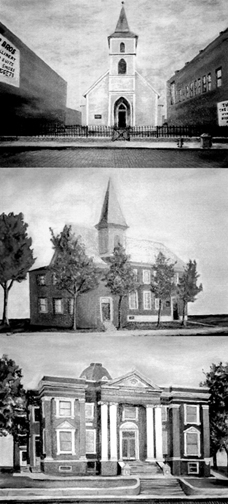
Records indicate that Central Baptist Church began as First Baptist Church on July 3, 1869, the same year that Johnson City was incorporated. Asa Routh was pastor aided by Martin V. Noffsinger, an employee of Holston Baptist Church. In that era, it was customary to change pastors about every year. They received $100 a year for preaching one Sunday a month. Charter members included A. Carr, Jessee Duncan, Sarah Duncan, Phoebe Duncan, Rachael Duncan, D.A. Edwards, Susan Duncan, Perline Edwards, S.A.F. Edwards, Sarah Carr, C.W. Carr, Catherine Carr, Levina Carr, Sarah E. Carr, Joseph F. Carr, Elizabeth Rice, Henry Price, Susan C. Price and Nannie Landreth.

Meetings were held in the First Presbyterian Church on W. Main for the first 12 years. In the first worship service, Rev. Routh preached a message from Matthew 16:18, “Upon this rock I will build my church; and the gates of hell shall not prevail against it.” In May 1881, worship services were conducted on the second story of Science Hill High School on Roan Street. For the first time, a Sunday School was organized with 17 members in attendance.

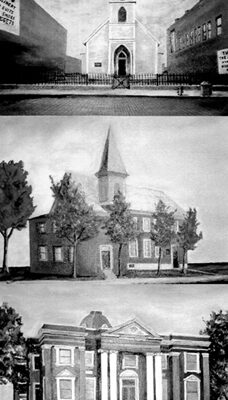
Desiring a permanent building of its own, the FBC soon purchased property at 224 E. Main Street (future Sterchi Furniture Co. site) from Colonel Reeves for $100. The 34 x 50 foot “Little White Church,” as it became known, was built at a cost of $2010.50. Pastor Thomas Hiter Crouch, the 6th pastor, led the first worship service in the new structure in April 1883. J. A. Cargille was superintendent.

A letter submitted by the church to the Holston Associationmeeting at Buffalo Ridge revealed interesting statistics: “Increased by letter 8, baptisms 7, excluded 7, dismissed 3. Amount spent for minutes $1.15. We have our church house nearly completed. We have an indebtedness of something near $500. We have a flourishing Sunday School with an enrollment of 140, average attendance of 75. Paid out for literature $14.60. Home Missions $5.”

In 1890, new pews were procured and a baptistery was installed. Prior to this, the ordinance of baptism was administered at Brush Creek Campground on W. Watauga on Sunday afternoons. Two church members, Mr. R.C. Hunter and Mrs. Dora Cargille Sproles are believed to be two of the last people baptized in the creek.

Friday, May 5, 1905 was a heartrending day for the populace of Johnson City. A devastating fire broke out along the south side of East Main between Roan and Spring streets, destroying everything in its path with one exception – the “Little White Church.” Many people deemed it a miracle of God while others questioned attending a church in the heart of the growing business district.

The church was essentially undamaged except for paint blister and smoke discoloration. Britton related a humorous story. At the next business meeting conducted by Pastor J.H. Snow, a plan was developed to refresh the church’s exterior. The men voted to let the women paint the church and pay the expenses. Over time, the church outgrew its facility. A strong debate divided the church as to whether to expand or relocate.  

On May 1, 1907, about 100 disgruntled members were granted letters of dismissal from the “Little White Church.” They quickly formed a new place of worship in the former Lusk School on the southeast corner of E. Watauga and N. Roan (future site of the Almeda Apartments). It became known as Roan Street Baptist Church with Tom Davis as pastor.

Wallace related an amusing story about the second church. People rode horse and ox drawn carts to town to do business on Saturdays. Many people parked their animals on a lot adjacent to the church. During the next business meeting, the church appointed a member as chairman of a committee whose job it was to arrive early on Sunday mornings to remove droppings from the lot.

Between 1907and 1910, both congregations needed larger facilities, but neither was financially able to build. They decided to reunite in 1910 and construct a new larger building at a site about equidistance between them. Church leaders narrowed their search to two lots, one owned by Isaac Harr and the other by G.M. Sitton. Both were ideally situated on N. Roan. They chose the Harr property and acquired it for $5000, requiring $1750 cash payment and notes to pay off the debt in two years.

The assets of both churches were transferred to the trustees of the new organization known as Central Baptist Church. The membership consisted of 510 people. The Main Street property was sold for $10,000. Tom Davis became the first pastor of the third church. Services were held at Roan Street Baptist Church until the new facility could be built. The cornerstone was laid in early spring 1912 and one year later the congregation moved into their impressive new building.

May Ross McDowell recalled that on Dec. 26, 1930 fire struck the church. Unlike the fire of 1905, the building was heavily damaged requiring extensive rebuilding. In spite of this being during the Great Depression, work began immediately to restore it. The ensuing loan became a burden on the ministry for several years. While work was being done, the congregation met for 10 months at Junior High School. During this time, a baptistry was added and a secondhand organ was purchased. In 1946, the church purchased Carillonic Bells.

Over the years, CBC spawned several area churches: Snow’s Chapel, Temple, Midway, Unaka Avenue, Clark Street, North Johnson City and Southwestern. Today, a drive by 300 N. Roan Street exemplifies the prophetic words offered by Rev. Routh on June 3, 1869 at the church’s first service. 
Read more

I received three responses pertaining to my recent columns concerning the 1925 Ford motorcar and the 1939 SHHS football season.

Murvin H. Perry wrote, “The public anticipation of the introduction of the ‘New Fords’ occurred in 1927 as Ford geared up to present the Model A, which came out as a 1928 model. People referred to the Model A as the ‘new Ford’ rather than its model designation. Also, the new car you describe as a 1925 model was really the 1926 Model T. It may have been introduced in 1925, but the features you enumerate – nickel plated radiator shell, gas tank in the cowl, crowned fenders, 29 x 4.40 balloon tires – appeared in the 1926 model. Balloon tires were an option in 1925, but the standard tire was the 30 x 3½ on a clincher rim.”

I checked my Sept. 16, 1925 newspaper source for the article. It spoke of a Ford showroom frenzy that year. Perhaps it continued to 1927 or resurfaced. Based on Murv’s note, the Fords showcased in the fall of 1925 were definitely 1926 models. Perry is a hands-on vintage Ford restorer and author of Murv’s Motoring Memories (Overmountain Press), a nostalgic collection of old-car memories.”

The next contributor was an anonymous John Doe: “Your article today on the 1939 Hilltoppers got my attention, especially since the Science Hill – Erwin High game wasn't mentioned. I noticed the article you were using was published on Nov. 22 and the Erwin game was played on Nov. 17 so that may explain the missing information. Erwin High was 9-2-1 in 1938 with the tie being a 7-7 game with, guess who, Science Hill. Erwin was 5-4-1 in 1939 going into the game with Science Hill.”

Mr. Doe then quoted from Lou Thornberry’s out-of-print book, “Remembering Old Erwin”: “Johnson City received 1,500 reserved tickets from Erwin High to sell during the week of the game. Additional blenchers were set up at Gentry Stadium to accommodate an expected 5,000 fans for the game. A crowd of 4,000 football fans turned out for the big game. The Blue Devils got off to a quick start as they recovered a Johnson City fumble on the Toppers' 21-yard line on the first series of plays. The Devils picked up one first down at the 11-yard line, but that was as close as they got to scoring. In fact that was the only first down the Devils earned all night.

“Johnson City scored their first touchdown in the first quarter. The Hilltoppers moved into Devil territory after a poor punt by the home team. With the ball on Erwin's 29-yard line, the Toppers pulled off one of their own trick plays. Fred Dulaney took the ball from center and ‘shoveled’ the ball to Kermit Tipton, who then lateraled the ball to Jack Osborne, who sprinted to the end zone. The extra point attempt was blocked by the Devils.

“The only other score came in the third quarter, again by Science Hill. Those six points came from a Kermit Tipton pass of twelve yards to Gayle Cox in the end zone. The Hilltoppers blanked Erwin 12-0 to tie Kingsport for the Big Five title. The report in the Johnson City paper noted that Erwin tried the ‘sleeper play’ twice, but the Toppers detected the play both times. That the Blue Devils failed to score against the Toppers was not too surprising. Johnson City's defense only allowed one touchdown all season and that was in a non-conference game at Mountain City.” 

I agree with you that the Hilltop article was written before the season ended and the Erwin game was omitted.

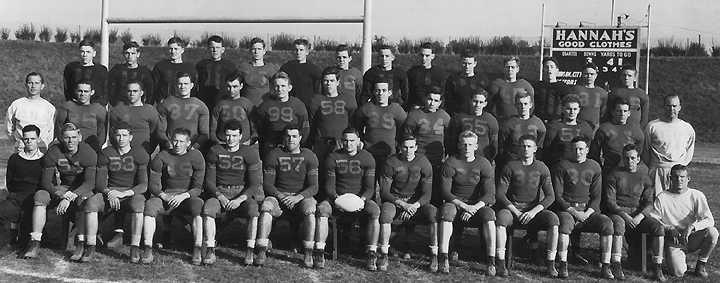
Carolyn Peoples Guinn: “I am the daughter of Jack Peoples. You mentioned Daddy in your Nov. 1, 2010 article about the 1939 SHHS football team. My brother, Alf Peoples, and I cannot locate Daddy in that photo.”

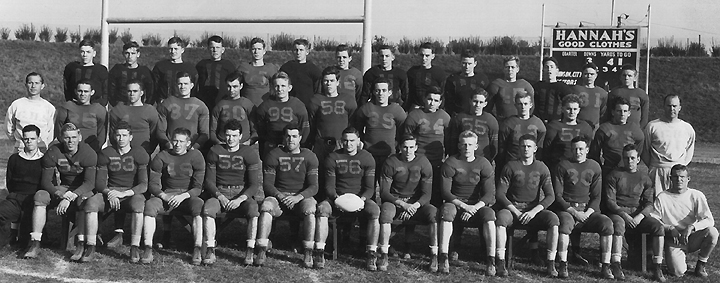
Sorry, I should have caught that. The Hilltop article was printed in Nov. 1939 while the photo came from the May 1939 Wataugan depicting the 1938 football squad. The correct 1939 team photo is shown above. 

Read more

The Tennessee Valley Authority, a federally owned corporation, was formed in 1933 with a five-fold purpose: flood control, power generation, economic development, river navigation and fertilizer manufacturing.

Timing was ideal due to massive flood problems over the years and a country trying to survive the Great Depression. TVA served most of Tennessee; parts of Alabama, Mississippi, Kentucky; and small slices of Georgia, North Carolina, South Carolina, West Virginia, Indiana and Virginia.

Before TVA existed, the East Tennessee area experienced a long history of devastating floods. In one incident that occurred in late May 1901, millions of dollars of damage and eight lives were lost from heavy rains that caused area rivers to overflow their banks. The Doe, Watauga, Holston, Chuckey and French Broad rivers devastated growing crops and anything in its way. Six bridges were swept away causing $60,000 damage.

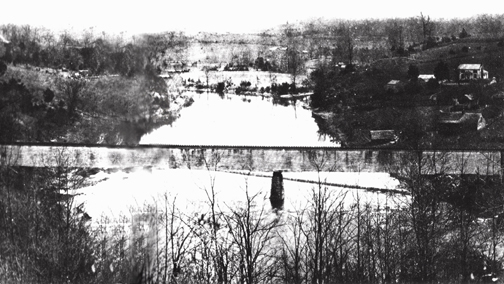
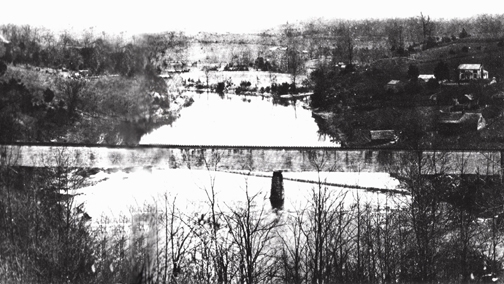
Over the course of several weeks, the Holston River steadily rose. Persons living near the river at the point where Netherland Island divided it in Washington County told of a remarkable discover by area resident, James Light. When the water began to manifest itself, people congregated on the banks, watching houses, barns, parts of bridges and dead cattle floating away, laying waste to fertile farmland.

The spectators along the bank spotted an object coming down the river that resembled a baby cradle. Mr. Light, a humble but daring citizen of the community, sat in his boat anchored on the bank and watched the object drift nearer. At the risk of his life and the hope that he might rescue what appeared to be an innocent baby from the ferocity of the flood, he shoved his boat forward into the dangerous current and hurried toward the object. After dexterously guiding his boat so as to escape being wrecked in the drifts, he finally rendezvoused with the infant at an angle a short distance down the river.

His boat soon came alongside the floating object, which proved to be a cradle in which lay a tiny blue-eyed baby girl, her eyes wide open and apparently happy as if on a pleasure outing. James picked up the child without disturbing her and carefully placed her in his boat. Once again, he surveyed the swirling drifts floating down on each side of him and steered frantically toward the shore. Every second counted.

The return voyage was a short one but full of peril. People on the bank, unaware that Light had picked up a little girl from the bosom of the storm-swept river, watched with great fear and trembling as he made for the shoreline. Intense was the gaze of those who watched from the shore and great was the relief to everyone when Light finally made a safe landing nearly half a mile downstream.

Joy was unbounded by the crowd of people who had gathered around Light and the baby. In a moment of emotion he called his little rescued treasure a “bundle of joy.” The ladies surrounding the near tragedy fondly and eagerly caressed the infant while Light received hearty congratulations and appreciation for being a hero, making him the proudest man in Washington County. He quickly forgot his personal losses caused by the tide.

In today’s era, local authorities would be summoned to handle the situation and to locate her parents, but in 1901, that was not the case. Since there was no available means of promptly identifying the child, Mr. Light announced to the crowd that he wanted them to spread the word. Also, he said he planned to advertise in the local newspapers in hopes of locating her parents. He admitted that, as poor as he was, he would not part with the child for a thousand dollars in gold.

The stories of yesteryear abound with this one having a happy ending. 

Read more

A trainload of 17 beautiful single ladies arrived in New York City on July 5, 1906 via the Southern and Pennsylvania Railroad. They were winners of a contest sponsored by the Chattanooga News.

The innovative newspaper limited those selected from the states of Tennessee, Alabama, Georgia and Kentucky. They subdivided the territory into 17 districts, allowing contestants to compete within their respective locations. The winners were those receiving the most votes based on the number and length of subscriptions to the paper.

Eight of the 17 young ladies were from Tennessee: Hattie Hunter (Johnson City), Flora Copeland (Soddy), Flossie Blackburn (Cleveland), Margaret Erwin (Lookout Mountain), Alice Magill (Dechard), Blanche Allison, Pauline Hancook and Catherine Robinson (all from Chattanooga).

The much sought-after plum was a two-week outing to the Big Apple, with two-day side-trips reserved for Boston, Philadelphia and Washington. After initially rendezvousing in Chattanooga, the group attended a ball and banquet in their honor at Lookout Inn, slept in the Pullman car that had been provided for the trip, left the city on Tuesday morning at 5:30 a.m. and arrived in Manhattan later that day. They were escorted to Hotel Flanders at 137 West 47thStreet where they lodged during their visit.

Before the train departed Chattanooga, the local merchants loaded it with “soda pop, ice cream, orangeade, and other frothy and harmless things for young ladies.” Mr. Hudiberg, the head chaperone, noted that there were 1,700 bottles of soft drinks on the train. The body of the Pullman was so full of drinks that the porters could hardly make up the berths. Consequently, the ice cream freezers were moved to the rear platform of the train to give more room. All members of the party were cheerful and in good spirits when they arrived in New York. Fortunately, not one suffered a mishap or experienced an illness. 

The party rode up 47thStreet until one of the girls exclaimed, “Stop. There is the hotel. It’s just like the picture we saw of it.” They all went into the lobby and settled in the parlor while they waited for their rooms to be assigned. They then took the elevator upstairs. The contest winners, chaperons and guards had intended to go to the New York Reef Garden the first night, but at dinner it was learned that their trunks hadn’t arrived from the train preventing them from putting on new dresses. The consensus was that they would not go to the theater.

During dinner, they were informed that a photographer was outside and wanted to take pictures of them. One girl made a hasty jaunt to her room where she quickly refreshed herself and returned in time for the group photo. The ladies decided not to go to the theatre. Instead they opted to walk up and down the Great White Way (Broadway, so named because of all of the white lights). Most of them had never seen it before, although not all were strangers to the Big Apple. One girl, it was learned, had won a prize offered by another afternoon paper in a previous contest. 


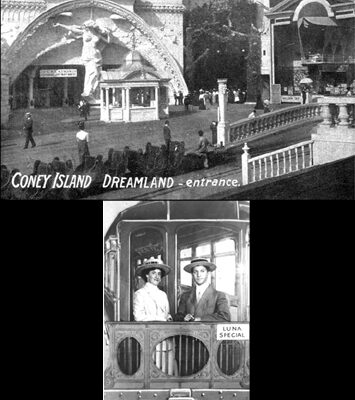
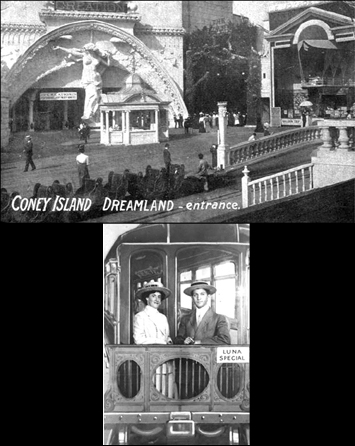
The next morning, the party observed the massive skyscrapers from the top of a large sightseeing automobile, followed by a shopping spree that afternoon. In the evening, they were treated to a theatre performance. Managers of the Proctor-Keith Vaudeville Company offered all their playhouses to the popular young women whenever they wanted to attend. The various Coney Island and other seaside attraction managers also asked to be hosts of the youthful beauties.

Two weeks came and went that included side trips, leaving the attention-getting beauties excited but fatigued and ready to return to their respective homes by train. They had something to dream about for the rest of their lives. 

Read more

The late Sue Eckstein once shared with me an undated newspaper clipping from a scrapbook that belonged to her father, Paul Carr. It documents several unrelated stories of early Johnson City, written by former Johnson City Press-Chronicle writer, Fred Hoss.

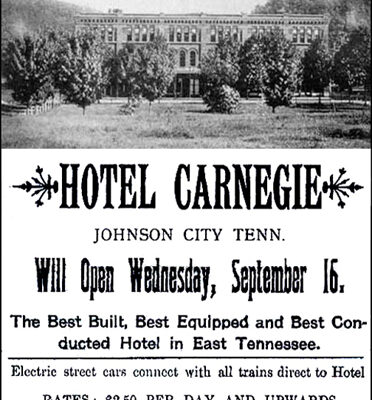
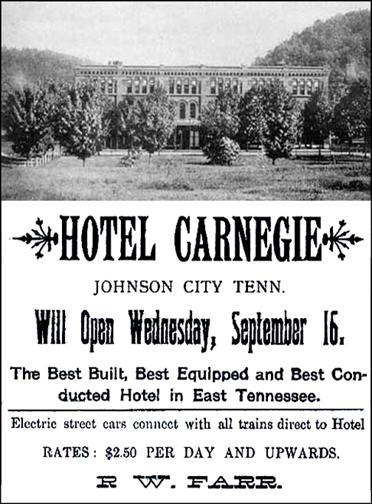
During the economic boom of the early 1890s, everything was going “Carnegie.” Old cow pastures were subdivided into lots that sold for as high as $1,500 and $2,000 each. The Three-Cs railroad had commenced its line through this section. It was being built through Cash Hollow with a depot in Carnegie. The road was graded to about Unaka Springs when a depression hit causing the railroad to come to a screeching halt. It was abandoned before it got started.

Almost overnight, the Carnegie Hotel, store buildings, tennis court, new houses and other developments were abandoned, becoming burrows for rodents. Some of them burned while others decayed and collapsed. The large block of railroad bonds owed by the city were relieved of the debt by the courts.

Later, lots in Carnegie sold for prices ranging from 15 cents to 10 dollars. City records show that one fellow in the western part of the country, who owned a lot that had been assessed at $5.00, regularly mailed in his tax check each year that ranged from 10 to 12 cents.

On other subjects, the late Henry H. Carr was described as a “master of argument” in court. His delivery was what his opponents deemed dangerously convincing. He stood while speaking with his eyes closed and without making a gesture. His demeanor gave people lockjaw to the extent that they could not respond to him.

Charlie Cargille, whose father started a photograph gallery in town, brought in the first big-wheeled bicycles. Skillful riders pedaled them to work and on trips about town. They became the envy of youngsters until Charlie Estes introduced the first “safety” bicycle. Not to be outdone, Cargille purchased a high-wheeled rubber tread buggy and a horse to pull it.

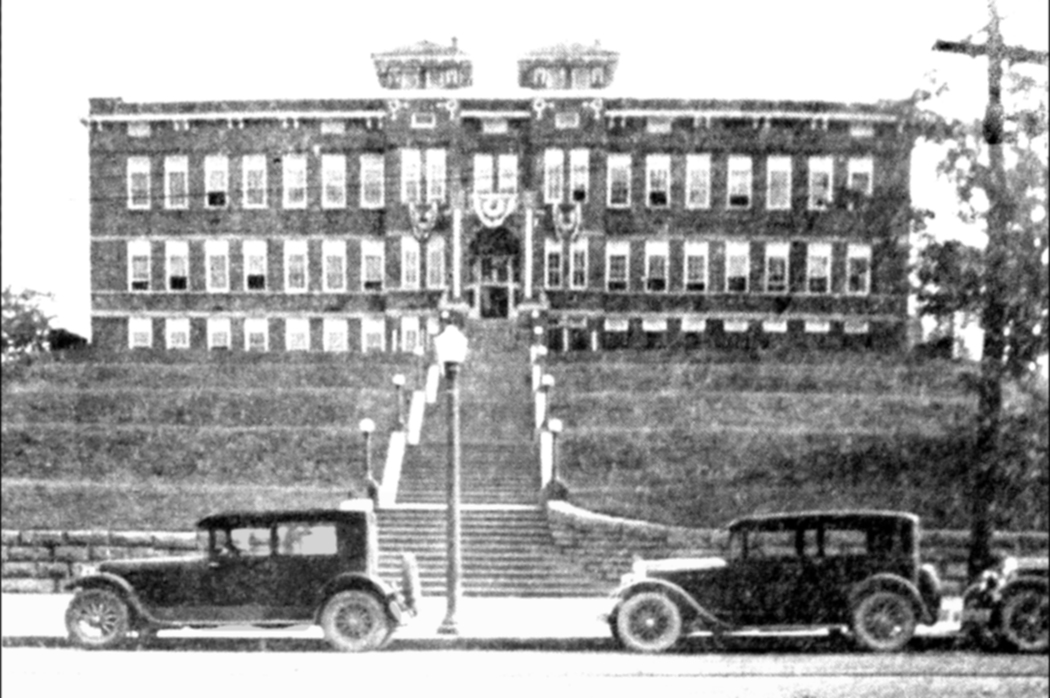
Hoss mentioned a large house owned by local lawyer Robert Burrow that sat on the hill behind Science Hill High School at N. Roan. The judge was still in law practice at the age of 90. He became a partner of Isaac Harr. Burrow would write a beautiful “copper-plate” by hand (a style of calligraphic writing) because Mr. Harr couldn’t read his own handwriting. Together, they produced winning documents.

Dr. Eb S. Miller, a leading doctor in Johnson City for many years, maintained records of births and deaths that became invaluable for folks needing to prove their age for governmental purposes. One old-timer humorously remarked that records in the doctor’s account books revealed that many people were born on credit.

The Bee Hive, a leading downtown department store, used the first moving window display in the city. A turntable made of wood operated in a socket with a shaft leading to the basement. It was turned by a “flutter wheel” operated by a stream of water. Folks came from miles around to gaze into the window and watch it turn. The genius behind the invention was identified as P.M. Ward.

And finally, there was a news story about patrons attending Jobe’s Opera House who became overly alarmed when a loud clap of thunder occurred during a performance. Two young girls screamed and created a stampede toward the stairs. Fortunately, cooler heads intervened and quickly barricaded the door preventing what could have been an avalanche of humanity falling down the steep stairwell. 

Read more

In 2009, the photography class of Kay Grogg, art and photography teacher at David Crockett High School, received a grant from the Harris Fund of the East Tennessee Foundation for a project titled, “Scanning Our Past to Preserve for the Future.”

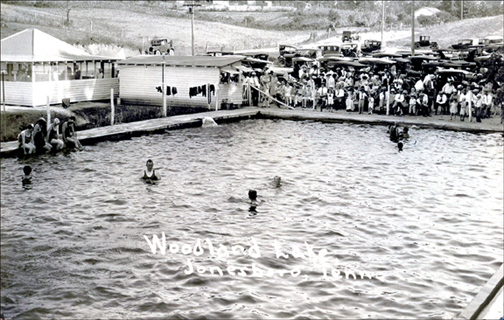
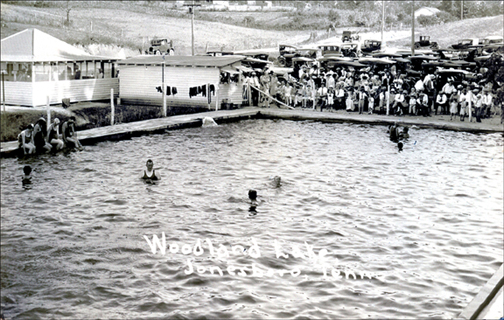
The charge was to acquire old photos and information related to Washington County with special emphasis on the area surrounding the school. Using word-of-mouth search, the group acquired information regarding the history of the county, including Woodland Lake swimming pool that was located where their school now resides. It was a popular recreation facility fondly remembered by older residents (including this writer). Jim Rhein, David Whitaker and Ron Dykes contributed an assortment of vintage photos, old advertisements and related facts regarding the former establishment.


An August 11, 1926 Jonesboro (now Jonesborough) Herald and Tribune newspaper contained a much-anticipated announcement: “Woodland Lake is now open to the public as an up-to-date pleasure resort for the people of this and other sections. Messrs. Rhein and Jackson have spared no expense in preparing this place for the pleasure and entertainment of both young and old.”

A promotional ad that same year by the Mill Spring Ice and Ice Cream Company amusingly noted, “Woodland Lake is in full operation representing an investment of several thousands of dollars. There are more than 50 ice cream containers scattered over the neighborhood, loaned to you in good faith. Will you please return them or drop us a line so we can get them? We need them badly.”

The most humorous clipping proclaimed in bold letters, “Own More Cows Picnic, Saturday, Aug. 13 (1927) at Woodland Lake, Jonesboro, Tennessee.” The Jonesboro Kiwanis Club sponsored the free event to publicize the location in Greeneville, Tennessee of Pet Milk’s Condensery (condensed milk) Plant and to urge farmers to bring milk to them to be made into dairy products to spur the economy.

After receiving pictures of the lake as it appeared in 1927, Kay’s students snapped current ones at the same location for comparison. In doing so, they located the ruins of the two original pools along the front of the property. They submitted several “then and now” photographs for an exhibition at the Jonesborough Visitor’s Center during May, National Historic Preservation Month.

Woodland Lake history began unfolding for the students: Spring Street was the site of the former Ice Plant for Jonesborough and the surrounding areas. Rudy Rhein (Jim’s father) and Jake Jackson (David’s Grandfather) co-owned the business. An ice cream shop behind the ice plant was adjacent to one of the street’s natural springs, hence the name.

Jake owned a small farm along the “Bristol to Memphis Highway,” now known as Old State Route 34, where he and his family spent their summers. About 1926, he and Rhein, operated Mill Spring Supply Company. They decided to expand their business by opening a swimming pool at that location. Subsequently, they dug a well and constructed two approximately 35-foot long pools near the highway on about six acres of farmland.

Double pools allowed one to be in operation while the other was down for emptying, cleaning and refilling, a laborsome task that occurred about every other day. Since water purification methods were crude, lifeguards heaped in heavy doses of chlorine to sanitize the water. Chlorine crystals could often be seen on the pool bottom. 

Over time, the entrepreneurs added picnic tables in the nearby woods, an L-shaped wooden change house, a concession stand that sold Mill Spring brand ice cream, a barbeque grill and an entrance booth. Admission to the pool was a quarter; a season ticket was available for $5.00. Bathing suits rented for a quarter. At the end of the day, previously leased suits were taken home by one of the owners, washed, dried and returned the next day.

Woodland Lake was well managed from the start; patrons had to be properly dressed and on their best behavior or they were asked to leave. Ice cream suppers (fund raisers) and family picnics became popular at the park. Businesses, civic clubs and church groups routinely held outings there. Former visitors to the pool warmly recall the refreshing, sometimes frigid spring water. 

In 1927-28, the owners incorporated further developments. Electricity became available; a water filter system was added, eliminating the need to alternate pool cleaning; and a combination lodge and restaurant was built that offered a fireplace, grill, jukebox, piano and dance floor for year-round evening enjoyment.

In 1929, Rhein and Jackson ended their joint business venture. Jackson assumed ownership of Woodland Lake while Rhein acquired Mill Spring Supply Company. In 1934, Rhein purchased the park and ran it until 1936 when he sold it to Fritz Brandt, a former Tennessee football standout under Coach Robert Neyland. The new owner added a bandstand and brought in local and national bands to attract customers. According to a July 14, 1938 newspaper clipping, Earl “Fatha” Hinds, a renowned jazz pianist, and his group played there. In 1947, Brandt sold the park to the American Legion who operated the pool for several years chiefly as a place of recreation for children. Several people recalled it was operated by the VFW for a period of time.

During the summers of the late 1950s and early 60s, the Jonesboro Parks and Recreation Department bussed youngsters to and from Woodland Lake on Wednesday, Thursday and Friday mornings. There was no charge for the roundtrip bus ride or swimming at the pool. In addition, the department provided additional lifeguards. Jane May was the director.

Admission to the pool by the 1960s was 50 cents. Patrons took a numbered wicker basket into the change rooms, placed their clothing and personal items in it and returned it to the attendant who stored it on a shelf for safekeeping. The pool had two spring-operated wooden diving boards, one high and one low, on the right side of the deep end that were fabricated from 2 x 10 lumber. 

In 1964, Woodland Lake was sold to Joe Ramsey who kept it operating until 1968 when the Washington County School Board acquired the property for construction of David Crockett High School. Woodland Lake’s 42-year rein of memorable community service was history.

When asked about her photography class’s plans for this year, Mrs. Grogg responded: “I would like to continue this project but on a smaller scale. We need more photos of the school property from later years. If Johnson City Press readers have any to share, we would love to scan them for our project. Call the school at (423) 753-1150.” 

Read more

A January 1930 Johnson City Chronicle newspaper clipping concerning a unique program promoted by Johnson City High School’s (Science Hill) Home Economics Department had an eye-catching title, “Menus Planned by Students for Fat Folks.”

A subtitle further stated, “Home Economics Department of Senior High Display Samples of Goodies.” The display cabinet of the Home Economics Department caused much commentary among the student body and Parent-Teachers Meeting on that Tuesday afternoon. Appetizing odors permeated the air, causing a significant number of students to crowd close to the glass door to see what was appealing to their sense of smell.

Several “oohs” and “aahs” were heard attributable to a display of delicious foods that had been arranged for students in two groups, those overweight and those underweight. Imagine that occurring today. The newspaper provided a sample of a suggested daily menu of food items (and corresponding calorie count) for each group. Quantity was not always specified.

Overweight Diet

The 200-calorie breakfast menu consisted of grapefruit (100, no sugar), black coffee (0), thin cream (50) and toast (50).

The luncheon 425-calorie offering was comprised of two bran muffins (250), beans (75) and pineapple salad (100).

The evening meal yielded 625 calories with a listing of beets (100), meatloaf (100), bran muffins (275) and asparagus on toast (150).

The overweight person’s daily count totaled 1,250 calories.

Underweight Diet

Breakfast displayed six offerings totaling 575 calories: oranges (75), bacon (100), eggs (100), milk (125), toast (50) and cornflakes topped with bananas (125).

For lunch, persons on this diet were allowed 880 calories: peas and carrots (125), graham bread (70), mousse with chocolate sauce (300), milk (125), slice of meat loaf (150) and potatoes (110).

The dinner meal contained 1,180 calories (555 more than that for those on the overweight diet) that included bran muffins (125), French cocktail (250), pineapple salad with cheese and dressing (325), tomatoes (110), cold chicken (200), spinach (80), carrots (75) and beans (15). The underweight person’s daily total came to 2,635 calories, more that twice that for the overweight person.

The plum (no pun intended) in all this was that when a person crossed the line from overweight to underweight, they were encouraged to switch diets. The lower calorie diet was supposed to reduce weight while the higher one was designed to keep students at their ideal weight.

A closer inspection revealed that the underweight crowd painfully uttered the “oohs” while the underweight ones joyfully proclaimed the “aahs.”  However, the two groups were pleased that both healthy meals were aimed at keeping students at their prescribed normal weights.

On a further note … A few weeks later, 65 members of the school’s Home Economics Club and a few guests met in the home of Miss Josephine Cloninger at 212 E. Eighth Avenue. Assisting hostesses were Misses Anna Bell St. Clair, Rhea Seaver and Edith Cox (my aunt). Several pupils from the Foods and Cookery section of the department presented an entertaining two-act program titled, “The Contrast.”

According to another newspaper clipping: “Delicious refreshments were served consisting of sandwiches (352), hot chocolate (112) and cookies (101).” Depending on the quantity consumed, the calorie count could easily have exceeded 1200. This group, who likely had a hand in developing the two school diets, was definitely not aiming the social event’s snacks at fat folks.   

Read more

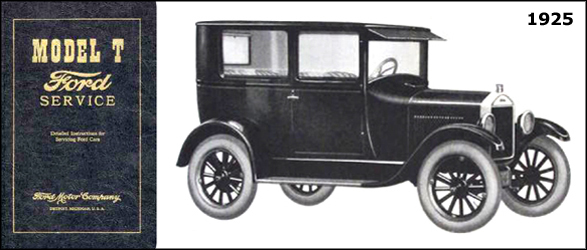
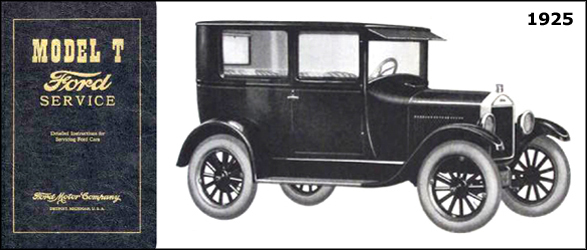
In 1925, an acknowledgement was made that although several automobile manufacturers had been building motorcars since 1900, it was the inimitable Henry Ford who produced a vehicle that exceeded the realm of manufacture to become an institution.

The new Ford that year appeared to live up to its expectations and more. The announcement that the new 1925 Ford was about to roll off the assembly line greatly aroused public interest. When the car was finally unveiled, hundreds of thousands of people all over the country crowded into Ford showrooms within a span of days to inspect the new product. In large cities as well as small ones, the machine was equally well received, the new model dominating popular conversation.

Johnson City’s dealer was Universal Motor Corporation, located in the southeast corner of the intersection of King and Boone streets. They sold the Ford, Lincoln and Fordson (tractor) vehicles. The city displayed the same excitement being generated across the country. The dealership was immensely packed throughout business hours. According to one comment: “Barring any discussion of merits or relative values of the various small cars now on the markets and with the thought of fairness to all, it is probable that never has a new model of any make at any price and at any time attracted as much attention.” That was quite a statement.

The automobile was distinctly improved over previous years. It possessed modern stylish lines, crowned fenders, beveled topsides, a one-man type top, larger and more comfortable seats, balloon tires, a rear mounted spare tire housed in a sturdy carrier, a license plate holder, rear lights of improved design and durability and side curtains that swung with the doors.

Also, the coils were removed from their time-honored position on the dash and installed alongside the motor block in a waterproof metal case. The steering wheel was larger and positioned at a more comfortable and casual location. The seat cushions were tilted for comfort and the upholstery was pleated in accordance with accepted standards. Doors were wider than in previous models. The gasoline tank was built into the dash, allowing the filler to be accessible through an opening with a lid that on the average car acts as a cowl (chimney) ventilator.

Passengers did not have to be bothered in order to take on fuel. The windshield was of the ventilating type, comparable with shields on more expensive open cars. The body was four inches lower, permitting more legroom in both front and rear tonneaus.

Amazingly even with all the improvements, there was no increase in price from the previous year. Color options were limited with most touring cars appearing in standard black, but the public was informed that other colors would soon be made available. Buyers didn’t care about their car’s paint; they wanted a Ford. 

Gas supplies were plentiful in 1925, but the oil companies made an interesting prophetic observation that could have been made in today’s environment: “Although the production of gasoline increased 600% in the last ten years, from 1.5 billion gallons in 1914 to nine billion gallons in 1924, it is believed the reduction of gasoline consumption by improvement in automotive engines or the development of substitute fuels or other sources of energy is expected to proceed faster than the exhaustion of our crude petroleum resources.”

Ford Motor Company was definitely in a class of its own in 1925, but that admiration would eventually change as competition from national and international car manufacturers leveled the playing field. 

Read more

Today’s column is the story of Julia Whalen, a young girl unknown in the annals of East Tennessee folklore except for one brief moment of valor displayed in a near train collision in the vicinity of Carter’s Station (Elizabethton) on the East Tennessee, Virginia and Georgia (ETV&G) Railroad in December 1874.

The railroad was created in 1869 by the consolidation of the East Tennessee and Virginia (ET&V) Railroad (connecting Knoxville with Bristol, through East Tennessee, east of Bay’s Mountain and between the Holston and Nolichucky rivers) and the East Tennessee and Georgia (ET&G) Railroad (linking Knoxville and Dalton, GA). Julia’s brief instant of fame occurred when she observed an approaching freight train speeding forward unaware of another train on the same track.

The sketchy details are noted in a newspaper clipping from that era: “Her presence of mind on that morning was wonderful. She first thought of motioning down the freight train from Bristol, then reflected that it was coming down grade and would be impossible for it to be checked up, so she ran on the track toward Carter, tore her red shawl from her shoulders and waved it, pointing back to the train that was invisible to the engineer but fast approaching.”

The article went on to say that Julia barely escaped death; she was confined to her bed after witnessing a near tragedy. Miss Whalen’s selfless story received national attention from the media. Her actions were described as being “exciting, earnest and persistent in her efforts to save the lives of others on the train without regard for her own safety.” Witnesses confirmed that the young lady bravely remained on the track until the engine was less than five feet from her person. The conductor and engineer, who initially thought the heroic mountain girl had been struck and killed by the train, stated emphatically that were it not for her timely appearance at the scene, everyone on the train would likely have been killed.

The article offered a brief glimpse of Julia’s life. Her father was described as being a warm, charitable, compassionate Irishman with a weakness for strong drink. He served in the Union army and died in Kentucky during the conflict. After the war, Mrs. Whalen married Johnny Burke, another kind Irishman who was employed as section hand on the ETV&G Railroad. After being smitten by paralysis, his disposition changed dramatically, causing him to became extremely bitter especially against young Julia, frequently threatening her life. Consequently, Mrs. Burke sought refuge for her daughter at night at the residence of her grandmother who lived nearby. Julia always returned home every morning with a forgiving heart and the desire to show love toward her unnatural, cruel and cold-hearted stepfather.

The situation grew from bad to worse until Mrs. Burke was confronted with a difficult situation – give up her husband or surrender her child to a family who would properly take care of her. She made the obvious choice; Johnny had to go. He surprisingly complied with his wife’s request and left the premises. 

Julia grew up adjacent to the railroad and became acquainted with a large number of railroad employees. The workers referred to her as “Little Julia,” a pet name that remained with her the rest of her life. She had an unusually beautiful face and an easy and gently disposition that drew the attention of all who came in contact with her. Although her education was limited, she carried with her a strong desire for formal schooling.

It is wonderful to discover a heartwarming story from the annals of yesteryear and bring an outstanding individual into the spotlight for a brief bow after all the years. 

Read more

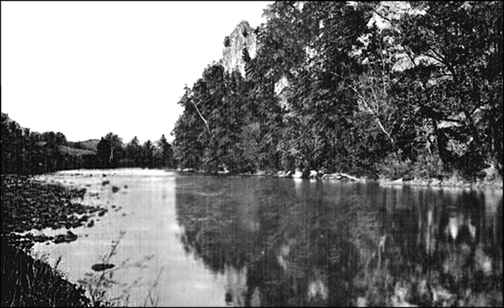
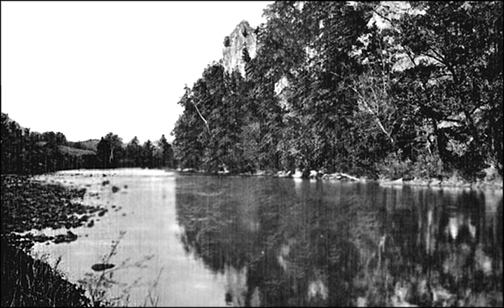
This past January, I wrote about White Rock Summit, the tallest peak on Buffalo Mountain that collapsed in 1882, as reported by several newspapers around the country. The massive rockslide was precipitated by two weeksof steady rain that flooded a sizable portion of East Tennessee that extended west to Knoxville. Damage was widespread.

Two people immediately corroborated the event. Dr. Ted Thomas of Milligan College sent me a student’s comments from a June 1884 group outing to the rock. In part, it said, “We started homeward, coming down the track of ruin caused by the fall of the great White Rock.” Mrs. Carsie Lodter, whose late husband once taught at Milligan, recalled conversations with her grandfather who heard the rumble from his nearby Oak Grove residence in Carter County.

Recently while perusing Thomas William Humes’ book, The Loyal Mountaineers of Tennessee (1888), I spotted another mention of the original rock as part of a depiction of the Watauga landscape in 1863, 19 years before the collapse: “In the southwest is the bold and craggy front of the Buffalo Mountain that may easily be fancied to resemble an ancient castle of massive strength and standing in solitude, its brow uplifted into the skies, impresses the mind of the spectator with a feeling of awe for its grandeur and majesty.” The author’s comment fits the older undisturbed rock, not the existing fractioned one.

In that year, the Civil War was raging. East Tennessee faced a dangerous scarcity of food because more than 30,000 of its able-bodied men had migrated north to serve in the Federal army, while others had been captured and forced into Southern prisons. Healthy, vigorous males were essentially unavailable to till the soil and engage in other hard labor. Those suffering the heaviness from extreme destitution the greatest were women, children, the elderly and invalids. As autumn marched toward winter, the outlook became more ominous and distressing for the populace.  

Confederate soldiers were quartered in all directions throughout East Tennessee, actively crossing Union-held land from one location to another. Their presence caused friction between people with divided allegiance (brother against brother) to the war. Soldiers on both sides competed for the same diminutive food supply. To add to the problem, provisions seized by one group were totally consumed, carried away, or destroyed to prevent it from falling into enemy hands.

East Tennesseans had seen conflict from a previous war. In 1780, the “Back-water men,” as Colonel Patrick Ferguson of the British Army called them, bravely gathered under John Sevier, Isaac Shelby and William Campbell for a secretive and successful military expedition to King's Mountain, South Carolina, bringing about an eventual end to the country’s fight for independence.

Even during trying times of two internal wars, the one bright spot in people’s lives was the natural beauty of their beautiful rugged surroundings. Across numerous mountains were pleasant valleys, through which flowed the Doe River, Buffalo Creek, Watauga River, Indian Creek and nearby Nolichucky River.

In addition to the comment concerning Buffalo Mountain’s rocky face, other places mentioned were the blue front of Holston Mountain, seven or eight miles away; Lynn Mountain, three miles east; and the blue outline of the Unaka and Roan mountains to the south.

These mental and physical areas of refuge offered temporary solace from the ravages of gruesome wars. The diverse features of the landscape combined to form awe-inspiring and beautiful landscapes for an ailing people. 

Read more