Tuesday, September 14, 1915 was an exciting day for circus lovers in Johnson City. At 6:00 a.m., as the sun slowly began to disperse the darkness in the morning sky, the first array of circus trains began to appear in the city.

The Gentry Brothers Famous Shows, known as “the cleanest circus in the world,” had arrived, bringing with it the promise of an entertaining spectacle for its residents. Four Gentry brothers, Henry B., Frank, Walter W. and J. W., all from Bloomington, Indiana, originated the circus in 1887; it remained in business off and on until 1934.

Because of the number of cars coming to Johnson City, officials had to make provisions with the railroad for track space. The number of railcars on hand was said to be twice that used in previous shows.

Early risers desiring to witness the circus unload were rewarded with sights of showmen who had tumbled from their berths, ready to go to work after a night’s slumber. While most residents were still in bed, the surrounding lots were magically transformed into a city of canvas tents. To the casual observer, the exhibition appeared to be one of disorder and confusion, but the operation was performed as it had been done so many times before with not a single worker wasting time and energy.

At 10:30 a.m., the circus was ready for its famous street parade, which was billed as “taking place rain or shine.” By this time, the parade route was aptly populated with curious spectators of all ages.

Although the procession route is not known, it was advertised to be “a solid mile of gold and glitter.” Based on this clue and the previous carnivals and circuses that came to the city over the years, the likely starting point was at the railroad tracks near Model Mill (later General Mills). It probably turned left onto W. Walnut Street, took another left onto Buffalo Street, bore right onto E. Main Street at Fountain Square and traveled straight ahead to the large open field that the city’s Municipal Building now occupies.

The parade was a precursor to and an advertisement for what would later be presented in the big canvas circus tent. Oldsters and youngsters were caught up in dreams of fantasyland. The owners hoped this public display would attract scores of paying patrons to the performances.

The circus offered two exhibitions in Johnson City that day. Doors opened for a complimentary inspection of the animals in the menagerie at 1:00 p.m. and 7:00 p.m. Each performance commenced one hour after the gates opened. The displays were of a larger and grander scale than those previously offered. Children attending the show in the afternoon slot were permitted to ride an elephant or pony under the care of a trained and courteous attendant.

The Gentry Brothers Famous Shows, which were promoted as “the world’s pioneers in trained animal exhibitions,” had been extensively enlarged to offer realistic taming of jungle leopards and other ferocious beasts within “canvas coliseums.”

In addition to several feature acts, three of them were new to America: The Carr-Thomas Trio, sensational burlesquing acrobats; The Cole Troupe, novelty artists of breathtaking and difficult acts on the high wire; and The Krannell Sisters, aerial butterflies swinging by their teeth in a fascinating display of grace and splendor in mid-air. 

A funny story circulated about the circus. A fire once caused workers to scamper about pulling hose lines to extinguish the blaze. The next day, a trained monkey was observed pulling hose from a box in a corner of the menagerie. This action destined the primate to become the first monkey fire chief in the world. Soon, other monkeys mimicked the act and they, too, learned to battle a fake blaze. The act became an instant favorite with circus fans.

After the final show, the circus promptly returned to the railroad cars and discretely departed for its next destination, ending an exciting day for Johnson Citians.

Read more

My History/Heritage page feature last week dealt with the opening of a new Science Hill High School at N. Roan Street and John Exum Parkway. A different location was proposed in 1946 when C. Howard McCorkle, then principal of the school, sent a letter to the Johnson City Planning Commission proposing a 4-part program:

1. Construct a new senior high school building for grades 9-12 on property surrounded by E. Main, E. Market and Bert streets, adjacent to the Central Fire Hall. The main entrance would face south toward Roosevelt (later renamed Memorial) Stadium. Except for a small physical education gym included in the new design, the old gymnasium on “The Hill,” built in 1939, would continue to be used for sporting events.

2. Designate one large wing of the new facility for a combination school and civic auditorium capable of seating 1500 to 2000 people, thereby replacing the existing City Hall auditorium at Boone and W. Main streets.

3. Convert the old downtown senior high facility (N. Roan Street) to junior high for seventh and eighth grades. 

4. Remodel the existing junior high building constructed in 1922 at N. Roan and Fairview for a medical arts center. This would allow ample space and parking for most of the city doctors to have office suites there. Another advantage was its close proximity to the new Memorial Hospital next door. McCorkle and the School Board believed that this would greatly enhance the possibility of Johnson City becoming a future medical center.  

The new grade arrangement was known as the “6-2-4 Plan” (grammar schools, 1-6; junior high, 7-8; and senior high, 9-12), replacing the present “6-3-3 Plan” (grammar schools, 1-6; junior high, 7-9; and senior high, 10-12). Another bonus was that it would reduce congestion at the new hospital. The new high school would be near its designated athletic and drill fields. Further, the new junior high would be slightly closer to its athletic fields. An attractive feature of the new proposal was that none of the existing facilities would be abandoned or razed.

In spite of McCorkle’s petition, the Board of Education issued a resolution requesting that the city refrain from using the proposed strip of land for a new high school. Mayor Welsford P. Artz stated that the city had been approached by a manufacturing firm and was quoted a price for 600 feet of the 1000-foot frontage property in question. The type of building the company proposed was what the commission wanted to see there. It was to be a low one-story building, occupying only a comparatively small portion of the lot. The firm further intended to beautify the grounds, making it an attractive addition to the town. However, the city set aside a portion of the land adjacent to the fire station for future use.

The School Board immediately countered with another letter to the commissioners: “In the near future, the normal growth in the city’s population and the growing obsoleteness of Science Hill High School will make the erection of a new (school) imperative and that the land in question is an ideal site for a modern high school. It is adjacent to the stadium and ballpark, away from the congestion and noise of the downtown section, on the side of town toward where future growth will likely occur, level with ample parking space, abundant space for a modern high school building with a auditorium and room for a large recreation center in addition to a high school campus.”  

McCorkle’s proposal was rejected and the offer for the company to build there fell through. The land was essentially not used until years later when the city relocated its municipal and safety offices on the site. It would be another 15 years before a new high school would be constructed in North Johnson City.  

Read more

The Selective Service Act was implemented during Woodrow Wilson's presidency in 1917 because the government wanted to ensure that the country’s military services had enough qualified men.

The new law resulted in many Americans being called for combat in World War I. When President Franklin Roosevelt signed the Selective Training and Service Act of 1940, the country had its first peacetime draft.

Some local residents likely recall registering for the draft at the local Selective Service System, Local Board #97 several years later when it was located in the Hamilton National Bank building at E. Main and Spring streets. The Clerk in charge was Walter Phlegar who used a manual typewriter to type the registrant’s card with his two index fingers. He and his wife, Mary, lived at the beautiful Montrose Court on Virginia Avenue.

The November 22, 1950 edition of Milligan College’s student publication, “The Stampede,” asked and answered the question of undeniable importance to draft eligible males: “How does the draft affect you, Mr. College Student?” That year, 219,771 men from around the country were drafted into military service.

The campus periodical answered the question by publishing guidelines for male students from bulletins issued by the Selective Service. Local boards established several conditions for deferment consideration, all of which had to be met.

The new law required men to register for the draft at his local board, defined as the one nearest his home, within five days after reaching their 18th birthday. However, a student already attending school such as Milligan was permitted to register with the board nearest the campus and request that they forward the paperwork to his home board.

Those who received a classification card had a Selective Service identification number on it, which was to be used in all correspondence with the board. A student was also required to keep his home board informed of any address change. The registrant must have completed at least one academic year of a full-time course of instruction at a college, university, or similar institution of learning.

The college or university was required to certify that the student’s scholastic standing at the college placed him among the upper half of his class. The consequence of poor grades dramatically highlighted the importance of maintaining good academic standing.

The local board received from the college verification that a student who desired to enroll in a full-time curriculum at the college did so prior to August 1, 1950 for the academic year ending in the spring of 1951. In the case of a registrant meeting the above conditions to whom an order to report for induction into military service had been issued, the local board was authorized to reopen the case for reconsideration.

 The law further stated that any notice mailed from the board was considered “active” regardless of whether or not the registrant received it. The draft-eligible male also had to notify the board if he married after the registration date since that would change his classification. Anyone receiving an induction notice from his Selective Service Board could report immediately to another board and ask for a transfer from the board where the request of transfer was made. Persons born before August 31, 1922 (age 28 or older) were not required to keep their local board informed of any change of address; their records were placed in storage.

In 1973, the draft ended and the U.S. converted to an all-volunteer military, which continues to this day. 

Read more

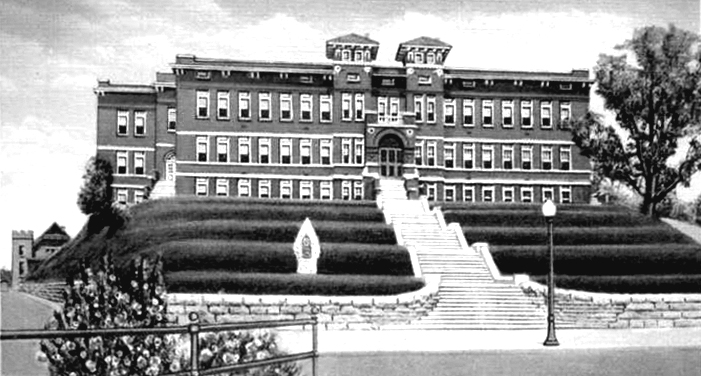
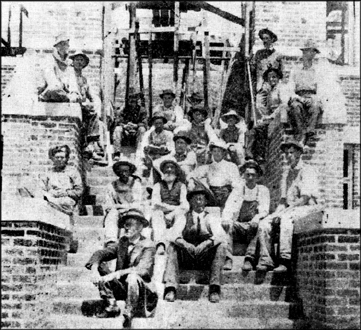
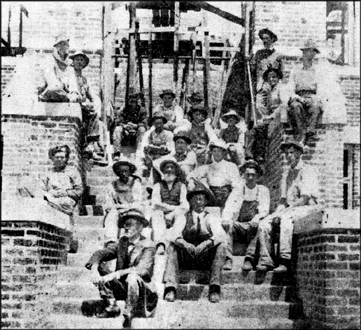
Monday, March 6, 1961 was a much-anticipated day for Science Hill High School students. On that date, the majestic old downtown high school building that was razed and rebuilt in 1910 on what students referred to as “The Hill,” ceased to be the city’s main high school.

Workmen take a break while building the “Old” Downtown Science Hill High School in 1910

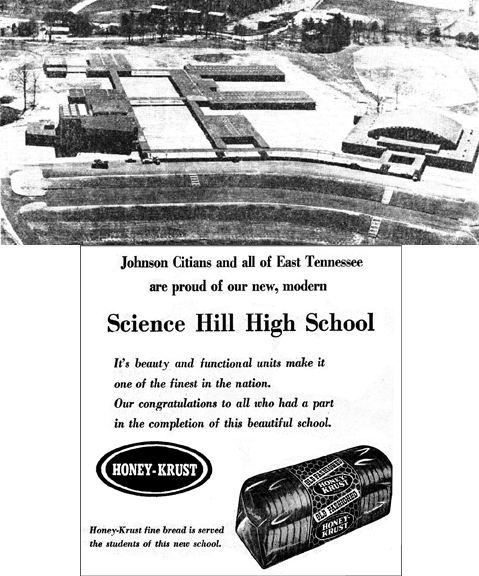
A great deal attention was drawn a few miles to the north where the baton of progress passed forward to a new long-awaited modern, expansive facility. Linda Moore Hodge, who graduated in the first class from the new facility, saved and shared the opening day Johnson City Press Chronicle with this writer. Local advertisers flooded the paper with congratulatory remarks.

The “new” Science Hill High School as it appeared just prior to occupancy in 1961. Many businesses congratulated city officials for the accomplishment.

The new innovative $2.5 million campus-style school was a dream come true, brought about by a growing student population and a cramped aged facility situated in the congested business district. The new structure did not materialize overnight; serious discussions for it originated in 1957. During November of that year, Johnson Citians went to the polls and voted to issue $2.6 million worth of bonds, which were offered to the public the following March.

Thus began a flurry of activity. Board members and city officials visited selected campuses in several southern cities to formulate ideas for the new Science Hill. It became readily apparent that multiple campus-style buildings offered the most economical option that would satisfy existing and future needs.

A 40-acre site was selected at the intersection of John Exum Parkway and N. Roan Street. A sizable quantity of land was needed, far in excess of the 2.5 acres that the downtown school occupied. The acreage was sufficient to provide for six separate interconnected buildings with covered walkways, a gymnasium, ample parking space and plenty of outside practice fields for athletics.

Although official groundbreaking began in December 1958, actual construction did not start until the following July. Even then, a steel shortage halted work for a period of time. Further, a large hill that originally occupied the new site had to be leveled. In an almost unanimous decision, school officials retained the same name as the old one. Leland Cardwell was selected as the architect and J.E. Green and Company was awarded the construction contract.

Science Hill was declared to be the largest electrically heated school in the world. Most rooms had hookups for future air-conditioning needs. In all, the sprawling complex occupied 104,500 square feet of floor space.

The auditorium/theater complex sported an impressive foyer with terrazzo floors and colorful tile walls. A steeply inclined floor made it easy for 800 seat occupiers to see the stage. There was space overhead for 25 sets of lights plus a required fireproof curtain. Skylights over the stage could be darkened by simply regulating shades that covered each section. In front of the stage was room for a good-sized orchestra.

The acoustical ceiling band room had ample storage space for instruments, a recording room and sheet music space. A soundproof choral room was designed to handle large and small groups of singers.

The nerve center of the new campus was the Administration Building, which was centrally located among the other buildings. It contained a 2-way public address system connected to all rooms along with closed circuit telephones (internal house phones limited to the campus with no incoming or outgoing call capability), a public address system and a radio hookup. An emergency bright red “hot phone” was available that allowed the caller who picked up the receiver to be automatically connected with every speaker in the school. 

The Classroom Building contained 24 rooms that were described as being “light, bright, spacious and attractive, and it may be some time before the first students can stop admiring it long enough to concentrate on studies.” In it were the science laboratories consisting of a combined chemistry and physics laboratory, one dedicated chemistry lab and a third one for biology. A special projects room allowed students working on long-range projects to leave them set up for days or weeks.

The library had two separate reading rooms, with each surrounded by easy-to-reach books on head-level shelves. The rooms were separated by the librarian’s office, the check out counter and a conference room that allowed groups of students to work on common projects. The library lobby was furnished informally, thereby inviting students to relax at free times and enjoy literary gems. A feature not usually found in other schools was a night depository, permitting students to return books after hours.

The Useful Arts Building contained the home economics department, which consisted of two rooms with three complete kitchen units, stoves, refrigerators, storage space and counter workspace. In these two rooms were sewing machines, cutting tables and fitting rooms. Here young ladies learned to sew a fine seam on sewing machines of all types, be it making pajamas or an evening gown. Another section of the building contained the well-lighted art department.

Entering the gymnasium, one encountered a foyer that was large enough to serve as the ROTC drill hall during the day and accommodate 2,500 basketball fans at night. A floor-to-ceiling partition could be activated to quietly and quickly expand across the entire length of the gym, separating two full size basketball courts. Another button allowed 2,000 rollaway seats to come out from the sides. Using folding chairs on each end of the gym provided accommodations for an additional 500 people.

The cafeteria’s main dining room seated 350 students utilizing four food lines with two designated for students desiring a hot lunch and two for those wanting a cold snack. The lobby contained informal furniture where students who had caught up with their studies could go for relaxation. The dining hall could be cleared of tables and chairs for school socials. Also, a terrace with southern exposure allowed students to bring along their charcoal burners and have a cookout for class, school or special group events. The kitchen was 100% stainless steel throughout ranging from a walk-in refrigerator to a shining commercial type dishwasher.

The new Science Hill High School was dedicated and opened to the public on Sunday, March 5 at 2:30 p.m. in the gymnasium. The Education Committee of the Chamber of Commerce handled arrangements for the important event. On hand were current board members: R.T. Haemsch (chairman), William Sells (vice chairman), Forrest Morris, George Speed, Dr. E.T. Brading, Viola Mathes and Mrs. N.T. Sizemore. Former board members who had a hand in the project were Gerald Goode, L. Cecil Gray, John Howren and Ray Humphreys.

City Manager David Burkhalter presided over the ceremonies: The school band played the National Anthem. Rev. Ferguson Wood, pastor of First Presbyterian Church, gave the invocation. Mr. Burkhalter introduced special guests. Mayor Ross Spears made the building presentation, which was accepted by R.T. Haemsch, chairman of the Johnson City Board of Education. Thomas Boles directed the high school choir, after which Frances Harman, a senior, sang the “Battle Hymn of the Republic.” Howard McCorkle, superintendent of city schools, then introduced Dr. Andrew Holt, president of the University of Tennessee, who gave the keynote address. Rev. James Canady, pastor of Central Baptist Church, offered a prayer of dedication and benediction. The dedication service was concluded after Mayor Spears and the audience provided the litany for the dedication.   

Read more

My January 9 column concerning the retirement of former Johnson City School Superintendent, C.E. Rogers, prompted a letter from Ms. Pat Willard, who commented about several of the people mentioned in the article.

“I knew who Mr. Rogers was,” said Ms. Willard, “because his wife was in charge of the nursery school I attended as a young child during World War II. It was for children whose mothers were helping with the war effort by entering the work force. My mom worked at Dosser's Department Store selling yard goods. Every woman in the work force freed a man to go into the military.”

“Mrs. Rogers must have taken a special interest in me. One evening, my parents and I walked from our home in the 300 block of Poplar to the Rogers home on Maple in the block next to the college. They had arranged for me to attend Training School (University School) when I began school in the fall, but my parents left the decision to me. I chose to go to South Side School.”

“I am sure that Miss Nancy Beard of your article was the principal of South Side. There was a story that her favorite song was ‘Let it Snow’.”

Pat mentioned Edith Keyes, the part-time librarian at South Side who only worked in the afternoons around 1946. She encountered her again in the late 1990s as a member of the Monday Club and the Institute of Continuing Learning. Miss Keyes had a reserved parking space at the college. Some mornings when she arrived for work, she would find a car parked in her space. She would return home to Jonesboro (Jonesborough), call the college and tell them that she would be in to work when her parking space became available. Pat acknowledged that this could have been a tall tale.

I noted in my column that Mrs. Orville Martin was my occupations teacher in Junior High School. Pat also had her for the same subject. When she turned in a career book to her teacher, Mrs. Martin refused to let her be an architect or a dog breeder in the course, instead urging her to choose nursing. She complied and passed the class.

When Ms. Willard was in her senior year at Science Hill High School, her mother urged her to pursue civil engineering as a career. No one supported or objected to her decision. During the last semester of her senior year, she exchanged typing for mechanical drawing. The principal, George Greenwell, approved her taking the class, making her the only girl in the class. Mrs. Martin learned of her decision and sent word how proud she was of her. Pat studied civil engineering in college.

Ms. Willard mentioned Elise Lindsey whom she believed resided in the 100 block of West Poplar. Her father ran a gas station on South Roan. Pat believed that she likely taught at Columbus Powell.

Pat identified Margaret Woodruff as an elementary school principal. She surmised that she held the position at Stratton Elementary School on Oakland Avenue. She was also one of the three daughters of J.D. and M. E. Woodruff who built a house in the tree streets section of Johnson City in 1906. Mr. Woodruff was a timber agent. She noted that the house was still unpainted with natural chestnut woodwork in most of its many rooms. The family reared eight children in that house before Mrs. Woodruff, a widow by then, sold the property to Pat’s father in l951. The family moved to a large red brick house in the 200 block of Locust Street.

Although Pat did not know School Superintendent C. Howard McCorkle, she knew who he was. She remembered Mrs. Starrett as a very stately woman who taught music in the area.

Pat concluded by saying, “You mentioned others whose names are familiar to me but about whom I have no definite memories. This was great fun. This was a nice little walk down memory lane.” 

Read more

In 1953, Johnson City had 62 mostly “Mom and Pop” restaurants in the Johnson City area. Most were located within a short distance of the downtown Fountain Square area for the convenience of shoppers and workers.

Two of my family members owned restaurants in the early 1950s. I mentioned one, The Green Bean, at 514 W. Market in my “Aunt Ween” column last October. The other one operated at 501 W. Market about 1951-52 at the former site of (Carl) Long’s Lunch (previously Long’s Barbeque).

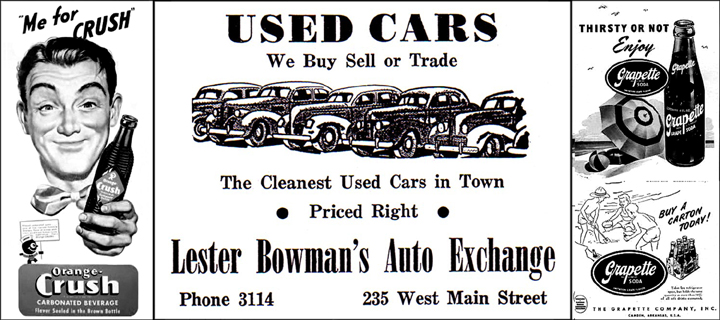
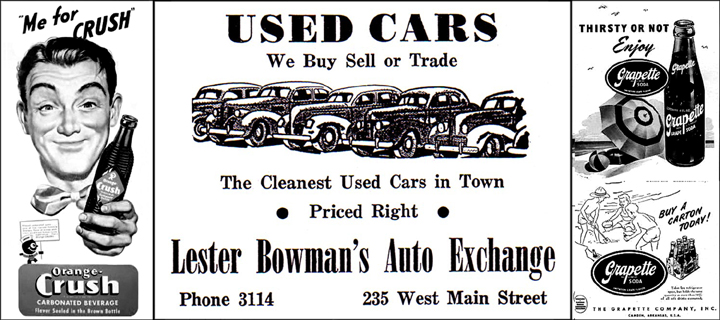
The new owners were Lester and Carrie Bowman and Staley and Jennie Cain. Lester ran Lester Bowman’s Auto Exchange just two doors west at 505 W. Market (previously located at 235 W. Main). Jennie and her sister, Pauline were vaudeville performers, known as the Bowman Sisters, in New York in the early 1930s.

The two families opened the business a couple of years before Pauline established hers. The name of it escapes family and friends; perhaps a reader will know. Mom, Dad and I ate there frequently. In spite of all the nourishing meals they doled out, hamburger and French fries were about all I ever ate.

Staley worked at Lester’s car lot so Carrie and Jennie were pretty much responsible for running the café on a day-to-day basis. I am sure the men came over regularly to chow down the victuals. Lester's job was selling cars, not flipping hamburgers.

Carrie and Jennie placed one bottle of each different brand of soft drink they sold on a high shelf behind the food counter that included Pepsi Cola, Coca Cola, Royal Crown Cola, Old Colony, Double Cola, Orange Crush, Dr. Pepper, TruAde, Mil-Kay Orange (made with real oranges), Hires Root Beer, Dr. Swett’s Root Beer, Upper 10, Red Rock, Tip, Frostie Root Beer, Golden Cola, Grapette, Nehi Grape, Nehi Orange and Cheerwine.

Carrie Bowman was a witty lady who spoke a colorful language of her own. Those who remember her likely recall some of her unique sayings. In her younger days, a man once asked her, “Where have you been all my life?” Her respond was “I've only been born about half of it.” When she spotted an unattractive person, she would say, “They can't help being ugly, but they could at least stay home.” Anything slippery was referred to as “slicker than owl grease.”

After purchasing something, Carrie would often declare, “This ought to last me until I die, if I die when I ort (ought) to.” An impoverished person was “as poor as Job’s turkey.” Someone who made a quick exit took off like “Moody’s goose.” Anyone who went by “Shank’s mare” walked. If an inconsiderate person blew his car horn at her, she would said, “Blow your nose; you'll get more out of it.” Two more quotes were “Pretty is as pretty does” and “Have it your way.” 

Lester once invited my family to eat at the restaurant with a new family who had just moved to Johnson City. They were Mervin and Mildred Pratt. While we ate, they discussed a new business venture they were starting in the city. They quickly got my attention when they said it would be called Dairy Queen and located at 714 W. Market Street (opposite the Kiwanis Park Little League ball field. We lived near there.

A Science Hill classmate of mine, Bill Durham, once told me that his sister, Christine, was the first employee they hired. Living so close to the Queen, I often walked down there for a “Cone with the Curl on Top.” As I recall, they were priced at five and ten cents depending on the size, milk shakes cost a quarter and banana splits were pricey at 50 cents. This was the first time I ever had the option of eating a cone dipped in chocolate and spread with nuts. Mervin’s place was quite popular since it was the only one in town, but that would soon change.

The Bowman-Cain restaurant operated between one and two years before closing, but my love for the “Cone with the Curl on Top” continues to this day. 

Read more

Lewis Brown commented on my Nov. 21 reader response column in which Thomas Beckner mentioned the Krystal-type hamburger place in Johnson City that was across from the old Hamilton Bank building on E. Main. Tom believed the burgers were five or ten cents each. He said he could still recall the smell of the place.

“The restaurant Tom spoke of,” said Lewis, “was called the Jiffy Burger and the hamburgers cost seven cents each. What a deal. I believe it was open for about a year around 1955. About the time they closed, Dairy Queen started selling their famous little burgers for 10 cents. They ran weekly specials that sometimes included pricing them at a dollar a dozen.”

Louis remembered the business being a simple layout in a building that was long and narrow. When a customer entered the front door, he or she approached a small counter with a small grill beside it for placing an order. A man, whom Brown believed was the owner, poured oil on the grill, added chopped onions, placed burgers on top of the onions and cooked them. Within a couple of minutes, the mouth-watering products were done. While they were grilling, he heated the buns on the corner of the grill. The burgers were square and wrapped in paper. Each one was garnished with mustard and two thin-sliced pickles.

Brown surmised that the location was probably the same one that once operated as Harrison’s Jewelers (201 E. Main, adjacent to Anderson Drug Store). He first heard about the restaurant from some of the older kids in his neighborhood and checked it out on his next trip downtown, which included a trip to the movies. He was not disappointed. He believed he was with Mark McCown or Mackey Therrell.

He speculated that the enterprise failed because it was located on Main Street that presented significant competition from other eateries in the immediate area. He wondered how a 7-cent burger could have generated very much profit.

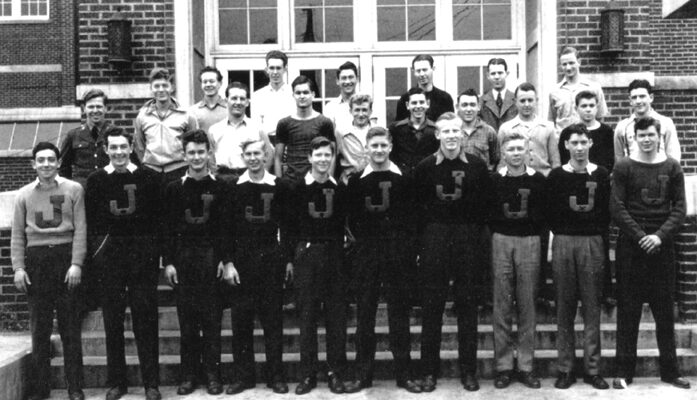
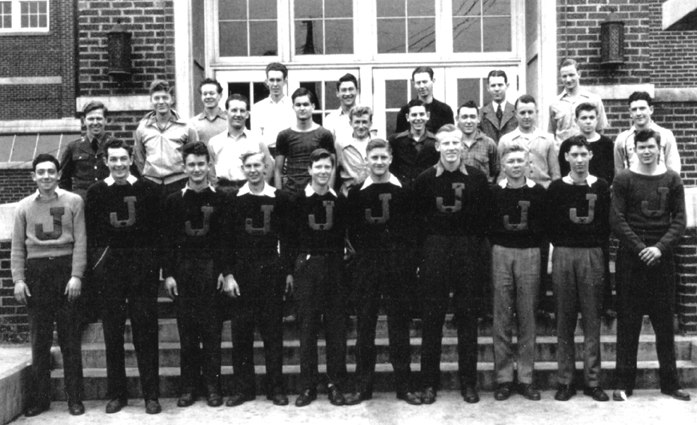
On another subject, I received a package in the mail from York Trivette, who was my contributor for the Hart’s Jewelers column in May 2009. “I’m sending you,” he said, “a picture of the ‘J’ Club of Science Hill High School from The Wataugan yearbook of 1942 for your consideration of using it in a future heritage column.

“The ‘J’ Club was composed of boys who earned the letter for meeting certain goals in one or more of the various athletic events such as basketball, football, baseball, tennis or track. Today, the boys receive an ‘SH’ instead of just a ‘J’. They probably also get a jacket.” York noted that the photo was taken a few months before most all of the boys entered the armed forces. The country was at war.

Trivette related that the school was referred to then as Johnson City High School, rather than Science Hill High School as it is today. He recalled a favorite cheer used by the cheerleaders: “Are we in it? Yes, I guess. JCHS. Yes, yes, yes.”

Trivette identified several of the boys in the photo and hoped that some of my readers, who are children or grandchildren of a student pictured, might identify one of those noted with a question mark and a number.

First row (l to r): Ralph Carmichael, (?1), Terry Epperson, (?2), York Trivette, Fred Frazier, Red Caughron, (?3), Carlyle Dowdy, (?4).

Second row: (?5), Charlie Johnson, (?6), Buddy Price, (?7), Buford Goldstein, (?8), Roy Holloway, Donnie Miller, Charles Ray Alexander.

Third row: Jay Tipton, (?9), Randall Walters, Coach Denver Dyer, Coach Howard Dyer and Buddy Poole.

Forward any names you can identify and I will share them with York and also incorporate in a future column. 

Read more

In 1958, the late Dorothy Hamill, Johnson City Press-Chronicle writer, interviewed the executives of Dale and Carroll Productions, a local animated cartoon production enterprise.

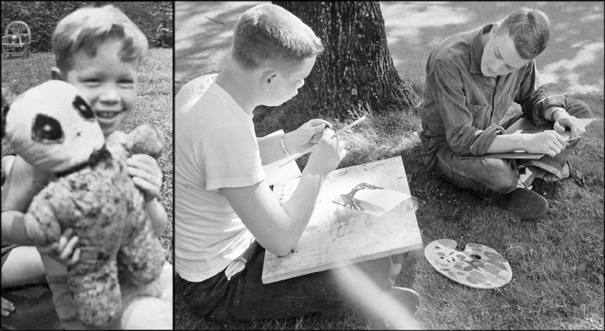
Hamill quizzed Glenn Dale and Larry Carroll (now deceased) about their creation of an adorable little cartoon teddy bear named Henny. Actually, the company’s top brass were enterprising 16-year-old Science Hill High School juniors who possessed an overt desire to produce quality cartoons.
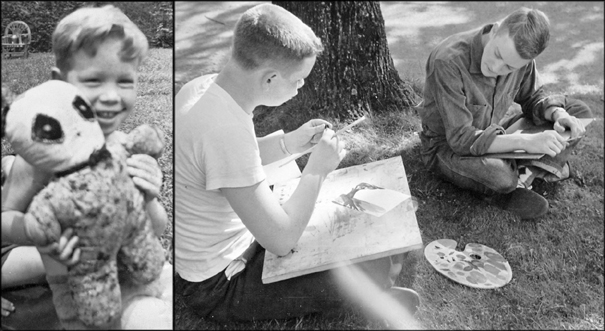
 

Glen Dale Holds Henny / Glenn and Larry Carroll at Work under a Tree on a Cartoon 

Henny was born in 1956 in a makeshift studio in the Dale home on W. Locust Street. The youngsters fashioned the character from a favorite stuffed animal that belonged to Glenn. The one-room operation was comprised of a couple of adjoining tables, typewriter, cameras, oil and water based paints, record player, reel-to-reel tape recorder, microphone and a storyboard.

Within two years, the indomitable pair generated a sizable quantity of work that included building much of their studio equipment, experimenting with techniques, sketching the hundreds of painstaking drawings necessary for animation and writing story sequences.

Glenn and Larry had known each other since elementary school days. Both were gifted artists and had created some beautiful oil paintings. They attributed their inspiration to pursue the vast technical field of animated film to Walt Disney. Henny became to Dale and Carroll what Mickey Mouse was to Walt Disney. Over time, Henny was almost like a real person to his producers.
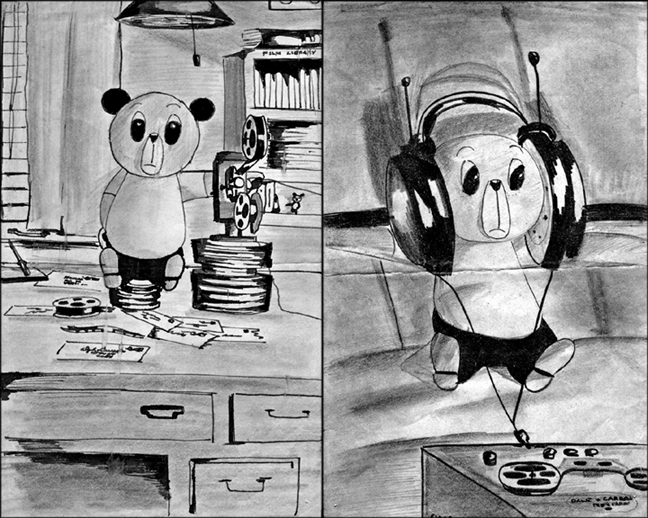
The youngsters initially fabricated flipbooks (small volumes containing images on each page that give the illusion of continuous movement when the edges of the pages are quickly flipped). Their journey into film animation received a significant boost when Glenn was given a movie camera for Christmas. 

At the time of Hamill’s interview, the young men had five films “in the can” with two more in production. They added a soundtrack for one episode by synchronizing it with the film; they even composed the music score. The youngsters described the tune as being catchy with a fast-beat rhythm. They played their clarinets into the microphone of a tape recorder while Glenn’s younger brother, Don, displayed his talent on piano. They further added sound effects and supplied the all-important voice of Henny.

According to Glenn in 1959: “First, we try to get an idea of the story, making it as original as we possibly can. We feel that originality is very important in movie making. Then we sit around and discuss the story and when we have it in mind, we write down the outline.”

During this process, the talented twosome decided on the characters they would use in the film and the role each would assume. Then they made a series of small sketches that highlighted the main facets of action. The young artists accomplished most of this with pen and ink and, on one occasion, used shoe polish.

A few of the individual pictures were pinned on a beaverboard (light wood-like building material) storyboard (graphic organizer in the form of illustrations or images displayed in sequence for the purpose of pre-visualizing a motion picture, animation, motion graphic or interactive media sequence). With these items visually before them, they began filling in the story line.

Larry further stated: “Every camera angle has to be figured too and then, of course, comes the drawing. For a 7-minute cartoon, over 9,000 separate frames or drawings are needed. If, for instance, Henny throws a ball, a series of sketches had to be made. In each one, the position of the arm was changed ever so slightly.”

Since every sketch had to be filmed individually, the camera was equipped with a device that enabled the boys to film one frame at a time with one of them operating the camera and the other moving the pictures in and out. The initial three cartoons made were referred to as “gags,” which were mainly isolated incidents such as Henny finding a firecracker that explodes.

In one production, “The House that Henny Built,” the little teddy bear decides to build a dwelling in the woods. When he stops to rescue a rabbit being attacked by a fierce bear, the larger animal turns on him causing the forest creatures to come to his aid and even help him build his house. This cartoon was composed of background music, sound effects and spoken lines.

Early in their animation efforts, Glenn and Larry drew in the background, cut it out, superimposed it on the picture, sketched their characters on a sheet of heavy cellophane and placed it on top of the background. That changed when they built a multiplane, a contrivance whereby the camera can be set at the top and take pictures on three different levels, thus giving the illusion of depth. 

Dale and Carroll mixed their own paints using mostly watercolor, but used oils for the background. They also constructed sound equipment utilizing a camera tripod for the base, another one on top and a microphone hung on one arm.

In one film, Henny was launched to the moon, but not before his creators extensively researched the subject of outer space to ensure completely scientific accuracy. In the production, they used composer Stravinsky’s music as background and then added tunes of their own composition.

In another cartoon titled “For Sale,” Henny purchases a dog, loses it and then finds it. Once a story was developed, the boys could sketch the action at their individual homes, but during preliminary drafting, it was imperative they work together in the studio.

Glenn recalled when Henny was used in SHHS’s student newspaper, the Hilltop: “The paper used a single cartoon panel that appeared in several editions of the periodical. I guess Henny became a kind of school mascot. Caricatures included Henny in class asleep at his desk behind a textbook, looking at one of the many beautiful young women at SHHS instead of face-forward toward the teacher and standing on the football field with a zero on his ill-fitting jersey. Sometimes, he would appear in large-scale posters in the role of instructor or advertising some school cause or event. It still puzzles me that Henny never graduated from high school.”

One episode featured Henny as a baker who falls asleep and plunges into a batch of fresh dough, requiring him to discard it and start over. Two others involved a character named Bax that was designed by Larry.

The Hamill piece was brought to the attention of a freelance writer in Amarillo, Texas who, using material from the Press-Chronicle and from further interviews, produced an article for national syndication. Shortly, it came to the attention of Disney who then contacted the boys with advice, information and encouragement.

“We later designed effects animation for a student film enterprise in Richmond, Virginia,” said Glenn “that was brought to their attention by the syndicated article. Their last project consisted of three short commercials for a bakery whose motto was ‘baked while you sleep.’”

When Glenn was asked what happened to Henny after 1959, he responded, “Henny is alive and well, although he has been ‘renovated’ more than once and now ‘bears’ little resemblance to the ancient prototype (stuffed animal) on which his film image was based. He has, as far as I know, participated in no film projects since the late 1950s, piqued, perhaps, by the fact that none of his cinematic efforts ever won him an Oscar, not even a nomination.”

Glenn Dale and Larry Carroll expressed a strong desire to enter the animated cartoon field professionally after they finished their education. To that end, they learned all they could about motion picture techniques from printed material and kept abreast of new technology by experimenting with color film, cinemascope and stereophonic sound.

Glenn modestly offered glowing words about the talents of Carroll: “Although we both had artistic talent, Larry was the superior natural draughtsman. He, to the best of my memory, produced most of the cartoon panels for the Hilltop. He consistently produced excellent work animating characters, designing backgrounds and background layouts and in story design. I have no doubt that Larry would have excelled in many aspects of motion picture production and design had he chosen that career.” 

Read more

“Go west, young man (and grow up with the country)” became a rallying cry in the United States in 1865, popularized by American author, Horace Greeley. It concerned Manifest Destiny, massive expansion across the continent.

The newspaper editor advocated westward growth because he believed the fertile farmland that extended throughout the west was an ideal place for hard-working people to succeed. Young men from Virginia, Tennessee and the Carolinas readily heeded the call.

Promotions by western railroad agents that beguiled young men with exaggerated tales of high wages and plentiful opportunities in the west. With imaginations inflamed by these fanciful “artful dodgers,” they saved their hard-earned cash for the extensive and expensive journey ahead. They arrived to find that the west was saturated with hopefuls like themselves who were looking for easy money that did not exist. They likely could have done as well or perhaps better had they stayed home. 

Some found higher wages, but with them came increased living expenses. Instead of land being cheaper, it was often higher and fraught with added costs, including irrigation equipment needed to make the ground more fertile. Even when productive crops were grown, the railroads took the bulk of the profits in transporting them to populated areas where there were enough residents to consume them.

Many young men drifted from place to place, which further added to the railroad’s revenue. Countless drifters, realizing their circumstances were not what they desired, longed to return home but were too embarrassed to do so.  They learned that there was no pot of shiny gold waiting for them at the end of the rainbow because the land was too desiccated to produce the colorful arc. Indeed, the “fine medicine” that was advertised in local papers was not for the drifter from the east but for the greedy agents who solicited them.  

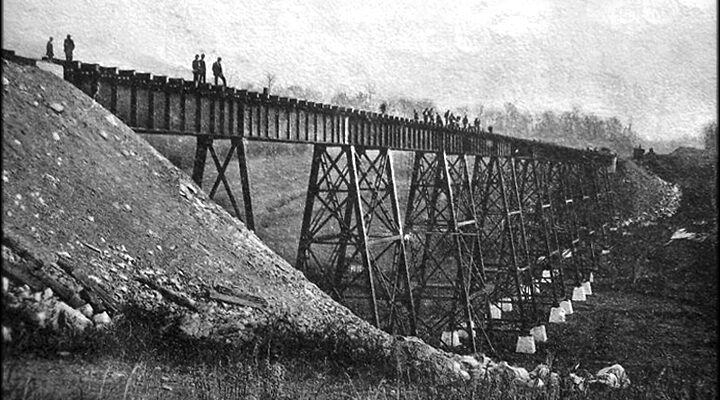
CC&O Railroad Trussle in Boones Creek

My September 5, 2011 Yesteryear column dealt with the festive celebrations that occurred in Johnson City and Spartanburg with the completion of the Carolina, Clinchfield and Ohio (CC&O) Railroad between Dante, Virginia and Spartanburg, South Carolina on October 29, 1909. The new railroad, built at an enormous cost brought by significant engineering challenges from laying track over abnormally rough terrain, was now ready to transport coal from a rich coalfield in the mountains. The risky venture greatly enhanced the economic outlook of the area.

By 1910, mountainous folks initiated their own rallying cry to “Come back east, young man (and help move coal). Many of the native-born people had been gone for a considerable number of years. They were needed to lend a hand with the development of the country that had been opened up by the presence of the new railroad.

The economy in the four states was so greatly improved that it was advertised as “the most popular movement of recent times.” Local newspapers became the primary medium for convincing home folks to return to their native land.

The CC&O Railway printed 5,000 circulars for school children to use in gathering the names and addresses of persons who had moved west. In turn, they were delivered to the board of trade and then to the railroads participating in the “Back Home” movement. Also, the railroad placed identical ads in newspapers. It was estimated that a million former southerners were asked to visit their old homes.

Organizers underestimated how successful the “come back home” crusade would be to area residents. The campaign achieved its noble goal.  

Read more

Prior to 1840, political campaign music was immensely in vogue with local voters because it added a new exciting facet to the gatherings. However, beginning that year, the music fell into disfavor until its use was revived for the campaign of 1860. Its newfound popularity was credited for sparking enthusiasm throughout the north to bring Abraham Lincoln to the presidency.

After the 1860 election, music once again fell into disuse. Although campaign songbooks continued to be popular and circulated to the masses, there was less picking, singing and bowing at political stumps and rallies.

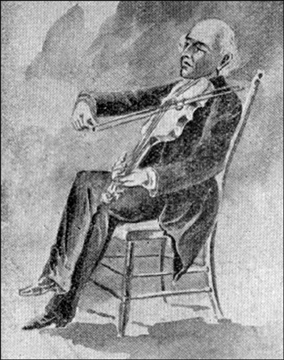
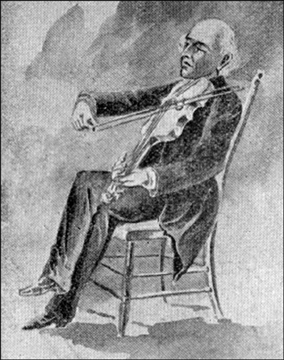
The seesaw scenario cycled again in 1886 when two Tennessee brothers, Bob and Alf Taylor, made state history by competing against each other for governor of the state in a spirited contest known as the “War of the Roses.” Both men were accomplished fiddlers and employed music to energize their campaigns and their audiences.

Robert L Taylor undoubtedly aided himself in his canvass for Governor when he developed the curious habit of carrying his fiddle to meetings and entertaining audiences with renderings of popular tunes. Even his critics could be observed discretely tapping their toes to a lively fiddle tune such as “Old Joe Clark.”

Bob Taylor became known as the fiddling governor, but he obviously possessed other leadership qualities since he was thrice elected to the governorship and became a U.S. Senator in 1907. Several years prior, Taylor defeated Congressman Augustus Herman Pettibone who was a classical scholar and one of the ablest Republicans of that era. Bob’s ridicule, stories and spoof were considerably over the top for the always-serious politician.

On one occasion, Augustus, a Carpetbagger (a Northerner who went to the South after the Civil War for political or financial gain) scoffed at his competitor as a mere fiddler who was trying to break into Congress. The next day, Bob brought his fiddle and a carpetbag (a traveling bag appropriately made of carpet fiber), arrayed them on the platform and asked the audience which they preferred to follow. The crowd applauded heartily.

At night, Bob attended country dances and furnished music for the ever-growing crowd, charming them with such selections as “Molly Hare,” “Polly, Put the Kettle On and “Rare Back Davy.” Republicans from that East Tennessee district deserted Pettibone and supported his admired competitor, electing him by over a thousand votes.

Pettibone’s rhetoric and sophistry were not vote catchers like Bob’s pastoral fiddle and charming eloquence. During one gathering, Bob brought his zealous crowd to an elevated pitch of merriment and enthusiasm by one of his incomparable anecdotes. When his challenger arose to reply, he said to the large crowd, “I will not attempt to excite your ‘risibles’.” At this juncture of the speech, a nearby countrified Republican asked a bystander what he meant by “risibles” and was told that it meant “laughter.” The old man promptly responded, “Then why didn’t he say so.”

Bob’s fiddle was obviously a love of his life. Once, during a speech, he described what he deemed to be the key to happiness: “A nice farm of 75 acres about five miles from a small town with a clear stream of water traversing its entire length, a smokehouse in the rear of the house tilled with fine meat, a barn with a pair of good coachers (large, closed, four-wheeled carriages with an elevated exterior seat for the driver) and a saddle horse, a springhouse, four or five peacocks, a drove of geese and ducks to sport in the stream and a quaint little orchard of productive trees.

Every Saturday, the former governor saddled his horse and rode into town to buy the weekly newspaper. Here he met two or three friends in front of the corner grocery where they chewed tobacco and swapped yarns. One would surmise that Bob always had his fiddle with him   

Read more