Author's Posts

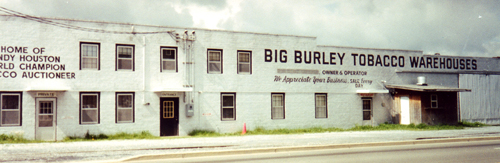
In the late 1940s, representatives of the American Broadcasting Company came to Johnson City to tape a live radio program from Big Burley Warehouse on Legion Street. The remote was from ABC’s popular “Ladies Be Seated” series that aired weekdays at 3:30 p.m. from Radio City in New York.
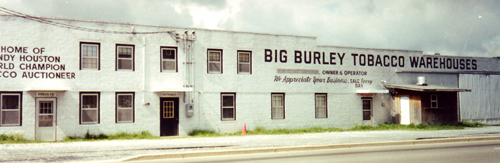
In the audience that afternoon was a youthful Merrill Moore who later became anchorman at WCYB-TV in Bristol. According to Moore, “It was a big thing for me to get to attend this show. They constructed a stage in one section of the warehouse and put up seats for an audience.

“It was not unusual during this time frame for network radio stations to set up in remote locales so fans could attend their favorite radio shows and observe their esteemed emcees in person. A sizable crowd showed up for the event. 

“Johnny Olson was emcee and was assisted by his wife, Penny. He later switched to television and hosted several television shows over the years, including working with Bob Barker on ‘The Price Is Right’ as the familiar announcer who repeatedly told participants to ‘Come on down.’”

“‘Ladies Be Seated” was primarily a ladies variety program. “I remember that they went into the audience, interviewed people, told jokes and gave away prizes. The format was similar to ‘Don McNeil’s Breakfast Club’ and ‘Luncheon at Sardi’s’ (1947 broadcast of live audience interviews from Vincent Sardi’s Restaurant in New York).” 

A typical program opened with merriment from the audience, the prompter telling a joke and spectators singing the opening theme, “You Are My Sunshine,” to the accompaniment of an organist. Announcer Walter Herlihy opened with “It’s fun time across the nation. Yes, if you have some chore to do, somewhere to attend to, some job that needs completing, you’ll do it all the better and enjoy it all the more after listening to today’s game edition of ‘Ladies Be Seated.’” He then proclaimed to the audience with drawn-out words: “Ladies … Be … Seated.”

Walter next introduced the show’s host: “Good afternoon ladies and gentlemen, this is Walter Herlihy welcoming you to another of your favorite afternoon parties sent to you each weekday at this time from New York. Yes, it’s time for the ladies to be seated and the gentlemen to join in our festival of fun. And to start our party, we bring you a man of the world, a gentleman who has been on every street but Bradstreet and will never get there because he laughs at money and pays money for laughter. And here he is, Johnny Olson.”

Olson respond, “This is Johnny Olson sending greetings to the men in the street, the housewife at home and advising all our friends everywhere that putting a smile on your face is right up my alley and we are going to try to prove it with today’s edition of ‘Ladies Be Seated.’”

The participants were mostly women. Typical entertainment included a lady alternately answering questions from Olson one moment and singing a verse of  “Meet Me Tonight in Dreamland” the next, a husband and wife acting like love sick dogs while Johnny read a script and contestants awarded prize money for singing as determined by an applause meter, husband and wife blindfold gags and musical quizzes.

The program evolved from a show first heard over NBC’s Blue Network in 1930 as “Sisters of the Skillet,” featuring a parody of household hints. In 1944, the name and format were changed to a weekday 30-minute series. The show, sponsored by Quaker Oats, gave away about $6,000 worth of merchandise each week. “Ladies Be Seated” went off the air in 1950. 
Read more

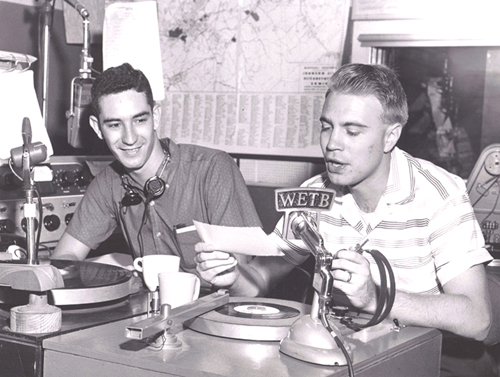
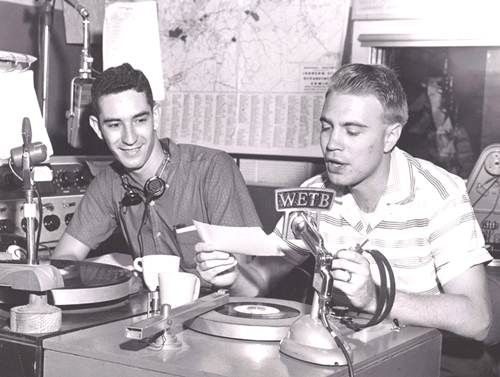
Between 1958 and 1961, listeners tuned to WETB AM-790 on their radio dials each weekday morning from 7 to 9 were treated to two young aspiring radio announcers, Joe Goodpasture and Merrill Moore.

The young men, hosts of a program known as The “Joe and Mo Show,” grew up across the street from each other on W. Pine Street in Johnson City in the 1940s. Because of their common interest in radio, they became best friends. They often went by WJHL studios when it was located on S. Roan Street where they were given reams of Teletype copy. They took these home and practiced reading them, pretending to be news broadcasters.

Merrill rigged up a small radio station at his house. It was made out of an old phonograph oscillator and had a turntable and microphone. The boys actually transmitted from the Moore house and could be heard over a three-to-four-house radius, allowing some of their neighbors to receive them on their radios.

This action attracted neighborhood youngsters who joined them by giving sports reports and scores, reading news, airing a woman’s show that included recipes and becoming disc jockeys. Since they had only two 78-rpm records, their listeners had to endure four songs over and over: ‘Humoresque’/‘Tales from the Vienna Woods’ by Guy Lombardo and ‘Too Fat Polka’ (‘She’s Too Fat for Me’)/‘For Me and My Gal’ by Arthur Godfrey. 

The path forward that produced the “Joe and Mo Show” began to emerge when Goodpasture’s family moved to Bristol where Joe worked at WFHG and WOPI while in high school. After enrolling at East Tennessee State College, Joe was interviewed for a part-time job by Burney Burleson, Program Director of WETB. Bud Kelsey was station manager. Joe was offered a full-time job, working as a disc jockey on the morning show.

Meanwhile, Moore who had previously worked at WETB before going into the Army had returned full time to the station after his discharge from service in 1958. He was assigned the morning news broadcasts. The stage was set for the arrival of “Joe and Mo” over the airways.

Burleson originated and promoted the new show with clever newspaper ads. Since none of the shows were scripted, the team had to react spontaneously. This is what made the program uniquely interesting.

The “Joe and Mo Show” began broadcasting from 7-9 o’clock each weekday morning. Its format was a combination of talk radio and popular music from such artists as Perry Como, Hugo Winterhalter, Patti Page, Tony Bennett, Johnny Mathis and Les and Larry Elgart. It was a carryover of the big band era.

Joe opened the station at 5:30 a.m. and served as DJ until it became time for the morning team to begin the show. Merrill had to break away from his microphone about 7:30 in order to prepare himself for giving the news at 7:45.

The show offered a variety of zany pretense. One routine involved Mo asking motorists driving by the station on the Erwin highway to honk their horns. If no one responded, Joe went to his car in the parking lot and started tooting his own horn. Then he ran over to Merrill’s car and blew his horn. Finally, he scampered over to Jeep Jones’ (station engineer) Volkswagen and honked it. Each time this was done, Mo said something like “Thanks folks for blowing your horn at us and have a great day.” 

Another hilarity from the show was the “Joe and Mo, Hoe and Row, Garden Club of the Air.” The young men decided to incorporate a garden club into their routine. They dug about a 2×4-foot flower garden in the front corner of the building near the parking lot. Both individuals routinely went outside to report to their listeners how the garden was doing, making up all sorts of problems that they were having such as locust attacks, blight and constant difficulty getting anything to grow.

Listeners often called the station to offer advice on how to address some of the growing concerns. On one occasion, two female fans of the show showed up at the station and planted flowers in the garden. They were taken back by the smallness of it. 

Another popular air spoof was the “Joe and Mo Bird Watching Society and Friends of the Feather Association. The duo walked outside and sought to locate exotic birds in the surrounding area. Many of the species they spotted did not exist, such as the Hubcap Sparrow that flew along beside cars viewing itself in the wheels’ shiny hubcaps. It required a lot of creative imagination to do a show like this.

An additional feature was giving traffic reports. One of them went out in the car to get coffee and donuts for the crew. While he was out, he reported on traffic conditions on the roads. That was usually a gag because there were essentially no traffic problems in Johnson City in the late 1950s.

Occasionally, Mr. You Knew Too, a famous Nationalist Chinese Ambassador to the United Nations, came by the station and chatted with Joe and Mo on the air. In actuality, the oriental visitor was Merrill performing the role, all the while speaking in broken English, while Joe carried out the amusing interview. There was no end to such merriment.     

The “Joe and Mo Show” made instant celebrities out of Goodpasture and Moore. They were asked to emcee two beauty contests, one being the Miss Johnson City Pageant and the other the Miss Rhododendron Festival on Roan Mountain.

Also, Burley Shoun, a Mountain City farmer, artificially inseminated a cow and it bore twin calves. He was such a fan of the two radio personalities that he named one calf Joe and the other one Mo. The Johnson City Press-Chronicle carried the story accompanied by a photo of Joe communicating with Joe and Mo fellowshipping with Mo. The caption humorously noted that Mo (the calf) was slightly fatter than his twin brother.

The popular “Joe and Mo Show” was on the air between 1958 and 1961. Its demise came when Goodpasture went into the Air Force. Shortly afterward, Moore left the station. Not surprisingly, the popular WETB disc jockeys went on to have outstanding broadcasting careers.   

Read more

A 1920 booklet titled “Did You Know? – Book of Facts, Household Recipes and other Valuable Information” from the Chattanooga Drug and Chemical Company promoted three health products and at the same time offered 20 pages of interesting reading.

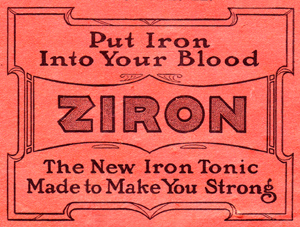
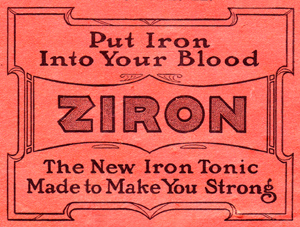
The main sales item was Ziron Iron Tonic, a medicine said to prevent diseases, not cure them. One user claimed that after taking two bottles of Ziron, she had more energy to do housework. “When I began taking it,” she said, “I weighed 129 pounds and now I weigh 140.”

Velvo Little Liver Pills were described as a purely vegetable remedy for problems associated with a “torpid liver.” A testimonial claimed, “I had a deep-seated cold and my liver did not act. I tried other liver pills (Carters Little Liver Pills maybe?) and did not do me any good. One dose of Velvo relieved me at once.”

Mentha-Col Chest Salve was sold as a refined, antiseptic, expectorant preparation, for external and internal use in coughs, colds, sore throat and simple chest troubles. An ad proclaimed that the product offered immediate relief to a little girl who was beset with chiggers, those annoying little red bugs found in wooded areas.

In a section titled “Games For Rainy Evenings” one amusement was called “It Is to Laugh.” A player was blindfolded and given a cane. The others joined hands and circled around him or her. The blindfolded person then tapped the floor for them to stop, pointed to someone and said “It Is to Laugh.” The selected person had to laugh without revealing his/her identity. If the person was identified, they traded places; if not, the blindfolded person tried again.

The newsy publication also contained 39 “Household Hints” such as preserving potatoes: “Dust the floor of the bin with lime; put in about six inches of potatoes; add more lime; and alternate in this manner. One bushel of lime was used for 50 bushels of potatoes. The lime was said to improve the flavor of the potatoes and prevent rotting.

“To renew a razor strop, apply clean tallow over the surface and work it in with the palm of your hand; then rub the (leather) strap with soft pewter or lead.

“To keep corn green, gather it with the husks on. Put a layer of salt in the bottom of a clean barrel, then add a layer of corn and alternate until the barrel is filled. Add another layer of salt and put on a weight on it. Make a little brine of salt and water, pour over the tip and set it cool place, being careful that it does not freeze. The corn will keep sweet and fresh the whole year. When you wish to use it, take off the husks and soak the corn for 24 hours in cold water.

“To test milk, procure a long, glass bottle. Cut a narrow strip of paper the length of the bottle from the neck to the bottom. Mark off the strip of paper with 100 equal parts and paste it on the bottle. Pour in the milk and let it stand. After the cream rises to the top, the number of spaces occupied by it will be the percentage of cream in the milk. It should occupy from 11 to 13 spaces.

“To cool a room, wet a large cloth and hang it in the room. Let the ventilation be good and the temperature will drop 10 to 20 degrees within an hour.” This might offer a possible solution to our energy crisis.”

And finally, one item dealt with how to determine a horse’s age by examining its teeth. Before three years old, the animal sheds one on each side of the center teeth. At four, it loses the two corner and last of the four teeth. At five, it cuts the under tusks. At six, the grooves and hollows begin to fill up and at eight, they are filled up.”

These informative booklets became a common fixture in area homes of yesteryear. 

Read more

About 1955, my dad sparked my interest in a unique leisure pursuit when he brought home a “Paint by Number” kit, consisting of two French city scenes. Each canvas was solid white and subdivided into numerous small areas, each containing a light blue handwritten number. In order to bring the picture to life, the artist had to paint it. The product was cleverly advertised as “Every Man a Rembrandt.” (Sorry ladies.)

The instructions said to match the paint color number with the pallet area number and apply the coat evenly without crossing lines. Over the next several weeks, I watched Dad meticulously transform both white canvas boards into beautiful works of art. He was proud of his creation and so was I, as evidenced by my displaying them on my bedroom wall for several years. 

Completion of a kit was not a frivolous overnight undertaking; it took weeks to finish one, especially if you planned to frame and hang it on a wall or use it as a gift. In actuality, its true value was measured by the person who painted it. Unlike watercolors that we became accustomed to as children, PBN kits utilized oil-based paint requiring the user to exercise caution so as not to get paint on everything. Brushes had to be kept in mineral spirits when not in use to prevent them from becoming dry.  

One trick was to chose a color and paint all the sections on the canvas that contained that number. Properly done, the beautifully dried painting was a testimony to the painter’s patient efforts. My first two paintings as I recall were “Blue Boy” and “Pinky,” popular subjects of that era. Neither of them ever graced anyone’s walls.

PBN kits did not enthrall everyone. Some critics viewed them as a form of mindless compliance of the masses by going through the motions of rote and expressionless labor that totally removed the painter’s creativity from the equation. However, others found the projects as intriguing introductions to painting for people not familiar with using oil-based paint.

In reality, the kits offered a sliding scale compromise between total creativity of painting freehand and having the security of a template. Many people deliberately altered the instructions and purposely painted over lines, removed specific objects from scenes and even changed color schemes, thus injecting a bit of imagination into the project.

The love affair with numbered paintings extended to the Eisenhower White House when then secretary Thomas Stephens collected PBN paintings from staff members and friends and displayed them in a West Wing corridor. 

The Paint By Number phenomenon originated in 1950 when a Palmer Paint Company employee, Dan Robbins, devised a clever way to help his business sell more paint. It came at an opportune time because postwar America was experiencing a sweet taste of the good life – free time, increased wages and a thirst for recreation.

After a rocky beginning fraught with numerous problems, the product experienced a meteoric climb in popularity, selling more than 12 million kits between 1951 and 1954. It was estimated that during this time American homes contained more PBN pictures than original works of art.

In the early 1990s, after several years of decline, the product came full circle and showed signs of popularity once again. Today, the do-it-yourself kits can be found in the craft section of some stores. Vintage paintings frequently are displayed in antique stores, rummage sales, flea markets and auctions thus demonstrating their longevity.  

Read more

Carol Simmons Archer is very proud of her late father, William Warren “Doc” Simmons and for good reason. He played a significant role in creating Johnson City’s Vocational Training program, which opened up a new world for high school students that were not college bound but needing an avenue for future employment.

According to Carol, “Dad was born in 1900 in the Powder Branch community of Carter County. Being one of 13 children, he spent his early life working on the family farm. He longed to enter college after high school to become a teacher, but his parents objected to his wanting to leave the farm and take up what they referred to as more ‘book learning.’ 

“Dad worked for nearby farmers and saved every penny he earned for his college tuition. After entering the local Normal School (ETSU), he traveled to the campus using a combination of transportation modes: walking, riding a mule to Milligan College and thumbing a ride on the back of some thoughtful farmers’ wagons. 

“While in college, Dad majored in Industrial Arts. He became a gifted wood craftsman and earned money by working at local lumber companies. Being a natural acrobat, he became a cheerleader. It was during this time that he met and married my mother, Dorothy.”

The future educationalist earned a BS degree from the Normal School and an MS degree from the University of Tennessee. After graduation, he taught at Junior High School on North Roan Street, which provided his family with enough income to build a house. He constructed a dwelling on Highland Avenue with his own hands.

Simmons later became principal at Keystone School. While employed there, he acquired the nickname “Doc,” a moniker that he would carry for the rest of his life.

“For years,” remarked Carol, “Dad spoke of the need for another avenue of learning for those students who preferred ‘hands on’ training over the traditional school curriculum. He believed vocational education was needed for those who wanted to begin earning a living immediately after high school. The concept never left his mind and he pursued every means possible to make it happen, including convincing the school board of its need. He also made numerous trips to Nashville to lobby for an additional educational training program.”

William’s efforts were rewarded when the board agreed with his proposal. About 1941, Martha Wilder School at Myrtle Avenue and New Street became Johnson City’s Vocation Training Center with “Doc” as its director. The school offered such crafts as welding, refrigeration, woodworking, masonry and auto mechanics. The self-made mentor remained at the school until his death in 1957.

The successful career program prevented some students from dropping out of school before graduating. Also, many area armed forces veterans took advantage of the training afforded by the center and acquired a skilled trade after their discharge from service.

Carol noted other glimpses of her father; he was an avid sports fan, highly sought after referee, official of the Burley Bowl Parade and devoted collector of area history. She recalls when he used to fire his pistol to start area high school football games. “Doc” received many honors for his contributions in local civic clubs, including being Lt. Governor for the Civitan Club and a member of Who’s Who in American Colleges and Universities.

Thanks to the pioneering efforts of William “Doc” Simmons, the vocational school tradition continues today at Science Hill Vocation/Technical Center with an expanded focus on academic and technical skills.  

Read more

Paul Gill sent me some material from his Weaver family genealogy that offered an insight into early Johnson City. His great grandfather, James David Weaver, was an influential builder in Johnson City. David, as he was known, was born on May 23, 1854 in Kingsport, Tennessee and later became an important businessman in Johnson City.

David attended Princeton School on what is now Princeton Road in North Johnson City. During his life, he became a blacksmith, contractor, architect and restaurateur. A Millard family who owned a farm located at 611 Mountcastle Drive raised him.


Paul recalls seeing the house before it was demolished. He described it as a beautiful two-story mansion consisting of 13 rooms that featured such upscale items as green marble fireplaces, leather wainscoting, covered ceilings and carved cherry woodwork. The red brick edifice featured a colonnaded veranda that was kept cool by several hundred-year-old oaks that surrounded the main house, carriage house and slave quarters. Even when the house fell in disarray a century later, it’s neglected and ruined finery still conveyed the quintessence of ante-bellum prosperity.

According to Weaver family genealogy, David is credited with constructing the Arlington Hotel, Jennings Building, Pardue/Windsor Hotel and the rectory of Munsey Memorial Church.

Weaver’s sons eventually followed in their father’s footsteps. One son, Charlie, built St. Johns Episcopal Church, Mayne Williams Library and Unaka Avenue Baptist Church, which he also helped establish. Another son, Fred, served as Johnson City’s building inspector for many years.

David Weaver co-owned and operated the Windsor Restaurant located at the intersection of the East Tennessee, Virginia and Georgia Railroad depot and Market Street. This site was likely situated where Idol Inn Café and later Byrd’s Restaurant stood. His business partner was James Wesley Scalf, an ancestor of Gladys Ledford Weaver.

David sold the eatery on Nov. 17, 1890. The deed read in part: “Know all men by these presents, that we, J.D. Weaver and Company of the town of Johnson City, Washington County, Tennessee, parties of the first part, of and in consideration of the sum of seven hundred two dollars and ninety eight cents, paid and to be paid as hereinafter stated, by L.O. Strain and W.H. Hallum, parties of the second part, of said sum, two hundred dollars in this day paid, the receipt of which is hereby acknowledged and the remainder to be paid in eight equal monthly installments …

The deed contained a surprisingly detailed listing of all property included in the transfer: “four sauce pans, one colander, nine pudding pans, six fry pans, two cake turners, one fryer, two flesh forks, two 14 quart beating bowls, one bed, one spring, one mattress, one pair blankets, one pair pillows, four comforts, one mirror, two washstands, one round table, two shades, three 10-foot extension tables, 46 chairs, two tables, two shades, one galvanized iron flue, one gasoline stove and three burners, one coffee boiler, one sauce pan, one dipper, one frying pan, …

“one large spoon, one cake turner, one dishpan, one six-quart bucket, one tea pot, one half-gallon cup, one large flesh fork, one potato masher, one half-gallon oil can, one rolling pin, one biscuit cutter, one meal sifter, five large spoons, one tin bucket, one bread pan, four joints of stove pipe, one heating stove and eight joints of pipe, one zinc stove board, two six foot show cases, 112 yards of carpet, seven dozen seven-inch plates, six dozen seven-inch deep plates, seven dozen fine hotel cups and saucers, seven dozen three-inch flat dishes, four dozen cream dishes, …

“one dozen sugar dishes, six dozen butter dishes, seven dozen five-inch plates, one-third dozen ice pitchers, seven dozen band tumblers, six dozen 26-inch trays, one crumb brush and tray, half-dozen cracker bowls, one-fourth dozen of mustards, two dozen peppers, two dozen salts, five-sixths dozen vinegars, five-sixth dozen syrups, one dozen pickles, half dozen celery stands, one dozen preserve stands, half dozen fruit stands, one-third dozen cake stands, two dozen egg cups, one dozen pat meals, six dozen ice creams, two 18-inch sq.meats and one half-dozen tooth pick holders.   

The deed concluded with the words: “In witness whereof the said parties of the first part have hereunto set their hands this the 17thday of November 1890.” Weaver died on March 3, 1924 and was buried in Johnson City’s Monte Vista Memorial Gardens. Paul Gill is proud of his Weaver family and has reason to be so. 

Read more

Three individuals, Gary Phillips, Dan Ward and Chris White, former Music Mart employees, shared memories of working at the Frick’s store once located on S. Roan Street.

Gary Phillips wrote first: “Bob, you might remember me as the kid who took over your Johnson City Press-Chronicle paper route around 1961 that included Lakeview Drive and surrounding streets.

“The summer after I graduated from Science Hill, I got a job working with the Fricks, repairing, cleaning and overhauling band instruments. I didn’t play any of them and had never been in a band, but Mr. Frick taught me what I needed to know to do the job.

“I started out making $.90 an hour and over four years worked my way up to $2 an hour. Those were great years working for the Fricks and, like you, I could tell many an anecdote on them. They were great folks to work for. I was there when they moved into the store next to their original store and worked there for probably a year or more.

“My in-laws currently live in south Johnson City off Roan Street and occasionally I’ll drive thru downtown on my way to their house. I miss seeing The Music Mart when I pass by there. So many great memories took place there.”

Dan Ward added his comments: Bob, in the fall of 1964, Gary Phillips called me and he asked me if I would be interested in applying for a part-time job at The Music Mart. Gary had started working there as a janitor, but Mr. Frick had promoted him to instrument repairman.

“I told Gary that I was interested in the part-time job but that I did not think that I would be qualified for a job at a music store because I did not play an instrument or read music. Gary told me to go ahead and apply for the job. Mr. Frick hired me and gave me Gary’s former job. 

“Henry and Mary Lou Frick were wonderful people to work with. They were hard workers, but they were very caring and compassionate. I performed various tasks over the next four years at The Music Mart, doing whatever needed to be done.

“I worked at the store in the afternoons after my classes at ETSU, all day on Saturday and full time during the summer. My salary from working there paid for my college education. After graduation from ETSU in June 1968, I continued working there until September 1968 when I went on active duty in the United States Army. The Fricks gave me a tape recorder when I went into service.” 

Finally, Chris White offered his remembrances:“Bob, your (Music Mart) columns resonated with me so powerfully and emotionally; it was very surreal. I too am a prodigal son of Mr. and Mrs. Henry Bond Frick. I worked part-time for the Frick's the entirety of my junior and senior high school years as well as my college years.  

“Mr. Frick was one of the most witty individuals I've ever met. The dryness in which he delivered his wittiness made him even funnier. He and I used to laugh together until literally tears formed in our eyes. With my young ‘green behind the ears’ naivety, Henry used to have a lot of fun with me, all in good spirit and humor. Each year he would ask Mrs. Frick: ‘Mummy,’ what day is Easter on this year? It was on Sunday last year.’ The man was hysterical. 

“I too, dressed and undressed the show window countless times with each seasonal theme. I also put thousands of miles on a vacuum cleaner in that store, as well as swept tons of waste off the sidewalks.

“Then there is Mrs. Frick.  She was a saint, dedicated to Mr. Frick, to her work, to superior customer service and to everyone around her. 

“Bob, I can't even begin to scratch the surface of the many wonderful and joyful memories I experienced during my time at “a sweet music store.”   

Read more

Louis Feathers grew up in North Johnson City in the 1920s and 30s, first on Lowell Street and then at four different addresses on nearby Baxter Street. During part of that time, the area was outside the city limits.

“I remember,” said Louis, “when our next door neighbors, the Meador family on Lowell Street had an Edison phonograph that played cylinder recordings. I even recall some of the selections I heard played: “Redwing,” “My Pretty Quadroon” and “Life’s Railway to Heaven.” Feathers experienced the rustic lifestyle of that era such as patronizing a hand dug wooden outhouse (a.k.a. “privy”) that sat out behind the house. He and his six siblings took Saturday night baths in a large laundry tub. In spite of such hardships, there were rewards of living in that era.

Louis further recalled, “Houses were built only on one side of Lowell Street. On the other side was a large cornfield. Just south of it was a large grassy hill that I heard was once part of a golf course before it was moved eastward to a new site at the Johnson City Country Club. Airplanes occasionally landed on the hill approximately 100 yards from our home. About a quarter mile from our home and beyond the field were Oakland Woods and Gump Woods. Those fields were great places for recreation.”

Louis’s father, Ezra, an avid coin and stamp collector, occasionally paid his paperboy with a rare coin that had a numismatic value approximately equivalent to the amount that he owed. “About 1927, my parents bought the home at 1021 N. Baxter Street,” said Louis. “This was to be our home for the next seven years. The Meadors were again our next-door neighbors during a part of this period.”

Louis indicated that when they resided on Lowell Street, their dad raised chickens, but after moving to Baxter Street, they had “rabbits, rabbits and more rabbits.” He estimated that they often had more than a hundred of the little critters at one time. An unpleasant task was for him and his brothers to clean out the rabbit hutch. The structure was designed to make cleaning easier, but it was still a chore. However, the droppings were in high demand by a neighbor who ran a truck farm.

Other rewards of living in that era were the wide-open fields in the area, which included many wild berry bushes and a large chestnut tree. Periodically, Ezra and his boys engaged in picking blackberries and dewberries (similar to blackberries except more spherical) after which Nannie would can them. With the depression and a large family to feed, preserving and storing food was a necessity. Ezra built his wife a rack of shelves for storage of hundreds of jars of canned goods in the basement space on their rear-sloping lot. The quantity of jars put up during the summer was a bragging issue among women at that time. In this competition, Mrs. Feathers was usually among the winners.

The house at 1021 Baxter was a small mansion compared to their previous home. Louis and his brothers playfully waxed and polished the hardwood floors by tying rags on their feet and skating all over the rooms. During the warm months, a large screened-in back porch just off the kitchen served as an extension of the living area and was the site of many of the activities associated with canning.

In subsequent years, the Feathers family lived in three additional Baxter Street houses: 1300, 1114 and 1116, the latter being the longest. I will feature more of Louis’s well-documented Johnson City memories in future columns. 

Read more

Recent issues concerning Memorial (initially called Roosevelt) Stadium at 540 E. Main Street evoke cherished memories from many older residents who attended SHHS football games and other sporting events there.

I fondly recall Dick Ellis’s play-by-play broadcast over WJCW radio of the Topper’s Friday night football games, Steve Spurrier’s spectacular quarterbacking years and Kermit “Little Tip” Tipton’s memorable coaching era.

SHHS football began in 1914. Fifteen years later, legendary coach, Stewart “Plowboy” Farmer, became head of the Hilltopper football program and remained at the helm until 1948, excluding the four war years when he served in the Army. Tipton was a star player for “Plowboy.” In 1946, the popular trainer again took charge of the football program for two additional seasons before wrapping up his illustrious career.

The Big Five Conference consisted of Science Hill, Dobyns-Bennett, Tennessee High, Elizabethton High and Unicoi County High. Coach Farmer won several league titles and is credited with putting Hilltopper athletics at the top of the heap.

In the mid 1930s, Farmer was honored for his coaching prowess with a parade in his honor that began at 2:30 p.m. on Lamont Street behind Hill-Summers Chevrolet Company and traveled up East Main Street into Roosevelt Stadium. That Friday was declared “Farmer Day” and the guest of honor was presented with an unspecified gift. Science Hill and Unicoi County high school bands participated in the festivities and squared off at 3:15 that afternoon on the gridiron.

Roosevelt Stadium was built between 1933 and 1935 during President Franklin D. Roosevelt’s New Deal. The facility was funded partially by WPA (Works Progress Administration) money, by city funding and from several people who offered $1000 loans to the project. Johnson Citians wanted a nice stadium and they got one. The sports complex was initially named after the 32ndpresident of the United States.

During the summer of 1947, the final year after “Plowboy’s” return, renovations were made to the football home of the fighting maroon and gold Hilltoppers. At that time, the school was located on top of the hill at Roan and Water streets diagonally facing the John Sevier Hotel.

Concrete stands were built north and south from goal to goal on both sides of the playing field, which provided for 8,000 seats. Also, the use of knockdown bleachers along each end zone further expanded seating capacity to 12,000. Other improvements were the installation of an electrically operated scoreboard and a new wide entrance along the north end. A field house was also planned for that year, but it was not ready in time for the opening game of the season.

Farmer’s returning lettermen in 1947 included Kenith Bryan (captain), William Haynes, Danny MaHaffey, Cad Shoun, Robert York and Ollin Clark. Those lost to graduation were Gene Arnold, Dick Booze, Jack Bible, Glenn Cox, Homer Bechtell, Bill Coleman, Johnny Carr, Robert Evans, Tom Hodges, Hartsell Lawson, Herman May, Eudy McKinney, Jim Speropulous, Tom Vance and Jim Whitmore.

The school’s 11-game schedule for 1947 included Mountain City (Sept. 12, home), Virginia High (Sept. 19, away), Knoxville City (Sept. 26, away), Morristown (Oct. 3, home), Tennessee High (Oct. 10, away), Knoxville Central (Oct. 17, home), Elizabethton (Oct. 24, home), Newport (Oct. 31, home), Erwin (Nov. 7, away), Kingsport (Nov. 14, home) and Landon High (Nov. 21, away, Jacksonville, Florida).

I plan to write additional articles on the teams that played under “Plowboy” Farmer.  

Read more

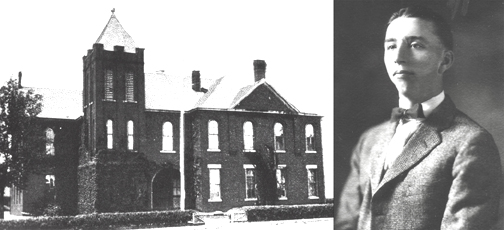
The start of a new school year is a time of moaning for some students and one of rejoicing for others. It also allows those of us who have long left the hallowed halls and ivy-covered walls to reflect on our favorite nostalgic memories. Such was the case on Aug. 29, 1965 when Dorothy Hamill, the late Johnson City Press-Chronicle writer, wrote an article about Cedar Creek Academy that once was located in the Gray community of Washington County.

Dorothy obtained her facts from A. Preston Gray, who resided in Kingsport and had attended the school. The original edifice consisted of a large room downstairs and a smaller one upstairs. The property was bordered on one side by a well-fenced farm and on the other by a dirt road. Preston quipped by saying that the road often provided the school with frequent student breaks, which occurred anytime a shiny horse-drawn buggy, log wagon pulled by panting oxen with bowed heads, or a threshing outfit went by. The latter caused the air to became permeated with the smell of wood smoke and hot cylinder oil.

Preston recalled two teachers. One brought his bicycle to school. It was the first bike that many of the children had ever seen before. During recess, the teacher rode the two-wheeler around the playground with youngsters following him like guards protecting a presidential car. Gray envied another professor because he could afford celluloid cuffs that rattled when he erased the blackboard.

Those were the days when zinc water buckets and dippers were standard equipment in schools. Brass-toed boots became badges of distinction for boys. Many youngsters carried an assortment of comic valentines for their sweethearts and sticks of white Long Tom Chewing Gum in their pockets.

Pranks were a regular occurrence such as throwing a musket cap in the pot bellied stove and watching it explode, inserting a pin in the folding seat, which gave out a mysterious ting when pulled out and filling a squirt gun from the water bucket and producing a sudden shower onto the blackboard.

The school maintained a tradition of planting trees on school property twice a year, once on Arbor Day and again at Christmas. In addition, the building became a platform for orators, such as the Tennyson Literary Society that met there on Friday nights.

Other sources of entertainment included listening to 78-rpm phonograph records of such recording stars as Ada Jones and Billy Murray, lectures by humorists Josh Billings and Eli Perkins and a performance from actor Bill Nye. Another popular event was attending “Magic Lantern” presentations. The device was capable of projecting slide images from plates onto a screen or wall. The subjects were generally travel logs.

“There was good music too,” Gray remembered, “with banjo, fiddle, harmonica and autoharp. One entertainment was held to raise money to supply a bell for the belfry; nickels, dimes, quarters and silver dollars came rolling in.”

In those days, teachers worked for very low wages. A principal once told Gray of asking for a raise from $19 to $20 a month and being rejected. Teachers routinely furnished erasers, crayons and wood for the stove at their expense. A school tradition was for teachers to treat students at Christmas; failure to do so meant a ducking in the frigid waters of nearby Cedar Creek.

Gray concluded his interview with Hamill with these words: “The only day I remember missing was when my teacher advised me to miss school and attend a circus at Johnson City. It was worth far more than a day in school.” 

Read more