Recent issues concerning Memorial (initially called Roosevelt) Stadium at 540 E. Main Street evoke cherished memories from many older residents who attended SHHS football games and other sporting events there.

I fondly recall Dick Ellis’s play-by-play broadcast over WJCW radio of the Topper’s Friday night football games, Steve Spurrier’s spectacular quarterbacking years and Kermit “Little Tip” Tipton’s memorable coaching era.

SHHS football began in 1914. Fifteen years later, legendary coach, Stewart “Plowboy” Farmer, became head of the Hilltopper football program and remained at the helm until 1948, excluding the four war years when he served in the Army. Tipton was a star player for “Plowboy.” In 1946, the popular trainer again took charge of the football program for two additional seasons before wrapping up his illustrious career.

The Big Five Conference consisted of Science Hill, Dobyns-Bennett, Tennessee High, Elizabethton High and Unicoi County High. Coach Farmer won several league titles and is credited with putting Hilltopper athletics at the top of the heap.

In the mid 1930s, Farmer was honored for his coaching prowess with a parade in his honor that began at 2:30 p.m. on Lamont Street behind Hill-Summers Chevrolet Company and traveled up East Main Street into Roosevelt Stadium. That Friday was declared “Farmer Day” and the guest of honor was presented with an unspecified gift. Science Hill and Unicoi County high school bands participated in the festivities and squared off at 3:15 that afternoon on the gridiron.

Roosevelt Stadium was built between 1933 and 1935 during President Franklin D. Roosevelt’s New Deal. The facility was funded partially by WPA (Works Progress Administration) money, by city funding and from several people who offered $1000 loans to the project. Johnson Citians wanted a nice stadium and they got one. The sports complex was initially named after the 32ndpresident of the United States.

During the summer of 1947, the final year after “Plowboy’s” return, renovations were made to the football home of the fighting maroon and gold Hilltoppers. At that time, the school was located on top of the hill at Roan and Water streets diagonally facing the John Sevier Hotel.

Concrete stands were built north and south from goal to goal on both sides of the playing field, which provided for 8,000 seats. Also, the use of knockdown bleachers along each end zone further expanded seating capacity to 12,000. Other improvements were the installation of an electrically operated scoreboard and a new wide entrance along the north end. A field house was also planned for that year, but it was not ready in time for the opening game of the season.

Farmer’s returning lettermen in 1947 included Kenith Bryan (captain), William Haynes, Danny MaHaffey, Cad Shoun, Robert York and Ollin Clark. Those lost to graduation were Gene Arnold, Dick Booze, Jack Bible, Glenn Cox, Homer Bechtell, Bill Coleman, Johnny Carr, Robert Evans, Tom Hodges, Hartsell Lawson, Herman May, Eudy McKinney, Jim Speropulous, Tom Vance and Jim Whitmore.

The school’s 11-game schedule for 1947 included Mountain City (Sept. 12, home), Virginia High (Sept. 19, away), Knoxville City (Sept. 26, away), Morristown (Oct. 3, home), Tennessee High (Oct. 10, away), Knoxville Central (Oct. 17, home), Elizabethton (Oct. 24, home), Newport (Oct. 31, home), Erwin (Nov. 7, away), Kingsport (Nov. 14, home) and Landon High (Nov. 21, away, Jacksonville, Florida).

I plan to write additional articles on the teams that played under “Plowboy” Farmer.  
Read more

The start of a new school year is a time of moaning for some students and one of rejoicing for others. It also allows those of us who have long left the hallowed halls and ivy-covered walls to reflect on our favorite nostalgic memories. Such was the case on Aug. 29, 1965 when Dorothy Hamill, the late Johnson City Press-Chronicle writer, wrote an article about Cedar Creek Academy that once was located in the Gray community of Washington County.

Dorothy obtained her facts from A. Preston Gray, who resided in Kingsport and had attended the school. The original edifice consisted of a large room downstairs and a smaller one upstairs. The property was bordered on one side by a well-fenced farm and on the other by a dirt road. Preston quipped by saying that the road often provided the school with frequent student breaks, which occurred anytime a shiny horse-drawn buggy, log wagon pulled by panting oxen with bowed heads, or a threshing outfit went by. The latter caused the air to became permeated with the smell of wood smoke and hot cylinder oil.

Preston recalled two teachers. One brought his bicycle to school. It was the first bike that many of the children had ever seen before. During recess, the teacher rode the two-wheeler around the playground with youngsters following him like guards protecting a presidential car. Gray envied another professor because he could afford celluloid cuffs that rattled when he erased the blackboard.

Those were the days when zinc water buckets and dippers were standard equipment in schools. Brass-toed boots became badges of distinction for boys. Many youngsters carried an assortment of comic valentines for their sweethearts and sticks of white Long Tom Chewing Gum in their pockets.

Pranks were a regular occurrence such as throwing a musket cap in the pot bellied stove and watching it explode, inserting a pin in the folding seat, which gave out a mysterious ting when pulled out and filling a squirt gun from the water bucket and producing a sudden shower onto the blackboard.

The school maintained a tradition of planting trees on school property twice a year, once on Arbor Day and again at Christmas. In addition, the building became a platform for orators, such as the Tennyson Literary Society that met there on Friday nights.

Other sources of entertainment included listening to 78-rpm phonograph records of such recording stars as Ada Jones and Billy Murray, lectures by humorists Josh Billings and Eli Perkins and a performance from actor Bill Nye. Another popular event was attending “Magic Lantern” presentations. The device was capable of projecting slide images from plates onto a screen or wall. The subjects were generally travel logs.

“There was good music too,” Gray remembered, “with banjo, fiddle, harmonica and autoharp. One entertainment was held to raise money to supply a bell for the belfry; nickels, dimes, quarters and silver dollars came rolling in.”

In those days, teachers worked for very low wages. A principal once told Gray of asking for a raise from $19 to $20 a month and being rejected. Teachers routinely furnished erasers, crayons and wood for the stove at their expense. A school tradition was for teachers to treat students at Christmas; failure to do so meant a ducking in the frigid waters of nearby Cedar Creek.

Gray concluded his interview with Hamill with these words: “The only day I remember missing was when my teacher advised me to miss school and attend a circus at Johnson City. It was worth far more than a day in school.” 

Read more

Lynn Williams, former WBEJ chief engineer, recently reminisced about local radio stations in the 1930s and 1940s, including his affiliation with the Elizabethton station.

According to Lynn, “The first broadcast in the East Tennessee area was WOPI in Bristol on June 15, 1929. My family didn’t have a radio, electricity, or other things considered essential today. I first heard the station’s programming at a neighbor’s house in 1932, but it wasn’t until 1938 that my dad purchased a used Philco battery-powered floor model, exposing me to the world of radio.”

Lynn sent me a list of 248 radio affiliates that were transmitting about 1940. Seven cities and eleven stations in Tennessee were shown: Johnson City (WJHL), Bristol (WOPI), Kingsport (WKPT), Knoxville (WNOX, WBIR, WROL), Nashville (WSM), Chattanooga (WAPO) and Memphis (WREC, WMC, WMPS).

Many radio broadcasts in that era featured live programming. “Hillbilly” music became the rage with the populace after XERA, a powerful station located in Mexico just across the border from Laredo, began playing this musical genre all across the country by such old-time music groups as The Carter Family.

WBEJ entered the expanding market on the evening of July 18, 1946 with a special remote broadcast from the Franklin Club. A young Bill Hale was control board operator that night. Those present were station owners, Mr. R.W. Rounsavilleand George Clark, staffmembers and several well-known personalities from Elizabethton and adjoining areas. A new era for Northeast Tennessee dawned with that broadcast. Frank White (“The Old Guide”) and Bill Marrs (“Professor Kingfish”) proclaimed a decade later over WBEJ: “It was like a ten dollar rug; you couldn’t beat it.”

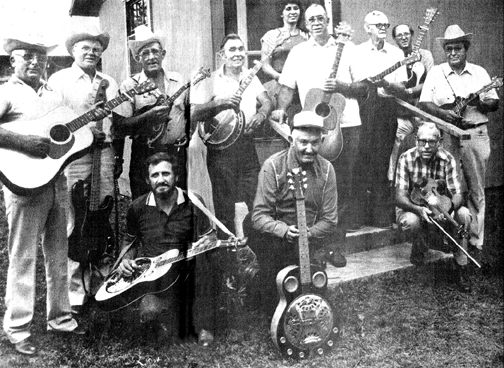
“For many years,” said Lynn, “groups of local musicians gathered at various places to “pick and grin.” My musical cousins and I performed locally that included performances on WJHL’s popular ‘Barrel of Fun’ program, initially broadcast from Kingsport and later at Elizabethton’s Bonnie Kate Theatre.”

Lynn recalled an important day in his life in 1946. He and a cousin were playing music on the front porch of his home at the corner and S. Main and Third streets. A young man whose name he cannot recall came walking across the Covered Bridge and stopped to listen to their music. He asked them if they would be interested in playing music for the new radio station being built in town when it became operational. They sent him back to the station with a resounding “yes” reply and promptly received an invitation for an audition. Someone suggested that they invite Paul Buckles to play with them and he too was receptive to the offer.

Buckles; his wife Aileen; T.N. Garland, a rayon plant coworker; Lynn’s cousin, Howard “Doc” Williams; the mystery lad; and Lynn assembled at Paul’s house on Elm Street to work up some numbers for their try-out. 

Lynn further wrote, “We went to the WBEJ studio and ran through several numbers. Bill Lowery, the station director, was very impressed and asked us to come back in another week. Regrettably, the young lad was excluded from the invitation, but he accepted the news okay. We used the extra time by meeting several more occasions for practice. It was then that another person, Norman ‘Curley’ White, joined our band. He had been performing on the ‘Barrel of Fun’ show since it first aired.

“We went for our second WBEJ audition and this time the control room was crowded with people who were there to listen to us. When we finished, they rushed enthusiastically into one of two front studios. Lowery offered us the 6-7 a.m. weekday slot, but I told him that an hour was too much for one band to perform and that we would be repeating songs. I suggested that 15 minutes would be the desired length. He agreed. Although we received no pay from the new station, we were permitted to advertise our show dates.

“Bill asked us if we had a name. Some of us had been calling ourselves, The Green Valley Mountaineers, a name I thought of earlier. We changed it to The Green Valley Boys, although Aileen was obviously not a boy. We went on the air Friday morning, July 19, 1946 at 6:15 a.m. for 15-minutes.

“A WBEJ script detailed our introduction: ‘It’s the Green Valley Boys. (Theme). Good morning, good morning. It’s time for some friends of yours to drop over for a quarter hour visit. It’s Paul Buckles and the Green Valley Boys, featuring the Williams Brothers, Little Dolly and all the Green Valley Boys.’ (Theme). ‘And now, here he is, that man of the morning, Paul Buckles. Paul, good morning. (The announcer handles the show from here until conclusion with the exception of the spots. The band plays five selections.) (Theme). ‘Well, there they go, Paul Buckles and all the Green Valley Boys. They’ll all be back tomorrow, same time, same station and we hope you’ll be listening.’”

Three additional bands played that morning: Conley Smith and the Blue Springs Ramblers, Rondald ‘Runt’ Collins and the Stringtown Ramblers and Don Smith and the Melody Boys with Betty Hazlewood. Our announcer was usually Bill Huddleston. Curley White often featured songs made popular by Bob Wills and Tex Ritter.

“Eventually, a fifth group, Uncle ‘Dud’ and the Mountaineers, joined our early morning gang. They were very professional, having been a part of J.E. Mainer’s Mountaineers performing on radio for several months prior. Before WBEJ’s signing them on the air, they were working at WJHL. Their popular program could be heard in town by merely standing on Elk Avenue and listening to automobile radios as they passed by.

“On Saturday mornings, the WBEJ musical groups and others that were not on the radio assembled at the studio for a jamboree-type get-together that was hosted by Bill Lowery. There was also a Saturday night show that was broadcast for a while from the Tennessee Theatre in Johnson City. For orchestra music lovers, WBEJ provided a weekly program from the ballroom in the Lynnwood Hotel in Elizabethton across the street from the studio.”

Lynn’s experience playing old-time music for WBEJ led to a long and colorful career with the station beginning in 1948 when he was hired as a transmitter operator engineer. He left the station in 1983 when it changed ownership. Paul and Curley became announcers; Curley also became a well-known country deejay. 

Read more

I was saddened by the passing of Sue Eckstein this past June. She became an ardent supporter of my “Yesteryear” column by acquainting me with numerous local history sources, including a bulky scrapbook that once belonged to her father, Paul Carr, who with his brother, Sam, owned Carr Brothers, Inc.

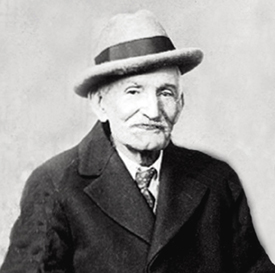
One clipping in the massive well-worn musty volume dealt with the demise in Morristown of old-time Civil War fiddler, Uncle Am Stuart (Ambrose Gaines Stuart; Aug. 24, 1853 –Mar. 17, 1926). My great uncle, Fiddlin’ Charlie Bowman knew and highly respected the gifted musician.

Am, who was born in Bristol, TN., learned to play the fiddle at an early age, eventually acquiring a vast song repertoire ranging from the trauma of the Civil War to upbeat mountain tunes of indigenous Appalachians. The old-time musician began displaying his special brand of acoustical music to family members, Saturday night gatherings, county fairs and local fiddle contests. He later married Fannie Nelson of Morristown; the union produced three children.

Uncle Am came from a colorful family. His brother, George R. Stuart, was a well-known evangelist. He; Sam P. Jones, another renowned revivalist; and Thomas Ryman, a riverboat captain, joined forces to hold massive revival meetings in Nashville’s Union Gospel Tabernacle. When Ryman died in 1904, Jones and Stuart conducted his funeral service in the spacious building and on that same day renamed it the Ryman Auditorium, future home of the Grand Ole Opry.

Ambrose possessed a trait not usually found in celebrated musicians. He was unassuming, not bent on winning awards or receiving publicity. According to the article, “he devoted much of his time to playing the witching old melodies for the enjoyment of others and getting tremendous pleasure out of it himself.”

Stuart began his illustrious career with Vocalion Records and ultimately recorded sixteen 78-rpm records. Some of the tunes he played were “Old Liza Jane,” “Cumberland Gap,” “Grey Eagle,” “Forky Deer,” “Sourwood Mountain,” “Wagoner,” “George Boker,” “Leather Breeches,” “Dixie,” “Old Granny Rattletrap,” “Rye Straw” (aka “Unfortunate Pup”) and “Sally Goodin.”

For many years, Am was affiliated with the Mosler Safe Company. Just a short time before his passing, he was awarded first place in a contest in the nation’s capital that featured 26 of the best old-time fiddlers in the country.

Also, Am had just signed a contract to appear with the Swartmore Chautauqua, a Pennsylvania based traveling tent show that operated between 1912 and 1930. The offerings consisted of a combination of vaudeville acts, theatre productions, lectures from well-known people and Bible sermons from famous preachers of that era.

Stuart’s passing did not go unnoticed. Crowds of people who thronged the Morristown Baptist Church showed their appreciation for him at his funeral. The service was conducted by the church pastor, Rev. J. Harvey Deere and assisted by Rev. F.H. Hay of the Morristown Presbyterian Church and Dr. S.B. Vaughn of the nearby Methodist Church.

Perhaps the most eye-catching item at the funeral was a flora offering comprised of a huge basket of flowers that surrounded a decorated fiddle and a broken bow. Like the beloved acoustical stringed instrument that he loved so much, his music was silenced on that sad 1926 day. Fortunately, many of his records were preserved for future generations of music devotees.

I will further honor Sue Eckstein with additional material from her local history treasures in future columns. 

Read more

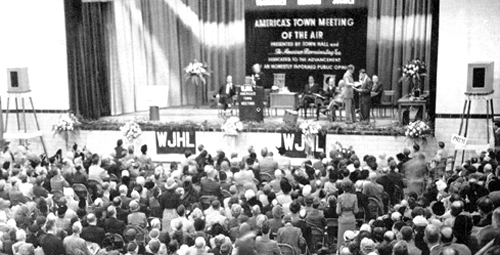
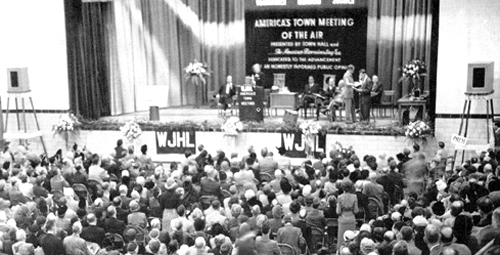
A 1952 Buccaneer, East Tennessee State University’s annual, contains a photo showing “America’s Town Meeting of the Air,” a remote radio broadcast from the college’s Memorial Gymnasium.

The show was broadcast live first on NBC then ABC radio from May 30, 1935 until 1956. It originated from New York City's Town Hall. When the program debuted for a six-week trial run, there were only 18 NBC affiliates carrying it. That soon changed and the show ran another 21 years.

The subject of the first show was: “Which Way America: Fascism, Communism, Socialism or Democracy?” George Denny Jr., Executive Director of the organization that produced the show, served as moderator for 17 years.

The producers desired to create a series that would replicate the successful town meetings from the early days of the country. Denny believed the program would attract the public’s attention, stimulate their interest and involve them in complex issues of the day.

By broadcasting at remote locations across the country, the program made it possible for listeners to attend and participate in the discussions. Interesting invited guests, both controversial and incontrovertiblebecame regular guests on the show. People outwardly expressed their feelings on heated subjects by applauding and cheering when they agreed and hissing and booing when they were in disagreement. The offering proved very successful.

The gym photo of the one-time event in Johnson City shows eight people on the stage with one person positioned behind a podium displaying a sign that declares, “WJHL – America’s Town Meeting.” Two additional signs with the letters “WJHL” hang on the side of the stage.

The floor is crammed with an equal mix of men and women sitting in folding metal chairs with not an empty seat to be found. Also filled are the side bleachers plus a few people overflowing into the seats above them. The crowd is well attired with men in suits and ladies in dresses.

Two elevated speakers are positioned on the floor at each side of the stage, which is adorned with seven large bouquets of flowers. A “Press” sign can also be seen on the floor at the far right.

A massive banner hanging at the rear of the stage reads, “Tolerance, Reason, Justice; America’s Town Meeting of the Air, Presented by Town Hall and the American Broadcasting Company, Dedicated to the Advancement of an Honestly Informed Public Opinion.

I contacted Herb Howard, early WJHL radio and television announcer whose senior picture was also in the annual, to see if he recalled the program. He responded, “I do remember very well ‘America's Town Meeting of the Air,’ which was a weekly public affairs program produced and broadcast by ABC Radio.

“The government forced NBC to sell its Blue Network in 1943. It became known simply as ‘The Blue Network’ until it acquired the name ABC. WJHL invited the American Broadcasting Company to do one of its weekly debate-like programs in Johnson City, becoming the first performance of any kind in the “new” gymnasium on ETSC's campus. WJHL provided the announcers.

“Ed Cowell opened the program by ringing a hand-held bell and shouting out, ‘Town Meeting Tonight, Town Meeting Tonight.’  I was asked to do the straight intros and two or three public service announcements. This was my first experience on a national radio network. They sent me a $25 check for services.”

In its waning days, Denny struggled to keep the program’s focus on openness and objectivity after it became a heated grievance session. The show was dropped in 1956.   

Read more

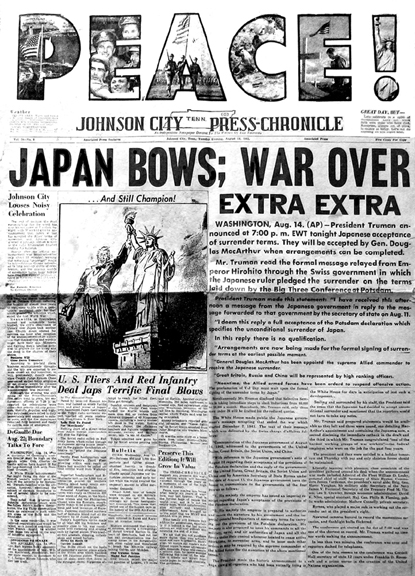
The August 14, 1945 Johnson City Press Chronicle headline with “PEACE” written across the top of it in large bold letters said it all: “Japan Bows; War Over” – Washington, Aug. 14 (AP) – President Truman announced at 7:00 p.m. EWT (Eastern War Time) tonight. – Japanese acceptance of surrender terms. They will be accepted by Gen. Douglas MacArthur when arrangements can be completed.”

The event would become known as “V-J Day.” The yellowed with age and frayed paper went on to say: “The Press Chronicle suggests you preserve this war-end edition, which will become valuable through the years as a memento of one of the high points of history. Peace, now coming into being after nearly six years of warfare may last forever. This is the fervent hope of people the world over and is not an empty hope. World collaboration plus military and scientific achievement have brought us to the point that we must and shall live in peace”. Fortunately, my dad complied, saving the entire newspaper.

Although the First World War was supposed to be “the war to end all wars,” it failed to do so. Why then were we naive enough to think the second one would bring lasting peace for all mankind. The Korean conflict punctured that fragile bubble within a few years.

The cost of the global war was high in several respects. From Pearl Harbor to V-J Day, 16 million of 160 million Americans were in uniform; 400 thousand lost their lives; and 700 thousand were wounded. The entire world celebrated the end of fighting especially the military personnel who played an active role in the bitter clash.

Johnson City conducted its own celebratory party. According to the paper: “Shortly after the official announcement was broadcast, after only about 10 minutes warning that something important would be told, Johnson Citians unleashed its long pent-up spirits and the raucous sounds of automobile horns, boys’ bicycle bells, whistlings and wahoos started in earnest. The first signs of celebration were heard in the western end of town.

“Meanwhile, as firecrackers popped and automobile horns blasted, the cities observance of victory over Japan took another line. Church doors opened for services one hour after reception of the announcement at 8:30 p.m. so that thanksgiving and worship might have their day. Ministers and fighting men's families gathered in prayers for the living and the dead in churches of their choice.”

I vaguely remember the exciting event. Grandpa Cox took Grandma, Mom and me for a ride in his “old brown Dodge,” as the family called it. We drove all over town celebrating with others the end of the war. Vehicular horns were blaring everywhere. My assignment was to sit on Grandpa’s steering column and blow his horn.

I truly did not understand what was happening; the war was over and servicemen were coming home. My grandparent’s son, my mom’s husband and my dad would soon be on his way to Johnson City. Although I was too young to remember him when he went into service, I routinely “wrote” him through Mom’s letters.

Although to some extent I recall the festivities surrounding V-J Day, I have no recollection of any commemoration associated with V-E (Victory Over Europe) Day on May 8, 1945, probably because of my age. 

The reality of the war’s culmination for me came a few months later when a handsome young man wearing an OD (Olive Drab) green uniform and carrying a large duffle bag anxiously entered our front door Gardner Apartment into the waiting arms of his loving wife.  

Read more

My recent article concerning a 1964 opening day program of Johnson City’s Little League Baseball sent to me by Doug Bernardi prompted a letter from Alf Taylor.

“Your recent article on the Johnson City Little League,” said Alf, ‘stirred some memories.’ I was involved in the early days in the formation and coaching of Little League baseball in Johnson City.

“I remember four teams and only one league the first year: Pet Dairy, Leon Ferenbach, Courtesy Motors and Hill-Summers Chevrolet. I coached Hill-Summers Styleliners. Coach Madison Brooks (former basketball coach at East Tennessee State University) coached the Pet Dairy Pets; Ben Pollack coached Leon Ferenbach.”

Taylor recalled playing games at Soldiers Home (later called Mountain Home and eventually the Veterans Administration). He indicated they rolled out and put a snow fence in the outfield and “stepped off”’ the bases.

According to Alf, “We had uniforms, which were pretty neat in those days since most of us had grown up playing ‘sand lot’ with ‘unies’ (uniforms). Parents of players were helpful back then and not critical of others. I was out of my league coaching against such fine athletes as Coach Madison Brooks and Coach Ben Pollack. Al Meade soon joined me in coaching and we had a great time.”

Taylor indicated that the most noteworthy things he remembered about the infant days of Little League were the individuals involved in the game: “John Gilligan umpired and he was great. Coach Brooks was not only a fine Christian example but also a fine athlete, as was Ben Pollack. During our first season, we ended up on top not because of my coaching ability but because we had Jimmy Edwards, a big left-handed pitcher.

“Some of the other players I remember on the Styleliners were Jimmy Conley, Bob Taylor and Larry Bain. Although Bain was only eight years old and so tiny his catcher’s equipment dragged the ground, he ‘caught’ Jimmy Edwards. Everyone else was afraid to ‘catch him’ because he threw so hard. The other teams were also fearful of Jimmy, which is why we won so many games.”

Alf recalled that sometimes after the team practiced in a muddy field, he hauled the players home sitting in the trunk of his car to keep them from tracking mud inside his vehicle. He said the boy’s parents did not seem to mind his doing that.

Alf gave honorable mention to several players that he referred to as “naturals”: “Ben Pollack came up with the Crigger brothers, Larry and Jerry. Those guys were born with a ball, bat and glove in their hands. They were not only good boys but so coachable and very disciplined. Coach Brooks had Johnnie Brooks, a natural athlete, and later on he acquired Wayne Miller and the Sanders brothers, Jim and Bob. Afterward, I coached Pat Wolfe who was the most perfect gentleman and a great athlete. His dad brought him from below Jonesborough to every game and practice.

“You article mentioned Wayne Burchfield. One day, while we were practicing out behind the power plant at ETSC (later ETSU), he showed up for practice. I picked up a glove and ball and invited Wayne to ‘throw a few’ with me.’ The first ball he threw nearly knocked me down. Wayne wasn’t as big as a peanut, but he threw the hardest I had ever seen for a little guy. He had one speed – fast and hard. I never made the mistake of ‘tossing’ with him again.”

Alf concluded his letter by hoping that other former Little League players and coaches would share their memories about the game as well. Please e-mail them to me and I will forward them to him. 

Read more

On July 3, 1945, the Daily News of New York City sold only 106,000 papers instead of its usual 3 million copies because it and 13 other dailies were at odds with the Mail Deliverers Union. This caused 1,700 people to go on strike.

Mayor Fiorello H. LaGuardia, sympathetic with children and adults who missed their daily comic strips, began reading them over radio station WNYC. On one broadcast, he said: “Now children, I know you are all disappointed today that you didn’t get the funnies, so gather around. Ah, here’s Dick Tracy. Let’s see what Dick Tracy is doing. …”

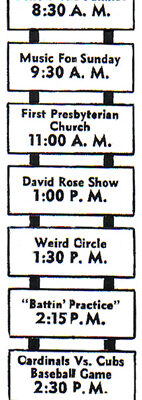
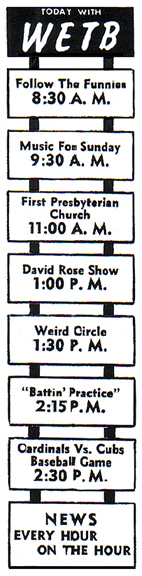
In 1948, WETB-AM 790, owned by Johnson City Press-Chronicle, broadcast its version of radio comics with a program titled, “Follow the Funnies.” The concept was to bring newspaper comic characters to life through the medium of radio. Seven people figured into the early offering: Ray Moore, Patty Smithdeal Fulton, Lee Archer, Newbill “Will” Williamson (copy editor for the Johnson City Press), Bill Snitger (known as Bill Dunn), Merrill Moore and Jim Pendergast.

I contacted Merrill and Patty to see what they remembered about the show that featured such comic strips as ‘Blondie,’ ‘Captain Easy,’ ‘Little Orphan Annie,’ ‘Lucille Sweeney,’ “Joe Palooka,’ ‘Dick Tracy’ and others.

According to Merrill, “It was a taped half-hour show that came on every Sunday morning at 8:30 a.m., about the time people would be reading their morning newspapers. Ray Moore instigated the program. He and Patty were initially the main voices behind the show. I was happy to join them because this was the first time I had been on radio. We said to our listening audience: ‘Ok kids, go get your Johnson City Press-Chronicle and put it on your bed or on the floor and let’s follow the funnies this morning.’”

“We used the same story line from the newspaper, except we acted the dialogue rather than reading it. We added sound effects everywhere we could. Ray provided music intros and closures for each comic strip. His transcriptions and music for each funny were probably the most professional part of the show. We experimented with our voices and changed the pitch to achieve certain comic strip characters.

“Those were the days when there was little thought to saving shows for the future so we routinely taped over previous ones. Another problem was that we used acetate film, which was easily breakable. About the only sounds salvaged were Ray’s comic strip openings and closures.

 Patty added her memories of the show: “We taped the program on Saturday afternoons before Sunday airtime. We often broke into laughter while doing the show and had to redo it. It took us from one to two hours to tape each show, depending on how much fun we were having. We used a tape recorder, which was an improvement over what we had when I majored in radio at Stephens College in 1947. We cut discs at 33.3-rpm speed.

My office was in the Johnson City Press-Chronicle building on W. Main Street where I was copywriter and Director of Women’s Programs. I did a morning show from a broom closet.”

Patty recalled when Ray thrilled a young Merrill Moore by permitting him to come into the control room, cue a record for a sound effect and start it when prompted. At the time, Bud Kelsey, future station manager, was in college on the GI bill and working at the station in sales.

“When Ray Moore left WETB,” said Patty, “he got a job with WSB-AM in Atlanta and later moved to WSB-TV. He was offered a job with NBC but elected to remain at the station in Atlanta. In 1985, he was inducted into the Georgia Association of Broadcasters Hall of Fame.”

“Follow the Funnies” entertained its listeners for about a year and a half before it was cancelled.   

Read more

The Gump name stands tall in the annals of Johnson City history. A perusal of several old city directories yielded a myriad of Gump businesses over the years: A.S. Gump & Co. (Abraham S. Gump), Gumps (Martin I. Gump), Gump Brothers Clothing (Harry D. and Louis D. Gump), Gump’s Wholesale Grocery (Martin I. Gump), Gump Investment Company (Louis, Harry, Jay and Alan Gump), Bert Gump Insurance and Bert Gump Real Estate.

An area in north Johnson City, originally known as the H.D Gump Farm and later Hillrise Park subdivision, became what is today referred to as the Gump Addition. Mr. Harry Gump acquired the property consisting of 100 acres on Oct. 25, 1907 from Carnegie Realty Co. and Carnegie Development Co. The lengthy deed, written in typical land vernacular of that era stated:

“That boundary where the road, leading to and being near Holston Avenue and Baxter Street, crosses said branch; thence South 2 degrees 20’ West 494 feet to a set stone, … thence N 22 degrees 20’ W to a stake in the center of New Street, between Fifth and Sixth Avenues; thence with the center line of New Street in northerly direction to the center line of Sixth Avenue of said Addition; thence east with said center line of Sixth Avenue to the center line of High Street, …”  

 The Gump family is credited with another accomplishment – the naming of a number of streets in the Keystone community. The information came from the late Jay L. Gump, whose father and uncle bestowed the names to the streets.

In 1912, Harry D. and Louis D. Gump bought 132 acres in the designated area. They acquired the property from Mrs. Alice Earle who had obtained it from her father, A. Pardee Jr., builder of the narrow gauge railroad that brought iron ore from Cranberry, NC to the furnace in Johnson City.

A current map of Johnson City verifies some of the information found in my history archives. The land in question comprises 12 streets encompassed by East Main, Bert, Orleans and Broadway. Streets running parallel to E. Main are Pardee, Cranberry, Dyer, Colorado, Bettie and Orleans. Those running perpendicular to E. Main are Bert, Mary, Jay and Alan.  

Harry and Louis, deciding to subdivide the land, named it Keystone because both men were born in Pennsylvania, the Keystone State. Then, with city engineer, W.O. Dyer, they began systematically laying out streets and assigning names for them. They decided to start by using the first names of their children in the order of their birth.

The first two named were Bert and Mary streets, the children of Harry Gump followed by Jay and Alan streets, the sons of Louis Gump. Having quickly exhausted the names of their children, the Gump brothers then picked other appellations that they deemed fitting. Pardee Street came from the name of the original owner of the property, while Cranberry Street represented the Cranberry mines and furnace.

Dyer Street was named after the city engineer. Colorado Street was chosen because the brothers and their family had moved to the Centennial State from Pennsylvania and grew up there. Harry and Louis had their first jobs in Colorado working in a men’s clothing store. One more street in the Keystone grid needed a name; this time the oldest grandchild, Bettie, the daughter of Bert was picked.

After the naming process was complete, the brothers divided the land into lots and sold them to individuals.

Today, the Gump Addition and the nine Keystone streets serve as reminders of a family who has lived and worked in Johnson City for over 125 years. 

Read more

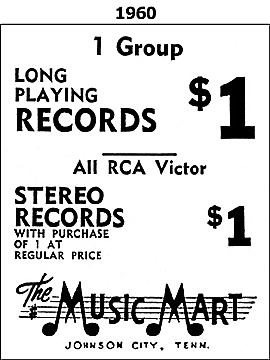
Four Responders Reflect on Frick’s Downtown Music Mart

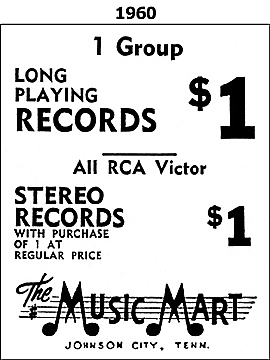
 My recent Music Mart article brought response from four people, Robert Bowman, James Edens and two people identified only as Mr. A and Mr. B. 

Mr. A stated, “Henry Frick was a perfectionist, an intelligent merchant and a skilled craftsman who demanded nothing less from his employees. Nevertheless, he was a compassionate gentleman whose place of business reflected his noble character.  Area piano teachers and bandleaders knew where to go for all their music-related needs: the Music Mart.”

Robert Bowman, who worked there from fall 1963 until spring 1966, remembered the close-knit couple “coming back from lunch, hand-in-hand, like high school sweethearts, usually bringing with them a new idea for the business.”

“Since it was the Music Mart on which band members from most local schools relied for upkeep of their instruments, Henry and Gary Phillips were kept steadily busy as repairmen six days per week.

“As a courier, I spent many hours out of the store, getting defective instruments to the post office for safe shipment to the appropriate factory, chauffeuring the youngest Frick daughter on designated Saturdays, getting Frick's car washed and picking up the family's dry cleaning.”

In my first article, I noted Henry’s unique dry humor. Robert supplied another example: “I was also responsible for dusting instruments and displays. One day, Mr. Frick approached me and said ‘Are you saving this dust for any reason?’

“Gene Young traveled throughout northeast Tennessee and southwest Virginia to elementary, junior high and senior high schools, collecting defective instruments and delivering restored ones. 

Bowman's successor and former neighbor, James Edens, made this comment: “You could set your watch by Gene's arrival. When that van pulled in, it was about time to lock up and go home.”

“Toward closing time each day,” recalled Robert, “every staffer was assigned to put vinyl records back into their proper sleeves after listeners usually left the discs in disarray. The store had private audition booths equipped with headsets that were liberally used by many junior high, senior high and college students.

An anonymous former hired hand, Mr. B, recalls the entire staff taking inventory annually on January 1: “The unpleasantness of this unwelcome ritual quickly subsided when Mr. Frick treated us mentally tired laborers to a delectable meal at the Dixie Drive-In Restaurant. The only negative element of these dining experiences was our boss man's insistence on celebrating the new year by every one eating black-eyed peas. I nearly choked.”

“Perhaps Mr. Frick's tolerance toward all youth,” said Bowman, “including those happy-go-lucky ones who often ‘parked’ in the sound booths for extended time spans, can be attributed to his hope that some of the hearers would become players, transforming mayhem to melody. From the wise man's perspective, negative behavior of these non-buyers, whose loud conversations distracted customers, might be eventually channeled into desirable activity, such as mastering a horn or a keyboard.”

Robert concluded with picturesque words: “A stroll down South Roan Street today yields no vestige of the little Music Mart. Yet, in the mind's eye, one can imagine the enterprising Henry puffing on his pipe, each smoke ring signaling an innovation for his beloved store while his soul-mate flashes a sweet smile of concurrence.” 

Read more