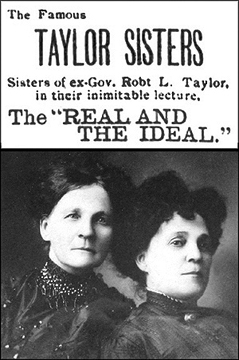
Brothers Bob and Alf Taylor, the “War of the Roses” campaigners in Tennessee’s 1886 colorful, often lighthearted, gubernatorial race (in which Bob won), are also remembered for their humorous lectures in theatres across the land.

Bob (the white rose wearing Democrat) known for his famous “Fiddle and Bow” delivery and Alf (the red rose adorning Republican) remembered for his clever “Up Salt River” address, occasionally joined forces for a shared talk that bore the name, “Yankee Doodle” (Alf) and “Dixie” (Bob).
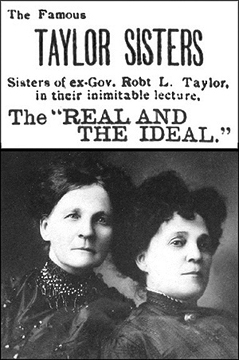
Some old newspaper clippings from 1902 spoke of two additional members of the multitalented Nathan Green and Emma Haynes Taylor family who also shared a speech and traveled on the lecture circuit.  They were Mrs. Rhoda Taylor Reeves and Mrs. Eva Taylor Jobe, twin sisters of Bob and Alf. The names Reeves and Jobe shine prominently in Johnson City history. Like their witty, creative siblings, they composed a clever dual act presentation that carried the title, “The Real and the Ideal.”

The Richmond Dispatch announced in February that year that the Taylor sisters would appear in Bristol, Tennessee under the auspices of the ladies of State Street Methodist Church. The address was a fundraiser for the benefit of the church, which needed  $12,000 to remodel the facility. The paper acknowledged that Mrs. Jobe and Mrs. Reeves were twin sisters of Bob and Alf Taylor – “The Taylor sisters expect to prove worthy rivals in the lecture field of their now famous brothers. Their dual lecture deals with two sides of human life, the real and the ideal and is said that they have a very able and brilliant dual production, which they deliver in interesting manner.”

In May, the Hopkinsville Kentuckian contained news that the ladies would present their lecture at the local Holland Opera House. In that same newspaper, it was also disclosed that Governor Bob Taylor would be in town that week as a stopover of his lecture tours. The century-old newspaper further gave an extract of the twin sisters’ talk that was taken from an editorial notice in the Bristol, Tennessee Courier: “The Real and the Ideal’ was handled in fascinating style last night. Mrs. Jobe preceded the dual lecture in a brief monologue gracefully rendered. Mrs. Reeves followed with her part of the lecture, which deals with the ‘real’ in human life. This side of the lecture clings to the ‘real’ as a basis but portrayed the errors and injustices that have arisen from the tendency to desert good things at home for false ideals that turn the heart from the course of duty, from the path of love and contentment to that of vanity and vexation of spirit.

“In a fascinating manner, Mrs. Jobe pictured the beauty and worth of the ‘ideal’ in life. Her production is not only rich in its expression of thought but also happy in the selection of ideas and carries with it a fascination peculiar to the grace and oratory of the Taylor family. The Taylor sisters are to be most heartily congratulated in the impression made last night.”

Furthermore, the newspaper exhibited an advertisement flyer providing additional information; “The Famous Taylor Sisters, Sisters of ex-Gov. Robert L. Taylor, in Their Inimitable Lecture, the ‘Real and the Ideal’ – The press speaks in the most flattering terms of these excellent, refined ladies and they should lecture to the capacity of the theatre.”

Those attending the performance paid fifty cents for seating on the entire lower floor and twenty-five cents for those in the gallery. The local Telegraph Office was listed as an outlet for ticket sales. 
Read more

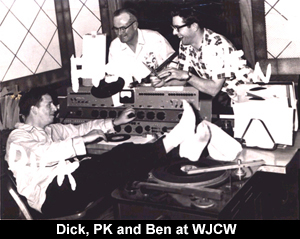
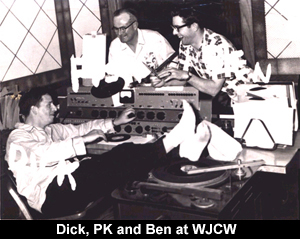
Professor Kingfish (Bill Marrs) and Little Richard (Dick Ellis) co-hosted a highly popular weekday morning radio talk show heard over WJCW in the 1960s and 70s.

In 1979, Dave Hogan (current WJCW morning show co-host and personal friend of the Marrs family) and Red Pitcher (former WJCW news and sports director) interviewed the professor. “My life began on December 3, 1910,” said Bill, “when the stork dropped me on Pea Ridge (near Bucksnort and Skinem, Alabama) beside a stump where Ma found me.”

The Marrs family was comprised of five boys and two girls. According to Bill: “Dad was one of the greatest foxhunters that ever blew a horn. One of his dogs was named Doodle, a lemon and white hound that ran so fast we had to put weight on him to slow him down.” As Marrs grew older, he earned three dollars a week washing dishes in a local restaurant. After high school, he opened Bill’s Pie and Sandwich Shop that also sold plate lunches for a dime.

Shortly into the interview, Kingfish unleashed the first of several jokes: “An old man was fishing illegally when he spotted the game warden approaching him. He pulled his fish to the surface, looked at the officer and said, ‘I’m not fishing. I’m just teaching him how to swim.’”

During the Great Depression, the restaurateur sold his business, deposited the money in a local bank and lost it when the institution declared a “bank holiday.” He started over, working until he acquired enough money to open another business.

In 1932, Bill met and married the love of his life, Pauline “Polly” Scott, eventually having two daughters, Patsy and Sandra. Bill decided to give radio and newspaper writing a try: “I appeared on WKSR radio in Pulaski with a 15-minute afternoon program called ‘The Kingfish Column of the Air.’ In 1938, I began writing a hunting and fishing column for the Pulaski Record. Later, I wrote an outdoor feature, ‘Now You Tell One,’ for the Nashville Tennessean.”

The family moved to Johnson City in 1948 to manage College Inn located in the Foremost Dairy Plant. They immediately fell in love with the lush natural beauty of East Tennessee. Bill’s moniker changed from Kingfish to Professor Kingfish when Middle Tennessee State University made him an honorary professor. Marrs and Wade Bulla ventured into the sausage business, naming their product Mr. Sausage. It was advertised as “Whole Hog or None,” meaning it was made from ham, shoulders and tenderloin, not scraps. Bill said it was so good “it would make a tadpole smack a whale.”

The professor suffered a heart attack that rendered him inactive for about six months. He sold his share of the business to Bulla and began painting landscapes and taking photographs of the area. He became quite good at both endeavors. When Bill recovered, he went to work for K-Saver Stamps, owned by Oakwood Market in Kingsport.

A turning point of Kingfish’s life occurred when Mr. Hanes Lancaster, Sr. (WJHL radio and television owner) offered him a hunting and fishing radio program. On the first show, Eddie Cowell introduced him to his listening audience saying that Pea Ridge’s loss was Johnson City’s gain. The Skipper Shop (103 W. Market) was the sponsor. This eventually led to Bill’s hosting a live hunting and fishing television show, “Outdoors with Professor Kingfish.” He remained on television for ten years appearing on WJHL and WCYB (Bristol). 

Not long after WJHL radio was sold and the call letters changed to WJCW, Marrs met Dick Ellis: “I was struggling with my early morning 30-minute outdoors show so Dick came on the air to help me. Reeves Kinkead (Hospital Pharmacy) heard us and agreed to be our sponsor. Dick adopted the name Little Richard for the new program.”

The early morning talk show featured a diversity of subjects ranging from girdles to wigs. Bill’s role was to simply depict his naturally relaxed country boy image. The awesome twosome conjured up an assortment of real and imaginary characters and stories for their faithful fans. Listeners became acquainted with Aunt Sukie, Cousin Herbert, Uncle Zeb, Pug Ugly Adams, Cousin Floy and Uncle Isaac. The wholesome country boys used no scripts and even adlibbed commercials. On their “Dog-Gone” segment, they located lost dogs, mules and husbands.

The show became immensely popular. Because of Bill’s fragile health, the station provided a means for him to broadcast from his home in Backlash Acres (Edgehill Circle). Once during a hospital stay, he spoke over the radio from his bed. Listeners found it hard to believe that Bill was broadcasting from home and Dick from the radio station. 

The colorful Kingfish let loose another yarn in the interview: “A fisherman came by the station to tell us that he had caught a six-pound bluegill. We told him that bluegill don’t grow that large and asked him what he used for bait. The man responded, ‘a three-pound grasshopper.’”

In late summer 1973, Professor Kingfish and Little Richard began occupying a booth each year at the Appalachian District Fair. Each was decked out in overalls, blue shirt, straw hat and shoes that actually had cow manure on them. Hoards of people drifted by the booth to meet their radio celebrities.

During the interview, Bill promoted a strong faith in God, good work ethics and a love for the outdoors. He indicated that he had lived a wonderful life and was blessed with a great family and friends. Little did Dave and Red know when they concluded the interview that Kingfish would pass away just six days later. Immediately after his passing and for the next 32 years, the annual “Professor Kingfish Gospel Sing forthe American Heart Fund Association” conducted a successful gospel singing fundraiser in Gray.

Professor Kingfish has left us, but his colorful homespun legacy lives on in the memories and hearts of those who loved him. (Thanks to Dave Hogan for providing a copy of the interview and Patsy Marrs Wilson for sharing supplemental facts and photographs of her late father.) 

Read more

On January 25, I wrote about the collapse of White Rock Summit in 1882 that terrified the roughly 750 townspeople living nearby. The event was reported in several newspapers around the country.

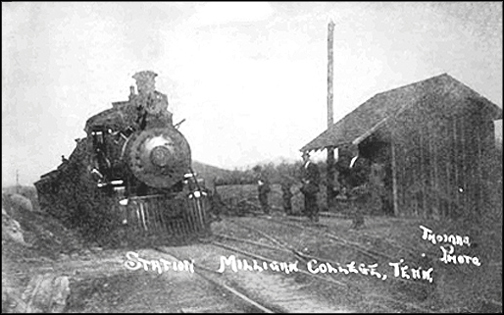
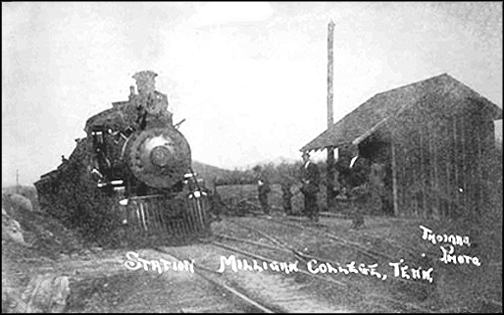
My conjecture at that time was that the beautiful White Rock we know today is a small component of a once enormous, impressive rock formation. To the rescue came Ted Thomas, associate professor of humanities, history and German at Milligan College. Dr. Thomas located an entry written by a student, James B. Lyons, in the June, 1884 edition of The Milligan Mentor that spoke of a campus group who two months prior had hiked to White Rock for a day’s outing.

According to the publication: “After eating our dinners on the highest peak and spending a few hours rambling around through the laurels and rocks, gathering botanic specimens, we started homeward, coming down the track of ruin caused by the fall of the great ‘White Rock.’ We reached the college just in time to see the glowing sun sink behind the western hills. … If we should search the world over from the ‘Vale of Tempe’ to the California Yosemite, we might find scenes more ruggedly sublime but none more beautiful and fair or breathe the spirit of a purer air.”

Dr. Thomas is the faculty sponsor for Phi Alpha Theta, a national honorary history society that was organized on the campus in 2001. Students, faculty and selected others receive an impressive e-mail each weekday titled, “Today in Milligan History.” My paraphrased brief of the contents of several 2010 Phi Alpha Theta newsletters illustrates a broad diversity of topics from the college as well as selected regional, state and national events:

1750 Dr. Thomas Walker explored the region east of Kingsport, encountering a massive 25-foot diameter elm tree.

1785 John Sevier took the oath of office as the Governor of the short-lived State of Franklin.

1864 Col. Nathaniel Greene Taylor appealed for financial and physical aid for Union loyalists in East Tennessee.

1912 U.S. Senator Robert “Our Bob” Taylor died at 9:40 a.m. in Providence Hospital in Washington, DC of complications related to gall bladder surgery.

1919 Thousands of friends and relatives were on hand to greet the troops coming home from World War I, arriving in Johnson City by train.

1935 Josephus Hopwood, founder and president of Buffalo Male and Female Institute (later renamed Milligan College), died at his “Hill Beautiful” Tennessee home.

1942 The “dormitory boys” of Milligan College became willing volunteers to the U.S. Forest Service by fighting forest fires in Sullivan, Johnson, and Carter counties.

1943 The Tennessee Army Reserve issued a call to report for active duty, affecting 11 Milligan College students. That same year, the stark reality of World War II saddened the school with news of the death of alumnus U.S. Navy Ensign Chad Gillenwater. 

1953 Milligan College’s 55-voice Concert Choir began a spring tour beginning with a caravan of nine cars driving to Atlanta for the Southern Christian Convention.

1989 The college approved the purchase of the Taylor property – a cow pasture located adjacent to the baseball field – that once belonged to Tennessee Governor Alf Taylor.

2006 The school announced that for the sixth time in seven years the school’s nursing graduates had a 100% pass rate for the National Licensure Examination.

2007 Eight students were placed on the Dean’s List Select after having achieved a 4.0 grade point average for two successive semesters.

I wish to thank Dr. Thomas and Phi Alpha Theta for significantly corroborating the 1882 rockslide report.  

Read more

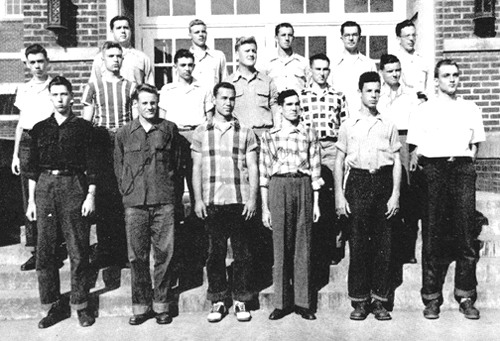
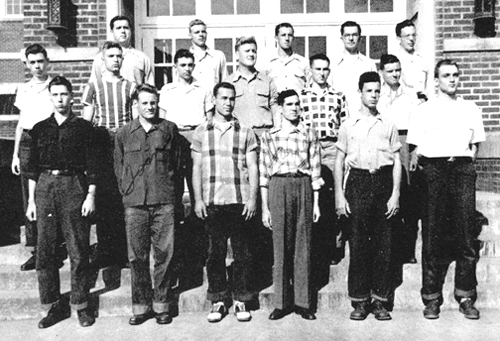
Glenn Stroup recently commented on my Science Hill High School Key Club article. He was mentioned in it as being a charter member when the club reorganized in 1949 after a hiatus during the World War II years.

Club members were (photo, l to r, f to b): 1- Bob Spencer, Tommy Coleman (V. Pres.), Delbert Marks (Tres.), Darrell Mullins (Pres.), Charles Day (Sec.), George Crisp. 2- Jimmy Overbay, Robert Moffitt, Jimmy Seehorn, Jim Greene, Robert McFall, Teddy Ottinger. 3- Ambers Wilson, Charles Stamm, Jim Berry, Reuben Treadway, Glenn Stroup.

Glenn noted that the Key Club was not the only student organization sponsored by a civic club; the Junior Civitan Club operated under the watchful eye of the local Civitan Club.

“Both groups were not social clubs, although we had social events,” said Glenn. “We were more oriented toward public service. We helped the parent civic clubs in their charity activities and sometimes attended their luncheon or dinner meetings. I recall that most of those were held at the John Sevier Hotel or the Peerless Steak House. There was a plethora of clubs and activities in school back then, all encouraged and supported by faculty and staff. We had activities that were extensions of classes such as Band, Orchestra, ROTC and Glee Club.”

Stroup examined his Science Hill annuals to identify some of the clubs of 60 years ago. Several of them were exclusively male or female organizations. The clubs (and sponsors) that he remembered were …

The Y-Teen Club (Nona Siler, boys only), Hi-Y Club (Frank Tannewitz, girls only), Library Service Club, T & I Club (Cecil King), Camera Club (Eddie LaSueur, president), Auditorium Club (appears the entire school was a member of it), FHA (no boys), Red Cross Club (apparently only for girls), Folk Dancing Club (only one boy visible in the photo), Allied Youth Club (Ruth McPherson), National Forensic League (a major influence in schools then), Drama Club (consisted of separate senior, junior and sophomore clubs), Girls' Athletic Club (obviously girls only), Rod and Gun Club (boys and girls, most famous classmate was journalist Bill Kovach, president), Football Club (obviously all male with another famous classmate: Big League baseball player, Joe McClain, president), Archery Club, Boys' and Girls' Swimming Clubs (two clubs) and finally, a Boys' and Girls' Chorus.

“I think our schools today have lost a lot by not having a wide range of clubs and activities,” said Stroup. “The old administrations were much more flexible and clubs could be created and discontinued rather quickly. My personal resume in the 1951 annual shows membership in the ‘Radio Announcers Club,’ which is not one of those listed in the Annual. I also have a 1950 Annual and note that there were a couple of clubs that year that did not show up in 1951.

“For example, 1950 shows a Latin Club as well as a Projection Club. I belonged to the latter one that sometimes enabled students to earn some money. Once trained, the person could volunteer to show movies at night meetings of various organizations and get paid for it. I did that for civic clubs and The Unaka Rod and Gun Club.” Glenn said that he planned to discuss the subject of school clubs at his next 1951 quarterly social.

The former Key Clubber suggested that I write a column about local bands and musicians from the 1940s and 50s: “We know that Mr. Weddle, the Science Hill Band director, played drums for a nationally known band and that George Eiche, Sr. of George's Men’s Shop had played professionally.”

Send me any information you have about local bands and I will include it in a future column. 

Read more

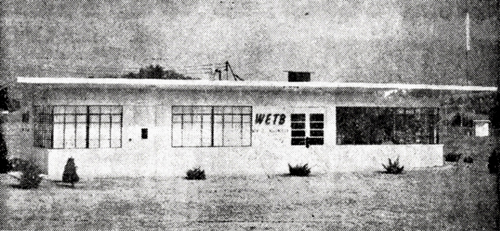
Ray Moore, former WSB (Atlanta) veteran radio/television broadcaster worked at radio station WETB on the Erwin Highway for two years in the early1950s. He shared memories of his early career at the station.

Ray desired to pursue a radio career at a time when television was making significant inroads into the entertainment industry. After posting and wading through “help wanted” Broadcasting Magazine ads, he finally received a telephone call from WETB inviting him to the station for an interview. He was impressed by the warm, friendly southern voice that greeted him over the phone.

According to Moore: “I arrived unceremoniously in Johnson City at my expense. The downtown district sat on a low plateau surrounded by the beautiful foothills of the Appalachian Mountains. The city had a college, lots of attractive homes and many good people that I came to love and appreciate. I met McBerney “Berney” Burleson, the Program Director and Cliff Goodman, the station manager. The city’s only newspaper, the Johnson City Press-Chronicle, owned WETB. It operated at 1,000 watts of power and was licensed to operate only during daylight hours. The studio and transmitter were in the same little white concrete block building about two miles south of town. The short tower sat just outside the building.”

Burleson offered Ray a job paying $55 a week, which he accepted instantly. He began as a newscaster with emphasis on the 8 a.m., noon and 5 p.m. newscasts. He roomed on the west end of town, arriving at work early enough to gather and write his first newscast before 8 a.m. Not owning a car, Moore hiked downtown to the bus station, grabbed a quick breakfast at a hole-in-the-wall diner and then rode the bus south on Roan Street to work. Missing the bus meant a long fast-paced weather-exposed trek to the station. Moore rapidly learned how bone-chilling winter mornings could be in East Tennessee.

Not long after Ray’s hiring, the station experienced financial difficulties. There were five people, including Moore, on the announcing staff; two had to go. Ray was spared after he agreed to take an announcing shift. He drew the afternoon slot, which actually suited him better by his not having to arrive at work so early. The radio announcer abruptly switched from being a sonorous and dignified newscaster to that of a disc jockey on the “Hillbilly Hit Parade.” “I had the most fun with that program,” said Ray. “The songs were wonderful with great philosophical musings. I played a sad song each day such as ‘Mother’s Not Dead, She’s Only Sleeping,’ ‘‘Neath a Cold Gray Tomb of Stone’ and ‘Will the Circle Be Unbroken.’ I loved the sad songs and began singing along with them.

“When school let out, we switched to big band music. In late afternoon, dignity and pomposity returned as I hosted ‘Music of the Masters,’ playing classical music that allowed me to practice the foreign pronunciations I had learned at Columbia. It was a tour de force.  “I invented a cast of characters and told stories about them over the air,” said Ray. “I became Ol’ Tex Moore; my gal was Calamity Jane; the villain was Cactus Jack; and my Horse was George.”

Ray indicated that occasionally when they were shorthanded, Berney took the mike and announced. During one memorable broadcast, he solemnly noted that Johnson City had lost one of its most prominent citizens. He meant to say that the gentlemen died of a cerebral hemorrhage; instead, he said death occurred from a cerebral hemorrhoid. That comment was not soon forgotten.

More of Ray’s story will be featured in a future column. 

Read more

During my years at Henry Johnson School in the early to mid 1950s, I played numerous outdoor games at recess and at home, several of which would be deemed too rough for schools to engage in today.

Let me escort us down memory lane by recalling a few of my favorites. As with most childhood activities, the rules varied considerably.

Dodgeball: This was my favorite. We divided into two teams of equal number of players. Team A formed two parallel lines several feet apart. Team B positioned themselves inside the two lines. The contest began when alternately each side of Team A began throwing a large ball toward Team B players. If the ball struck a person below the shoulders (a requirement), he or she came out of the contest. The last person standing was declared the winner of that team. The circumstances were then reversed with Team B forming two lines and Team A moving to the middle. This was good exercise and a lot of fun.

Red Rover: Two teams were selected and formed parallel lines a few feet apart facing one another and holding hands firmly. One side selected a person on the opposing team and shouted: “Red Rover, Red Rover, send (Bobby Cox) right over.” Bobby then left his post and ran as hard as he could toward some perceived weak spot in the opposing team’s line. If he succeeded in breaking through the human chain, he picked one person from that team to go back with him to his team. If he failed to break through the line, he joined that squad. This pastime had no losers because ultimately everyone ended up on the same team or they quit.  

Red Light, Green Light: One individual served as a human traffic light. Game players stood side by side about 25 feet away. The challenge began when the “light” shouted “green light” and immediately turned his/her back to the others. Everyone ran toward the “light.” Then, the “light” shouted “red light” and immediately wheeled around toward the challengers. Anyone caught moving even slightly after the “light” turned red was ejected. The signaler alternately said “green light” and “red light” allowing the pursuers to advance. Players had to pace themselves in order to freeze when the light changed. The first player to touch the “light” while it was green became the “light” for the next game. The “red light” was declared the winner if all pursuers were ejected. 

Crack the Whip: Six or more people formed a straight line by holding hands. The head person was the leader and the rear person was the caboose. The game commenced when the leader began running like crazy pulling his/her human train first in one direction and then in another. The leader and caboose were the only ones permitted to use both hands. The leader’s goal was to sling people off the train. Those who lost their grip were evicted from the train and the others then regrouped and continued their wild journey. The game’s fun was two-fold: trying to hold on to the train and making a noticeable spectacle of yourself when you were slung off.

King of the Hill: This was typically a boy’s game that was played on a mound of dirt or on a small hill. One person was chosen to be “king of the hill” by utilizing the “one potato, two-potato” method of selection. Then, one at a time, each player climbed the mound to physically dethrone the ruler by hurling him off the hill within a prescribed amount of time. If the attacker was successful, he became the new ruler. If not, the game continued until someone claimed the honor. There was no ultimate winner in this game, just a bunch of dirty, fatigued youngsters trying to demonstrate their wrestling might.

Today, we aging “youngsters” of yesteryear can only lament about those carefree days of our youth when we engaged in robust outdoor pastimes, rarely getting hurt.  

Read more

Charles W. Marshall, who worked for the Johnson City Police Department between December 1957 and October 1982, shared some prized photos and a Tennessee Fraternal Order of Police Magazine dated April 1966. 

The 118-page publication focused on police departments in six Tennessee cities: Chattanooga, Clarksville, Elizabethton, Cookeville, Murfreesboro and Johnson City. The JC section occupied 23 pages that included five locally written articles and 220 advertisements of businesses from that era.

The most striking item was titled, “The Night Has a Thousand Eyes for the Unwary and the Policeman.” Former Johnson City Press-Chronicle staffer, Jim Turner, teamed up with on-duty police officers working the 10 p.m. to 6 a.m. shift for a research project to gain firsthand experience of after-dark city crime.

Turner quickly learned that protection of approximately 35,000 city residents from attack, intrusion and other serious crimes rested that night with just nine officers. Lt. Tom Helton (future chief) commanded the night unit assisted by Sgt. George Adams, second-in-command and Sgt. Mickey Auer, desk sergeant and radio dispatcher. Jim recalled one incident on the first night of his assignment that was typical of the life of a police officer.

“My right hand grabbed for support,” said Jim, “as the police cruiser jumped from 20 to 50 miles an hour, then 60 and 70. As the driver jammed the accelerator to the floorboard, he thrust his left hand toward a toggle switch and the light atop the cruiser slashed its red warning signal through the after-midnight darkness. ‘Ten–four,’ he uttered into the microphone, acknowledging the radio call to rush to the aid of a gas station attendant who was in danger of being beaten by four toughs”

The news reporter, after realizing that he and the officer beside him were the only ones being dispatched to the scene, nervously began to contemplate what role, if any, he would play when they arrived at their destination. He knew that if the circumstances became combative he would have to offer his assistance. Fortunately, when they arrived only the attendant was present. After getting a description of the car and the suspects, the office and Jim attempted to locate them but to no avail.

Most police calls are centered on a troublesome situation that quickly spreads to one or more officers. A common dilemma for the dispatch is when someone reports another person’s actions to the police. Sometimes the desk sergeant has to wade through a barrage of irate verbiage before determining and courteously informing the person that no law had been broken.

 Turner learned that occasionally an officer found himself the target of vengeful acts by the person being arrested or by his family or friends. Another ploy was for influential individuals to contact the arresting officer to persuade or intimidate him into lowering or dropping the charge before the case reached court. Some influential violators threatened to have the officer fired for doing his job.

Jim related another difficult situation for police. “An officer stops a car in connection with a traffic violation or because it resembles an auto for which the police are searching, even if it is a partial description. As the officer approaches the seated driver of the car, he seldom has any hint of the driver’s identity or situation. He may be an innocent citizen who has unintentionally exceeded the speed limit or he may be a wanted man who knows his best chance for freedom is to shoot or disarm the officer making him especially vulnerable as he approaches the stopped vehicle.

The staff writer noted how one officer reduced the risk of a potentially dangerous situation after pulling a car over to the side of the road. “He focused the cruiser’s spotlight on the driver before getting out,” said Jim, “and he kept close to the side of the stopped car as he walked up to check the driver. The spotlight momentarily blinded him should he try to fire at the officer, but did not hinder him during the moment the officer stood beside the door.

One of the greatest disadvantages in police work was said to be the nervous strain to which policemen are subjected. The article indicated that three city policemen had undergone stomach surgery attributed to job strain within the past two to three years. The malady was not confined to those who walked beats or patrolled in cruisers; it even applied to what appeared to be a stress-free job – the desk sergeant and radio dispatcher. A man promoted to this job soon asked to return to his former job that caused him to incur a reduction in rank from sergeant to patrolman.

The newsman summarized his experience with the Police Department by saying, “Before beginning this project, I had thought of day-to-day police work as requiring no special attributes other than an unusual amount of physical courage. In addition to possessing an abundance of courage and strength, the good officer must have a sharp knowledge of psychology, skill in diplomacy, infinite patience and a devotion to duty. And, if he is to retain his sanity in the face of all the frustrations that police work entails, he must also have a well-developed sense of humor.”

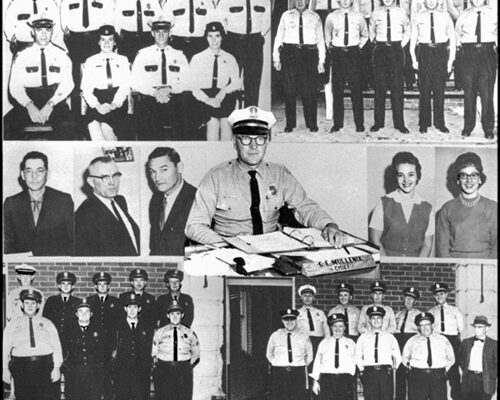
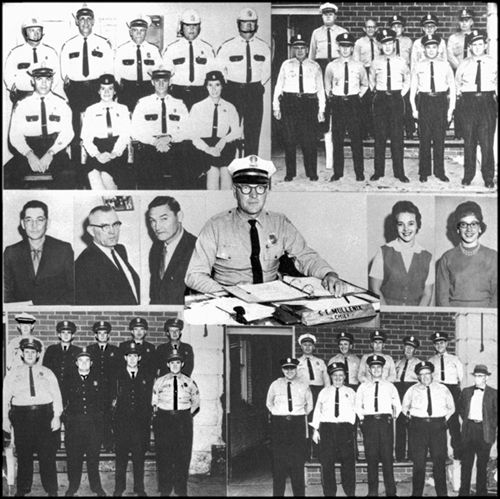
The ten-photo collage of the Johnson City Police Department taken in November 1962 shows (left to right, top to bottom):

Top Left: (front) John Senn, Wanda Lewis, Paul Odom, Judy Barnett, (back) Carroll Tranbarger, Johnny Howell, Earl Byrd, L.P. Auer, Bill Collins.

 Top Right: (front) Ben Treadway, Paul Laws, D.C. Laws, Cecil Clark, George Murray, (back) Tom Helton, Fleenor Masengill, Albert Wood, Ed Friesland, George Adams.

Middle: Bufford Tunnel, Louis Auer, Allen Chandler, Chief C.E. Mullenix, Imogene Bright, Catherine Laughren.

Bottom Left: (front) Wendell Snapp, John Robinson, Charles Miller, Charles Marshall, (back) Garland Musick, Wayne McKeeham, Bobby Greer, D.H. Byrd, Leland Dalton.

Bottom Right: (front) Rodney Rowlett, Harry Reed, Bill Butler, Raymond Conner, Sheelor Norris, (back) Frank Hicks, John Hughes, David Yates, Euel Painter, George Hicks. 

Read more

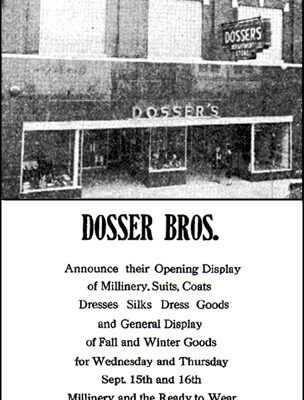
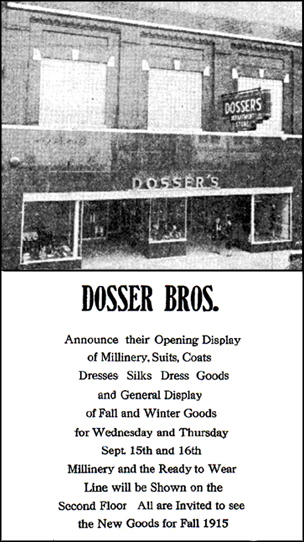
Many area residents fondly recall shopping at Dosser’s Department Store that once stood at 228-230 E. Main Street, sandwiched between Sterchi Brothers on the west, Beckner’s Jewelers on the east.

 According to an unidentified 1924 newspaper clipping (from the John Fain Anderson Collection, ETSU’s Archives of Appalachia), James H. Dosser came to Jonesboro about 1836. He gained business experience working as a store clerk.

In the 1850s, Dosser and a Mr. McEwen of Philadelphia erected a three-story brick building diagonally opposite the Washington County Courthouse and offered an extensive line of men’s wear and ladies’ yard goods. During the same decade, he formed another partnership known as Dosser and Stevenson. The businessman ultimately became an active builder with two large storehouses and several excellent dwellings as evidence of his prowess.

James Dosser had four sons: Robert N., Albert T., Frank F. and J. Harry. In 1907, Robert established a mercantile establishment in Morristown. Two years later, he and his brothers opened a store in Johnson City, known aptly as Dosser Brothers. Robert was president and principal owner of the business. He lived in Johnson City while his three siblings resided in Bristol, Morristown and Knoxville. 

A 1915 Chamber of Commerce publication had glowing remarks about Dosser Brothers: “This is one of the big and successful department store enterprises of Johnson City. The location is at 228-230 E. Main Street. The firm deals extensively in dry goods and notions, millinery and shoes and high-grade ladies’ ready-to-wear suits. The business has been established at this point for the past five and a half years and during this time has become recognized as one of their real leaders in the trade and the patronage is largely with the leading and representative families of Johnson City and vicinity. The family also operates stores in Bristol and Morristown.”


The Johnson City business experienced steady growth since its conception. The amount of trade during 1923 was said to be the largest in the history of the store up to that time. Sales were encouraging during those early years with the exception of one year just after the war.

The company began making plans in early 1924 for an even bigger and better Dosser Brothers Store. With this determined vision in mind, they installed new equipment on the first and second stories and acquired additional space by acquiring and connecting an archway with the second story of the adjoining Crumley Building. This gave the facility about 75 x 100 feet in the ready-to-wear department. Their strategy for ongoing business success was to keep pace with Johnson City’s growth and to ensure the capability to meet its demands.

A 1915 advertisement in the Johnson City Staff further offers an idea of the nature of the business: “The Millinery Department is showing a wonderful number of beautiful hats, adding new shapes, new trimmings and new ideas daily. Suits coats and dresses still are arriving in the latest and most approved models. Silk sweaters are attractively priced at $5.00, $5.50 and $6.00. The Billiken shoe is the most satisfactory selling shoe sold in Johnson City.”

During his life, Robert was affiliated with the Rotary Club, the Chamber of Commerce and the Country Club. He was an active member for many years of Munsey Memorial M.E. Church, South. He died on March 22, 1927 of pneumonia after being struck by a passing car.

Dosser’s Department Store, as it later became known, closed its doors in downtown Johnson City sometime after 1972 after a successful run of over 63 years. 

Read more

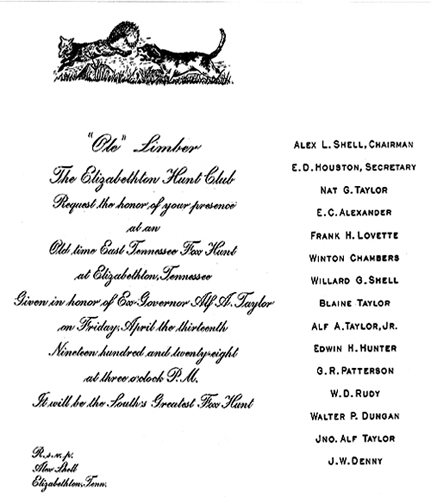
Two years ago, Mrs. Joann Conner sent me a copy of an invitation that was mailed to her grandfather, Dave Oliver, on March 28, 1928. It came from the Elizabethton Hunt Club, inviting him to a special foxhunt on April 13 to honor 80-year-old former Tennessee governor Alf Taylor.


Tomorrow is the 82ndanniversary of the storied event. Research reveals that 750 guests were invited to Bogart Knob (highest point between Buffalo and Unaka mountains) at the famous camp owned by the Taylor family. Local passenger trains brought in scores of people, including a Pullman carload from Nashville on Southern Railway train No. 26.

Preparation for the occasion included grading and surfacing the dirt road leading to the knob, erecting a large circus tent capable of holding 1000 guests, piping in water, installing electric lights, stringing telephone lines and delivering a piano. One newspaper article proclaimed, “Bogart Knob will be the center of the world on Friday.”

The hunt was strictly a stag affair. One group of disappointed ladies toured the camp the day before and humorously informed officials that they planned to don breeches and a moustache and sneak in the next day. Pre-festivities kicked off at 10 a.m. that day when several guests took part in a program for Elizabethton schools. Two hours later, event organizer, Alex Shell, hosted a luncheon for other notables.

At three p.m., a number of non-political speeches were delivered from the likes of Governor Horton of Tennessee, Hon. Ben H. Taylor (son of “Uncle Alf”), Hill McAlister (former state treasurer and future governor of Tennessee) and Judge W.R. Allen of Elizabethton (former judge of Tennessee courts).

Afterward, a program described as “pure Southern merriment” was held with four songs about Uncle Alf performed by the Ole Limber Quartet (often spelled “Quartette,” the same male group that made his race for governor in 1920 so memorable); the John Sevier Bell Hop Quartet;the Dixie Serenaders; Sydney M. Rowe (famous entertainer of Chuckey River, Tennessee); R.D. Wood’s String Band; and several others.

At six p.m., waiters who were decked out in spotless white uniforms, carrying plates to delight the hearts and stomachs of the most fastidious southerner, served the long awaited meal. It consisted of Tennessee Spring Lamb (proclaimed to be the tastiest dish in Dixie) with corn sticks, barbecued pork and other delightful southern dishes. The banquet consumed 10 sheep, 10 pigs and 500 pounds of beef barbecued in traditional Southern style and consumed with a truckload of fresh bread. It was the feast of feasts.

The much-anticipated fox chase began at nightfall. Although many “blooded” foxhounds (having ancestors of good blood) were present, only about 100 of them participated in the actual chase. Packs of about 20 dogs were released every few minutes until all them were active in the hunt. Old Limber, the now 12-year-old famed hound of Gov. Taylor, reportedly assumed his customary lead.

While the pursuit was in progress, movie cameras clicked off hunt scenes and telegraph wires carried the event to every part of the nation. All the while, Uncle Alf sat placidly in a camp chair with friends who tracked the general location of the foxes by listening to the music of the melodious baying hounds. He delighted his guests by musing over his favorite past foxhunts. The famed occasion continued unrelentingly all night until the first rays of sunlight appeared on the following morning, giving the much-fatigued dogs (and foxes) some needed rest.

“The South’s Greatest Foxhunt” was a fitting tribute to the man who had given so much of himself to his beloved volunteer state. He would depart this life 3.5 years later. 

Read more

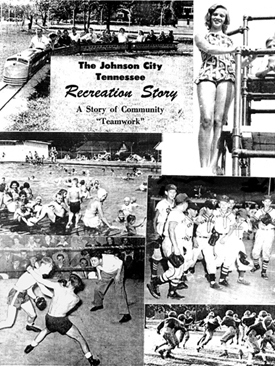
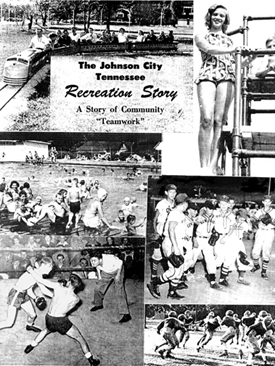
A 17-page pamphlet from 1954 titled, “The Johnson City Tennessee Recreation Story – ‘A Story of Community Teamwork,’” owned by Harrison “Frosty” Stout, was shared with me through Larry Ledford and Alan Bridwell.

The city’s recreation story can be traced to a City Basketball League game in 1947 at an unidentified location matching Leon Ferenbach and Gloria Rayon. Ferenbach superintendent, J.J. Jilton commented to someone, “This is a great game. It’s too bad it has to be played in this cracker box.” The location was not specified.

That causal statement was taken as a challenge to Recreation Director Howard Johnson who replied to Jilton, “Are you willing to help build a better place?” The same query was put to Bill Jenkins, coach and manager of the Gloria Rayon team, and other participants of the league. Several men met on January 12, 1947 for the purpose of forming a club for people interested in building a community recreation center for the city. 

Charter members were J.M. Carter (president), Robert F. Smith (vice-president), Howard Johnson (secretary-treasurer), Ted Jilton, Roy Feathers, Lawrence Owens, William Whittimore, Kent Neufer, J.J. Jilton, Eric Herrin, Mrs. and Mrs. Jimmy Smyth, Edna Frances, J.R. Jilton, Sells Blevins, Sam Cooper, William Jenkins, Bill Billings, Kathleen Goodin, Mr. and Mrs. Eddie Cowell, Nelson Burris, Roy Well, Joe Walker, Ted Burton and Nathan Thorp.

The group approved a 3-phase campaign to raise funds for the construction of a new sports facility: selling memberships in a recreation club; sponsoring athletic events, carnivals and other money-raising activities; and soliciting financial contributions.

On January 28, 1947, the organizers met with the Park and Recreation Board (C. Howard McCorkle, chairman; P.W. Alexander; W.J. “Dub” Smith; Mrs. H.C. Black; and M.U. Snodderly) and received a “thumbs up” for the club. 

Phase 1 began by netting $5,190.92 from 919 memberships, several sizable donations and numerous contributions resulting in part from the promotional efforts of Jimmy Smyth of the Johnson City Press-Chronicle and Eddie Cowell, host of  WJHL radio’s “Sports Parade.”

Phase 2 was launched with a dance by noted bandleader Tony Pastor and his group on Friday, March 28, 1947. During that gathering, the Junior Chamber of Commerce raffled off an automobile. Unfortunately, attendance was sparse due to a record snowfall and cold temperatures. The club also held a “Buy-A-Brick for One Dollar” campaign and awarded an automobile at a 4-Star Motorcycle Race at Memorial Stadium on July 5, 1947. This and several other fundraisers increased the fund total to $6,336.47.

When the endowment reached $15,000, the club decided to break ground for the new building. The plan, drawn up by Bob Woods, called for a 160’ by 80’ building on Legion Street. The Park and Recreation Board maintenance crew, headed by Dewey Stout and supervised by Howard Jenkins, commenced construction work on July 8, 1948. 

Footings were poured for the walls and afterward Southern Welding Company erected structural steel. General Shale Corporation graciously donated 10,000 cinderblocks and several suppliers of materials offered substantial discounts. The walls went up block-by-block and work proceeded on installing the roof until funds were exhausted, bringing a momentary pause to the project.

To the rescue came the Junior Service Auxiliary (Mrs. William G. Preas, general chairperson), donating funds from their September 28-29, 1949 “First Annual Johnson City Horse Show.” This effort added $2,663.49 into the fund allowing work to resume.

Phase 3 endeavors to solicit financial contributions to the building were not as promising, the main drawback being that three other significant money-raising efforts were occurring simultaneously in the city.

Fortunately, two organizations came forward – the National Federation of Employees (through the efforts of Vic Larmer and Charles Roller) and the Model Maniacs (Charles Hawkins and Caroline Muse). These two groups, along with former contributors of the Recreation Club, backed a highly successful Halloween Festival on Oct. 29-31, 1949, generating $991. About this time, City Commission approved a $10,000 loan for the recreation project.

With renewed funding, final work on the building proceeded with the pouring of a four-inch concrete floor, laying four by four creosote boards as sub-flooring and installing 16,000 square feet of hardwood flooring attached with 1000 pounds of nails. After completion, Allen Harris, Jr., a prominent local flooring businessman, commented, “I think this is one of the most beautiful floors I have ever seen.”

The long-awaited Recreation Building opened to the public on January 5, 1950, appropriately featuring a basketball game by the City Basketball League. The town no longer had to play the game in a “cracker box.” In early 1952, the balconies to the building were completed bringing total floor space to 24,000 square feet. Early1953 saw a modern entrance to the building along with a skate room, the installation of 2,000 seats, glass backboards and steel steps.

Over time, the city’s other playgrounds were improved and collectively began offering a variety of programs (sandbox, tennis, swimming, square dancing, roller-skating and baseball), each under the supervision of two or more trained leaders.

Special weeks were featured that focused on an activity such as “Tournament Week” (competition in paddle tennis, aerial tennis, horseshoes, checkers, croquet and others), “Fair Week” (displays of outstanding arts and crafts and hobby creations), “Sportsmanship Week” (special recognition to those who display good sportsmanship in games and contests), “’Citizenship Week” (special recognition of those who made the park more attractive and interesting) and others.

Various events were three-legged races, sack races, dashes, broad jumps, softball throw, basketball goal shooting contests and bicycle derbies were also held. Spring and summer brought softball and baseball leagues (Pee Wee, Midgets, Little League, Pony, Junior and Twilight Softball Leagues at the various ball fields. Fall and winter activities featured boxing and bodybuilding programs for boys and men.

The recreation brochure concluded by revealing “A Typical Day on a city Park & Recreation Playground” that opened at 9 a.m. and closed at 10 p.m. The city had something of which to be proud. 

Read more