Author's Posts

A Virginia legend states that when Native Americans destroyed several settlements on the New River, south of what became known as Hungry Mother Park, Molly Marley and her small child were among the survivors taken to the raiders' base north of the park. Upon finding help, the only words the child could utter were “Hungry Mother,” indicating a strong craving for food.

A significant highlight of the late 1940's was for my family to embark on a short excursion to a local state park, Hungry Mother State Park, located in Smyth County is just above the Virginia line near Marion, Virginia.

The park, which gets its name from the Hungry Mother Creek that feeds the lake, is situated on a 108-acre lake with a manmade beach. What makes it so pretty is the gorgeous view of the mountains surrounding the lake.
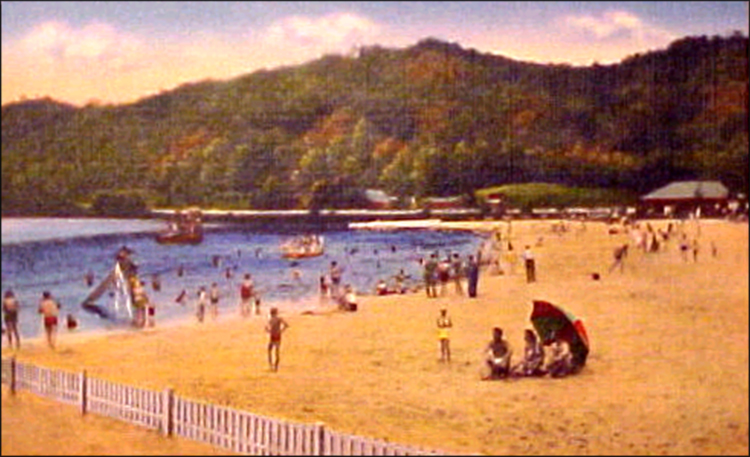
Hungry Mother Park with the little white fence visible in the lower left

The beach consisted of a fully enclosed white wooden fence positioned in the water along the left side of the beach. Parents could allow their youngsters to play in this fenced-in area without having to worry about them getting too far out in the water.

On one journey, I played in the sand with my bucket and shovel most of the day. When we departed and returned to our W. Watauga apartment, I realized that I did not have my bucket. Mom picked up the phone and pretended to call the park and ask them to be on the lookout for my sand bucket. This gave me hope that I would eventually get it back. Isn't that just like a mom? I soon forgot about my sand bucket.

We went to this recreational area several times during summer months. I have pictures of these trips in our family album. For some reason, we stopped going there around 1952.

During the July 4th, 1993 weekend, my family and I revisited Hungry Mother Park. It looked about the same except the wooden fence in the kiddy's pool was long gone. The picnic area was a little bigger than I remembered it. Several new parking lots had been added. It was about as crowded in 1993 as I remembered it to be in 1948.

I never gave any thought to how Hungry Mother Park got its unique name. During this visit, we pulled over at a Virginia welcoming station and I asked the attendant if she know how the park got its name. Surprisingly, she did not. I just had to find out. The lady, wanting to assist this, searched through some material she had but could find no reference to it. 

During March of 1996, my son, Brandon, and I went to our main public library. He was doing a research project on Edgar Allen Poe. While I was in one of the isles looking at some books, he came walking up to me grinning. He had found the park mentioned in a book.

And now, (drum roll)… According to my source, here is the legend of Hungry Mother Park: “An early pioneer named Molly Marley, her husband, and their small son were caught in an Indian raid;  her husband was killed immediately.

“Molly and her son fled from the Indians. After several days of wandering and eating berries to stay alive, Molly collapsed from hunger near a creek at the foot of a mountain. Her son, after trying to arouse his mother, followed the creek seeking help until he arrived at some houses. He was so weary and hungry himself that the only two words he uttered were “hungry” and “mother.” Help came too late for his mother.” The mountain was named Molly's Knob and the creek became identified as Hungry Mother Creek. The park later assumed that designation.
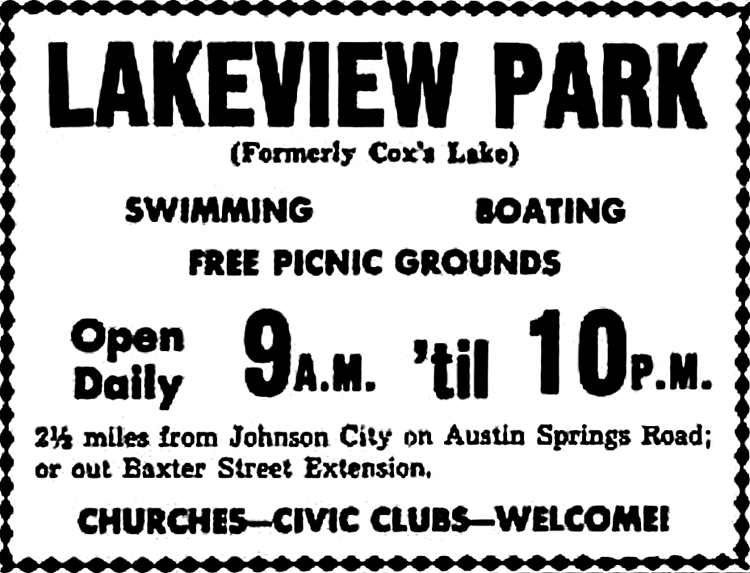
Advertisement for Lakeview Park, formerly Cox's Lake and later Cox's Lake

I have fond memories of going to that beautiful park on Saturdays in the late 1940s and early 1950s. I have no explanation why we stopped going there. I soon became much enamored with another body of water … Cox's Lake (originally known as Lake Wataussee), once located on Lakeview Drive (figure 2). I could quickly access it on my bicycle.

Once, I nearly got electrocuted when I stepped on a live wire that had fallen to the ground; I was in a wet bathing suit and caused quite a stir, but that is another story. And no, I didn't have my sand bucket and shovel at this lake.

Read more

With the death of Admiral Farragut, which took place at Portsmouth, New Hampshire, on Aug. 15, 1870, after a protracted illness, the country lost the officer who stood at the head of the Navy, not only in official rank but in universal estimation of merit based upon the severest tests most gloriously sustained.

David Glasco Farragut was born in East Tennessee (Campbell’s Station) on July 5, 1801, and was appointed a midshipman from that state in 1810, being only nine years old (yes, nine years old) at the time. He served under Captain David Porter during the war of 1812 in that brilliant cruise of the Essex. That is one of the proudest passages in the records of the American Navy. His own exploits many years after in the War of the Rebellion proved that he had not forgotten the lessons learned from his daring and skillful commander.

A long period of faithful and successful service, though without opportunity for startling achievements, succeeded the War of 1812, and when the Union expedition against New Orleans was organized, he was sent out in January 1862 as commander of the naval forces connected there, which soon grew into the Gulf Squadron.

Admiral Farragut in His Uniform (public domain)

In April of the same year, he passed Fort Jackson and St. Philip and drew up his squadron before the City of New Orleans, which lay at the mercy of his guns.

In May, he ascended as far as Vicksburg, passing formidable batteries and instituting in conjunction with Rear Admiral Davis, a bombardment, which proved unsuccessful for want mainly of a cooperating land force.

Farragut’s fleet was safely withdrawn to Pensacola and on July 11, he received the thanks of Congress and was, by the President, placed first upon the list of Rear Admirals.

In March 1868, he again ascended the Mississippi, passing the batteries of Port Hudson and cooperated with General Grant in the reduction of Vicksburg, which was accomplished in the early days of July.

The capture of the forts in Mobile Bay in August 1864, crowned a series of exploits, which for skill, daring and solid results, were unsurpassed in the history of Maritime warfare.

Admiral Farragut was advanced in July 1886, to the highest grade known in naval organization. His only considerable service since the war had been in a European cruise, which took on more the nature of a pleasure tour.

Farragut’s health, for a number of months prior, had been exceedingly uncertain and his recovery from a previous severe attack of illness at Chicago was a gratifying surprise to the country. He passed away at the age of 69.

The private character of the late Admiral was as admirable as his public services were glorious. He was remarkably studious of the moral welfare of the men under his command.

Note: The Battle of Campbell’s Station was a battle of the Knoxville Campaign of the American Civil War, occurring on November 16, 1863, at Campbell’s Station, (now Farragut), Knox County, Tennessee.

FarragutÆs grand funeral promoted the new Woodlawn Cemetery in the Bronx, founded in 1863, and his monument set the early standard for the cemeteryÆs memorial architecture. In the decades that followed the admiralÆs death, the rural cemetery received a reputation as a graveyard of AmericaÆs northeastern elite and as a gallery for skilled stone carvers and architects.

Today, FarragutÆs gravesite on Aurora Hill in the Bronx of New York is the best-preserved property directly associated with the first rear admiral, vice admiral, and four-star admirals in United States history.

A One-Dollar Postage Stamp Honors Admiral Farragut

Admiral David Glasgow FarragutÆs historic grave site is in Lot Number 1429-44, Section 14, a large circle in the center of the Woodlawn CemeteryÆs larger Aurora Hill Plot, where Farragut and his immediate family are interred. Farragut was the first person to be buried in the cemeteryÆs Aurora Hill Plot. His wife, son, and daughter-in-law joined him there later.

The impressive Farragut Monument marks his gravesite. The monument is a tall, carved, marble pillar on a granite block, and was the work of New York City-based stone carvers, Casoni & Isola.

I would encourage my readers to pursue the life of this truly outstanding man.

Read more

My passion is reading vintage history books about Northeast Tennessee and its surrounding areas. One treasured volume was written in 1913 by Margaret W. Morley of the Houghton Mifflin Company. Here is a sample of her prose:

“The Blue Ridge: What mountains ever offered themselves to the sun so enchanting as the long curve of the Appalachian chain where it passes through Virginia and North Carolina down to Alabama, running all the way full Southwest? This battlement of heaven was not named by accident.

It was named “blue” became there was no other name for it. It is blue; tremendously, thrillingly blue; tenderly, evasively blue. And the sky that contains it is also entrancingly blue; even the storms do not make it gloomy. When they pass by, the sun breaks out even more radiantly.

A Typical Quaint Mountaineer Home

“A mountain home is generally well-filled with children, and the grandmother, is vastly proud of her numerous descendants, although she sometimes has difficulty in remembering their full names, or even the number of them.

“There are names like John, Mary and Tom, but there are fancy ones like Mossy Bell, Luna Geneva, Vallerie May, Luranie Carriebel, Pearlamina Alethy Ivadee and a thousand others. Oftentimes, the poorer the family, the more fanciful the children's names, as though this being the only inheritance the parents wished to make as affluent as possible.

“The principle recreation of the country for the people is visiting. They travel long distances, and the smallest cabin is never too small to welcome home married sons and daughters who have come with their families to stay a while with “mammy” and “pappy.”

“In the villages, there are the ordinary amusements of young people: parties, dancing, picnics, box suppers, where girls fill boxes with fried chicken, bread, and cake, and the boys purchase them. And of course, there is music, the violin, better known as a fiddle, and guitar being the most popular instruments.

“Country music, (also referred to as old-time music, is often heard in the cool of the evening when the day's work is done and all sit about the blazing logs in the fireplace. How pleasantly comes back to memory one such scene. The only light comes from the fireplace, and dark shadows steal about the room as the fire flickers.

“In the glare of the burning logs sits a youth with his violin, rendering with zest the compositions of a local celebrity: “Sourwood Mountain,” “Cotton-eyed Joe,” “The Huckleberry Bush,” “The Blue-eyed Girl,” “Old Uncle Joe,” “Sally Gooden” and “A Pot Full of Pie and an Oven Full of Puddin'.”

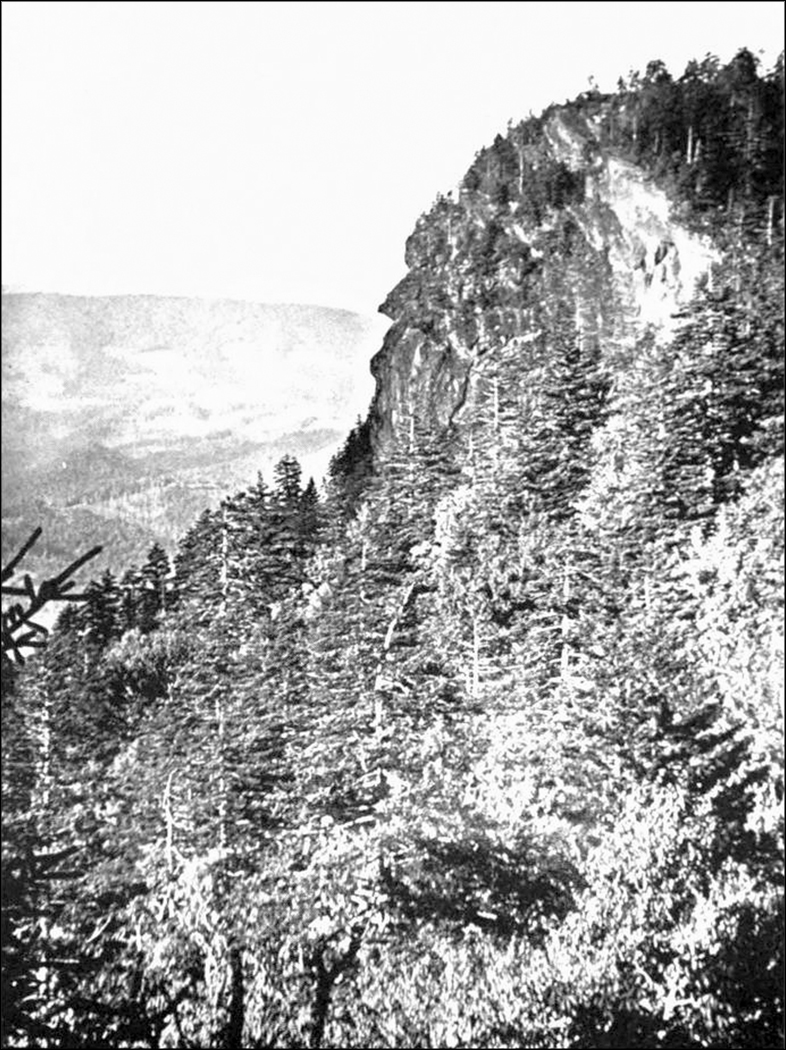
TheFamous Grandfather Mountain Profile of the Old Man

“The musician plays them with enthusiasm, one after the other. As he plays, young Jim sits in front of him, knee to knee and “beats straws.” The youngster cannot keep time without this unique assistance, which is rendered by means of a piece of broom-straw held between the fingers of the right hand and struck against one string at the neck of the violin, while the musician plays “his stuff” in the normal fashion.

“Jim also manages to beat time with his feet without disturbing the rhythmical “tang, tang” of the straw or distracting the fiddler. “Beating straws” seems to be confined to a section on the eastern slope of the Blue Ridge.

“After the fiddle solo concludes, Jim dances the 'stag dance,' first retiring to put on his shoes, for though he says he can dance better without them, the “splinters of civilization” have to be considered. A dirt floor is the original and proper foundation for the dance.

“Since the family gets up with the sun or earlier, all soon retire to rest. The visitors go in the parlor where stands the best bed. There is a carpet on the floor and a round table in the middle of the room, which holds the lamp and as ornaments, a dozen oyster shells. oodnight folks for tomorrow is another day.”

Read more

Recently, while watching a University of Tennessee basketball game, I thought about Harold Anthony “Lou” Bello,” a serious college basketball referee who also was a zany comedian on the court. I wondered if he was still alive but sadly found out that he passed away in 1991.

In the mid-1960s, I along with several of my classmates at the University of Tennessee, had the misfortune of having chemistry lab on Saturday afternoons, often during key sporting events.

Sometimes we would hurry through our experiments, scurry across campus and find a place to sit, usually on the floor at Stokely Athletics Center. This was especially meaningful if we knew that Lou Bello would be on there. 

The Man Himself – Lou Bella Officiating a Basketball Game

Bello, who became one of North Carolina's most colorful sports figures, was an uninhibited game official and would do anything to get a chuckle from the many fans. He successfully blended seriousness with foolishness, depending on the situation.

If a game was out of reach, you simply quit watching the contest and began focusing on “Lou.” Either way, you got your money's worth of entertainment.

A 1947 graduate of Duke University, Bella began officiating games in Duke's intramural program and later became a basketball official in the Atlantic Coast, Southeastern and Southern conferences.

He also officiated college and high school football and baseball games and was a Carolina League umpire from 1949 until 1952. He was a teacher in the Wake County, NC schools from 1950 to 1958 and again in 1966.

“Lou is all referee and part clown,” said Horace “Bones” McKinney, Wake Forest University's basketball coach from 1958 to 1965. “He had as good a judgment in it as anybody refereeing during my time. When I saw him walk out on the court, I was not concerned. I knew I would get as good a shake as anyone.” Lou practiced fairness.

“Lou was also very sensitive,” Mr. McKinney said.” If he thought he had hurt the coach with a missed call, it would bother him afterwards.”

Dean Smith, former head basketball coach at the University of North Carolina at Chapel Hill, said in a statement: “Lou was one of the great sports personalities in North Carolina, first as an official, then as a radio commentator and finally a fan of sports, particularly basketball.”

Lou got along with all the coaches and players, and when the game became one-sided, he'd kid around without embarrassing the losing team.

Mr. Bella stood out among the relatively anonymous group because of his antics. When crowds booed his introduction, he would simply bow,  applaud himself and ask for more. When fans threw pennies at him, he pocketed as many as he could find and then pleaded for half dollars.

Sports officials who refereed many games alongside Lou enjoyed his partner's unique humor. But they also saw his serious side. Lou worked every game as if it were the ACC, NBA or state championship.

Once before a game at Oxford Orphanage, Lou told his co-officials to work the game as serious as if it were the Super Bowl. He explained that this game was very important to the kids. He had a heart for youngsters.

Mr. Bella kept things lively and light. He had a great capacity to make people laugh by putting on a show. He did it in close games too, at least for a while.

People who attended Stokely Athletics Center always got their money's worth and more. At some expected moment, usually after a fowl call, Lou would come down the court galloping like a horse, blow his whistle and make funny comments about the call. He was probably the only official in the country who could get by with such unusual conduct. The crowd loved it.

When my mind drifts back to my University of Tennessee years, I usually see Lou Bello standing right in the middle of the court with a sly, silly grin on his face. He was one of a kind and he knew it. Sadly, he “fouled” out far too early in the “game.”

“Thank you, Lou, for the memories; you were absolutely a hoot. You have not been forgotten. We need more like you in this life.”

 It has been 55 years since he entertained me and I still remember him as if it were yesteryear.

Read more

In 1940, an unidentified announcer at WJHL radio wanted readers to understand that the idea that all there was to do at a radio station was to put on a record and let it play was erroneous to the extreme. He chose to send a letter to the newspaper educating the public: “Every minute of program material,” he said, “is carefully gone over and finally presented with a definite idea in mind. The purpose of the Program Department is to keep on the air the entertainment that is wanted by the listeners.

“Because there are approximately 350,000 listeners who tune into WJHL, the Program Department had to present a greatly varied program schedule in order to please every one of their listeners as frequently as possible.

“This is done by breaking down into separate units and scheduling as much variety therein as is possible. Yes, there is more popular music on the air than any other one type of entertainment, but that is because it pleases a greater number of people.

“And yet, only about 35 percent of a radio day consists of popular music. Some 20 percent is light classical and concert music while another 15 percent is news. Then comes religious programs and others. Every taste has to be satisfied at some time or another during the day. The more often listeners have available the type of program they like the best, the happier is the Program Department.

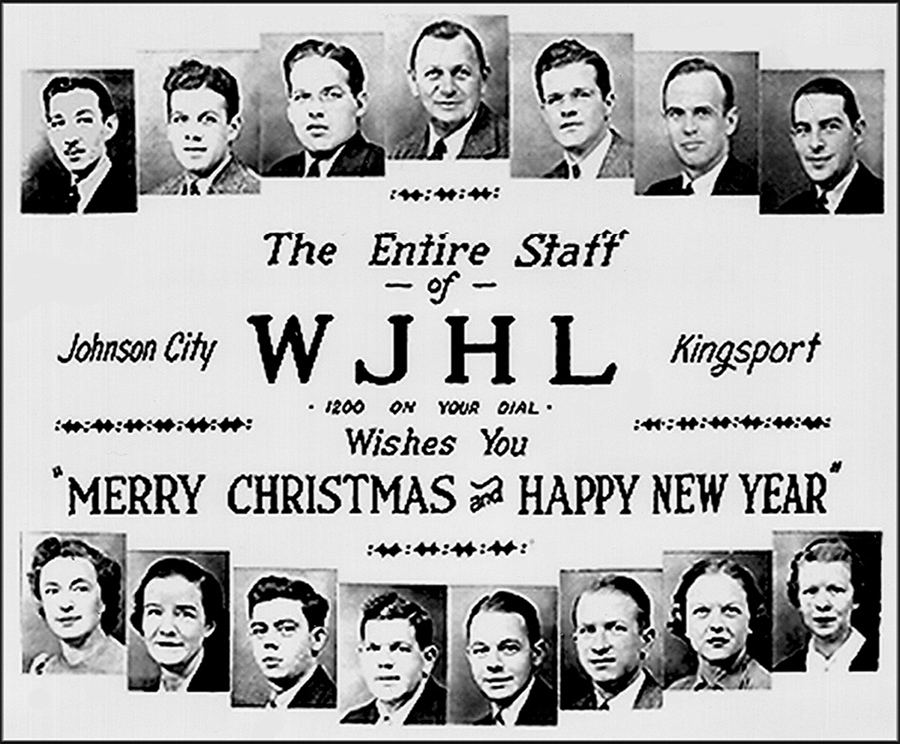
Unidentified WJHL Announcers Believed to Have Been in the Late 1930s-40s

“As for records, WJHL seldom uses them; instead, it uses transcriptions, which are vastly different. Here's how the Program Department at WJHL operates. All of the programs that go on the air are handled by this department. Some new idea might not become a program overnight, but given time, it usually works its way into the schedule sooner than later, and that is good.

“First, the idea has to culminate into a program that has a definite appeal to one group of listeners. If it is for the housewife, the idea is then scheduled as a mid-morning program. For the clerk in a store, an early evening program better fits the bill. For the kiddies, a late afternoon time works best. After all ideas are evaluated thoroughly, a program is established, which then requires rehearsals and timing.

“Then there is something else. The program, regardless of how good it is, cannot be scheduled too close to another program of a similar nature. Two programs of the same type of music or two programs of speakers cannot immediately follow one another. There has to be variety for the different listeners in that particular group.

“And so a clear time is picked, one that will not interfere with similar programs, and then the new program is set up on the master schedule from which comes the daily program schedule. Quite simply, however, there are some 69 quarter hours in each radio day. That is a lot of time to fill. Each program has to be timed and checked for program content.

“Then there is a matter of checking and filling all of the 50,000 musical selections, the crosschecking of all of the cards which enabled them to find these selections quickly, the on-going checking on copyrights, the unending search for new talent and the ability to present what the listeners want the most.”

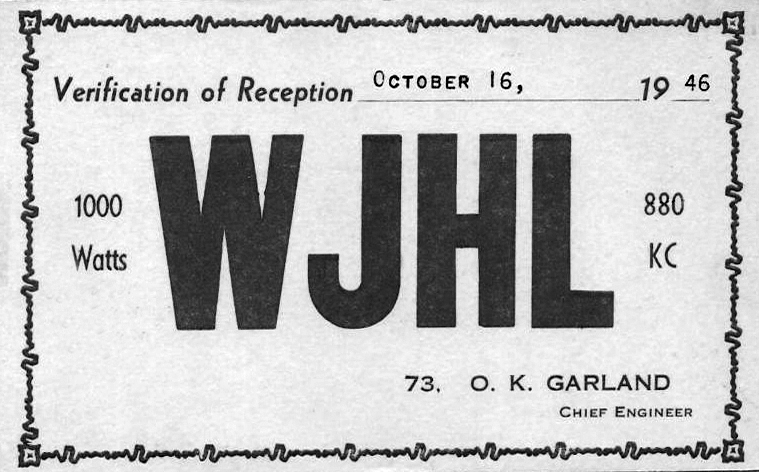
Verification of Reception for the Radio Station in 1946

“If this didn't help clear up in the minds of the listeners what goes on in the Program Department, they were invited to drop in at WJHL any night at a late hour and see for themselves. Meanwhile, the radio station hoped listeners would pay attention and become better acquainted with what was offered in the way of their favorite programs.

“The station was convinced that if the listener knew their station, they would have no trouble in keeping up with the things they liked the most in the way of radio entertainment.”

The announcer concluded his newspaper remarks noting that “WJHL's modernly arranged and equipped office and studio, ranked as one of the best for any city of comparable size in the country.

If you can identify any of the announcers in my column photo, which appears to have been taken in the 1940s, I will post it again with an update of the names I receive. The only person I can recognize is Henry Frick on the top far left. He and Mrs. Frick owned and operated The Music Mart on S. Roan Street for many years. I had the pleasure of working for him for three years.

Read more

Things sure have changed since John Cash Penney opened a dry goods store in Kemmerer, Wyoming 90 years ago. Back in 1902, America was a country of small towns, Kemmerer being one of them with a population of 900. Penney, a 26-year-old entrepreneur, figured they could support a dry goods store. His first day sales came to $466.59, an astonishing amount considering the most expensive item in the store was a $9.95 suit. More typical were the 35-cent overalls and 49-cent ladies shoes.

J.C. Penney Co. Notifies the Public of a New Store Opening in Johnson City, 1929

Penney's strategy was to set a fair price and stick firmly to it. That appealed to most residents who were accustomed to haggling with local merchants and who generally pressed for the highest price possible. Within five years, Penney had acquired three more stores and had moved his original dry goods store to a larger building.

Through the years, Penney was one of the first to apply new strategies to running department stores. In the early days, cash was kept in a muffin tin under the counter, but later Mr. Penney would adopt the Lamson Basket Method (baskets running on a wire and pulley system) and the intriguing looking Pneumatic Tube System, both of which whisked away customers' cash by overhead wires or vacuum tubes. It was worth a trip to the stores just to observe new technology at work.

In 1923, when JC Penney Company was 21 years old, it opened its first store in Johnson City at 319-21 E. Main Street (opposite the Johnson City Buick Company). This was its 475th store. You could buy a man's silk shirt for $4.88 and ladies new spring frocks – flat crepe in alluring colors, lively prints and staple shades – georgette in lovely models, scarf's, jackets, tiers and bows added interest at $14.75.

Children's shoes cost $2.49, girls dresses ranged from $.98 to $2.49, and a boy's suit went for $8.90. That year, men's waistband overalls, now called jeans, were $2.49. Women's cotton dresses went for $2.00 and dress shoes at $8.90.

The year 1929 brought about the need for a bigger store in Johnson City. Two buildings were purchased at 240-42 E. Main Street (opposite the Rialto Cafe). Some of us recall that location being occupied by Lorraine Shops and Booze Bros. Inc. Shoes. A bold clipping in the Johnson City Chronicle said, “J.C. Penney Co. To Move Into New Home Soon. New Building Modernly Equipped, To Be Occupied. Opening This Week.”

“The Burrow building, a two-story brick facility, has been entirely remodeled, two buildings have been combined with a new interior and plate glass front, and modern store fixtures and equipment provided.

“New and additional equipment has been secured by Penney for the new location, and a considerable larger stock will be displayed, complete stocks of clothing and accessories, for men, women and children and for the home as a complete department store in the most modern sense.

“Penney will move early this week and fuller announcements will be made as to opening dates and special features of interest to the public during the formal opening in their new home.”

Mr. J.C. Penny as He Looked in His Younger Days (public domain)

The next Penney move occurred 19 years later in 1948 when the store moved to the impressive, modernistic building at 307-13 E. Main St, (opposite Charles Stores Co.). J.C. Penney stayed downtown until 1980 when the Main Street store closed and the company reopened in the Johnson City Mall.

Though Mr. Penney was instrumental in bringing his ever-growing chain stores into the modern age, he is also known for his staunch opposition to increasing popular in-house credit. Early department stores were strictly cash only, mainly because it kept prices lower. Later, credit became necessary to be competitive and Penneys reluctantly complied.

James Cash Penney died Feb. 12, 1971, and was buried in Kemmerer, Wyoming. Since he opened his first store in 1902, the chain peaked at 2053 stores in 1973. 

Read more

The words to the song, “The Death of Floyd Collins,” speak of a Kentucky mining tragedy that claimed the life of a young cave explorer on January 30, 1925. Andrew B. Jenkins, a blind Atlanta evangelist, composed the original song and Fiddlin' John Carson (Okeh Records) and Vernon Dalhart (Perfect Records) each recorded the song about the tragic mishap.

Floyd Collins (public domain)

Floyd Collins' family owned Crystal Cave in Central Kentucky. Although it was described as a very nice cave, it was too far off the trail to attract tourists and generate needed income. Instead, nearby Mammoth Cave was the major draw for sightseers. Floyd was determined to find an entrance from his property to Mammoth Cave. Nearby Sand Cave had always been described as a collection of smaller “nothing” caves that were bypassed by almost everyone.

Collins enlarged a hole in the corner of Sand Cave hoping to find a shorter route to Mammoth Cave. He became fluent in using his voice to sound out nearby regions. Many people believe that Floyd had located a new passageway in Sand Cove just prior to the accident.

Floyd Collins' Birth Place

Over time, Floyd Collins had gained the reputation of being a gifted caver (as cave explorers became known) in the country surrounding the longest cave system in the world. Decades later, explorers found items in the caves indicating that Floyd was indeed gifted. But further exploration that fateful day in early 1925 came to an abrupt halt.

The caver was leaving a dangerously unstable passage when a 27-pound rock came crashing down on his foot, trapping him. Although the rock was not that heavy, it became wedged in other rocks, which prevented it from being moved to free Collins.

Just 120 feet from the entrance and 60 feet underground, Floyd lay unable to move in a cold, dark tunnel. The night passed with no relief for him.

Okeh Record of the Tragedy, Sung by Fiddlin' John Carson

For more than two weeks, Floyd suffered in his tight passage, while above him a carnival atmosphere of restless people congregated, hoping for a miracle. Each day, frequent news accounts were being reported in the Louisville, KY newspaper first-hand by a brave reporter who navigated the unstable cave passage, dropping food to Floyd, talking with him and even attempting to free him. But his noble efforts were to no avail.

Even today, Floyd Collins' sad drama can be found in old newspapers and library microfilms. The story was first reported as a minor mishap with full expectations that Collins would be freed within hours. That did not happen; the story worsened until it dominated front page news across the country and even abroad for two weeks, which included the Johnson City Press-Chronicle. Everybody become aware of Floyd Collins' quandary.

Family members and his fellow cavers tried to free him. When it became clear that his rescue would not be easy, his brother Homer spent nights in the cave with him to offer him moral support.

Despite efforts by numerous miners, the National Guard and the Red Cross, all attempts at rescue failed, and the crowd grew outside the cave as a media circus ensued. Even after all the attention, Floyd still lay hopelessly trapped and time was quickly running out.

Sign at the Site Where Floyd Collins Died 

Seventeen days after Floyd had entered the cave, a shaft finally reached him, but it was too late. Doctors believed he had died three days prior. The inevitable occurred sometime around the 15th day when, sadly, Floyd's voice was stilled forever.

Authorities decided that it was too dangerous to remove the body and left it where it lay. Some 80 days later, Floyd's brother, Homer, raised enough money to exhume him and give him a decent burial. Later, Crystal Cave was sold and Floyd's body was initially put in a glass topped coffin at the entrance to it. Later after several bizarre events occurred, he received a proper burial.

Today, a marker still stands at the cave entrance as a memorial to a brave man who was trapped alive for over two weeks and where he breathed his final tortured breath.

(Thanks to Alan Bridwell for assisting with this article.)

Read more

Prior to the summer of 1944, public recreation in Johnson City consisted of a baseball park on Legion Street, the Surjoi Swimming Pool (later renamed Carver Park near the intersection of W. Watauga and W. Market streets) and Memorial Football Stadium, constructed by the federal Works Progress Administration (WPA) in the 1930s.

In April 1944, the city charter was amended, establishing the first Park and Recreation Department. A nine member Board of Directors was appointed with Kiwanian C. Howard McCorkle serving as the first chairman and Kiwanian Howard A. Johnson as the first Park and Recreation Director.

Later that same year, Kiwanis became the first city group in Johnson City to sponsor a public park, known as Kiwanis Memorial Park, acquiring a sizable block of city property between Main and Market streets, on which they built two baseball diamonds, one on each end, and a nice picnic pavilion.

Kiwanis Park on W. Market Street. Henry Johnson School Can Be Seen in the Background

Not to be outdone, the rival Optimists offered sponsorship of a city playground on Poplar Street, a few months later, beginning a friendly competition among the city's civic groups, Lowe said.

In 1945, the Jaycees joined in the fun, sponsoring a neighborhood park adjacent to Stratton Elementary School. And in 1948, the Rotarians brought a new angle to the city's park system by developing a naturalistic picnic park on Broadway.

This helpful tradition continued through the next two decades, with the Lions Club adopting its park off Unaka Avenue in the late 1950s and the Civitan Club taking over what had previously served as the city dump in 1963.

In more recent years, the Metro Kiwanians developed a comprehensive park on Knob Creek Road. Later, the North Johnson City business club, forgetting all regional prejudice, took over sponsorship of the former Powell Square in Southwest Johnson City.

In the 43 years since the Kiwanians built their first baseball diamond on Market Street, their accumulated investment of time, labor and funds went to the creation of a $250,000 facility, which, according to Lowe, continued to be the most utilized park in the city.

In early 1950, my family moved to Johnson Avenue, directly behind Henry Johnson Elementary School playground. I vividly recall the three (I think) carousels inside the white picket fence. To power it, some of the older children ran on the inside of it while holding on to the rail until it reached a desirable speed. We then jumped aboard.

According to today's safety standards, some of these rides were a bit unsafe. Failure to get back on it could cause you to trip and fall on the ground. I don't see these rides anymore. The most common displeasure was motion sickness. We quickly learned when to stop riding it.

Another favorite was the metal sliding board midway in the park. Initially, sliding down it was difficult because it was a bit rusty. We corrected that deficiency by bringing sheets of wax paper from home and rubbing them on the slide for several minutes. It amazed us how slippery it became with only a few slides. The journey down it then meant a lightning fast departure into the dirt.   

Another memorable pastime was watching baseball games; Little League teams played on the east end of the park, and Connie Mack batted at the west side. Other games involved numerous adult leagues.

One significant memory of the park was the small snack shack facing Market Street and Henry Johnson School. My most frequent purchase was a frozen Zero candy bar that cost a nickel. Behind it to the south was the large elevated pavilion that was used for a variety of programs, including showing movies.

Even today, I occasionally drive to Kiwanis Park, park my vehicle and take a stroll back to my own private “yesteryear,” enjoying the memories that made our youthful lives so pleasurable. Where did the time go? 

Read more

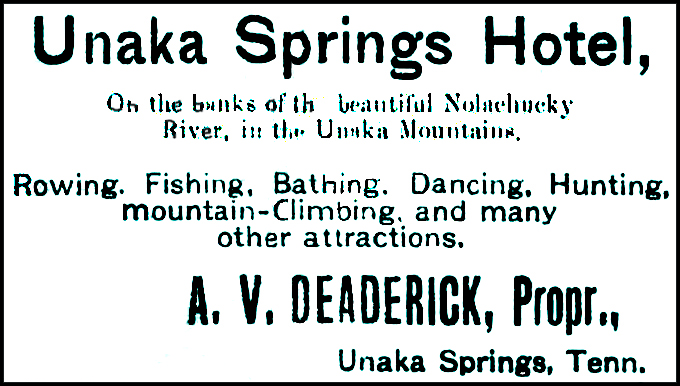
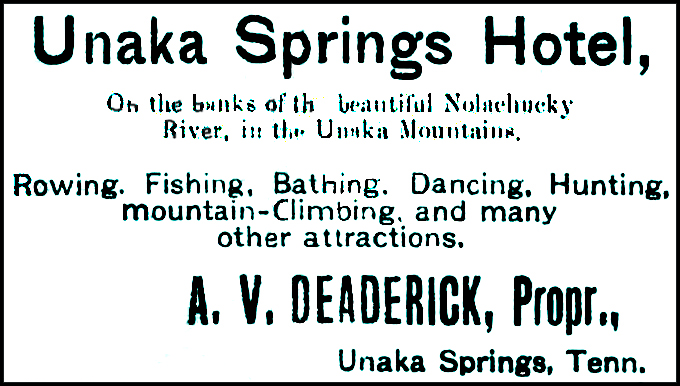
A July 1889 Comet newspaper article asked the question, “Where are you going to spend the month of August?”

“If you can’t afford to go to a high-priced summer resort, but still want to get out of the hot city for a few days or weeks of recreation and relaxation and go where you can stay cool, drink from chalybeate water (impregnated with or containing salts of iron). It is water as good as can be found anywhere.

“And then there’s fishing, hunting, boating and getting all-you-can-eat. You need to pack your essentials, travel to Unicoi County, stop at Unaka Springs at the Unaka Springs Hotel and converse with the friendly landlord, Mr. A.V. Deaderick.

“The owners of the establishment don’t exhibit a lot of style up there. In turn, they offer you something much better: good air, clean water, plenty of exercise and fresh food that will stick to your bones.

“If you’re looking for a stylish hotel, you don’t want to go to Unaka Springs, but if you’re seeking rest and want to go where you can get pure air, water, butter, milk and fresh fish that you catch yourself in the streams, Unaka is the place for you.

“At the spring, you can sit and view the handiwork of nature in all its glory; you can further listen to the rippling waters of the Nolachucky River for hours, until you forget the cares of the world and imagine that you are shut in by the towering peaks that rise all around you from your very feet.

“Don’t stop until you get to Unaka Springs and hear Uncle ‘Dot’ blow his dinner horn. That means he has something good on the table waiting for you to come and dine.

“The spring is about 18 miles from Johnson City and can be reached by hack easily in half a day. Also, a regular hack line is run from Jonesboro (Jonesborough).

“The three C’s railroad currently runs within 100 yards of the hotel, and next year it will be expanded to carry you the rest of the way to your destination.

“After passing Erwin, Tennessee, the road to the spring follows the Nolachucky the last two miles, and the tranquil scenery along that distance alone will more than repay you for taking the trip.

“After crossing the river and entering the hotel grounds, you’re completely shut off from the outside world. It’s a feeling beyond description. At your feet is the river, full of perch, just waiting for you to come and hook them (if you can) and all around you are mountains so close that you only need to step off the porch to began ascending. They are so high you cannot shoot over them even with a Winchester rifle.

“But we will not try any further to describe this wonderful place for you. If there’s any poetry in your soul and you want to realize what real pleasure is, go to the Unaka Springs Hotel, and if you’re not satisfied, the Comet will refund the money you paid by mailing it to you.”

I located a July 22, 1915 newspaper clipping titled, “Mr. and Mrs. Boyd Chaperone House Party.” The gathering was at Unaka Springs. I located the Boyd’s home residence in the directory as being at 211 W. Holston Avenue.” The article, which reads like a Who’s Who, had this to say:

“Misses. Maradin Prease (Preas?), Myrtle Lyle, Florence Summers, Ruth Faw, Mary Nell Dosser, Mildred Exum, Bernice Green, and Gertrude Williams. Messrs. Bob Miller, Eugene Parsons, Fred Lockett, Max Luck, Kyle Worley, Jim Martin, Jack Lyle and Bob Dosser, Jr. are enjoying a house party at Unaka Springs for 10 days, chaperoned by Mr. and Mrs. John Boyd. The management of this famous resort should feel proud of having such select crowds choose Unaka Springs for their outings.”

I would love to hear from someone who can remember the Unaka Springs Hotel when it was in operation and have memories of staying there. The last time I drove by there, and that was several years ago, the hotel building was still standing. I only wish Mr. Deaderick was still in the office.

Read more

In 1948, a popular CBS radio show was titled, “The Life of Riley,” starring William Bendix in the popular role of Chester A. Riley. The show's title depicts someone who has it made or lives “the life of Riley.” His oft-repeated familiar idiom on the show was, “What a revoltin' development this is.” Riley could easily be described as the “Archie Bunker” of the 1940s.

Undertaker Digby “Digger” O'Dell and the first Chester B. Riley, Jackie Gleason

While we would all agree that death is never funny, this show had an usual character in it by the name of Digby “Digger” O'Dell, known unaffectionately as “the friendly undertaker.” In real life, he was the character actor, John Brown. One of his familiar lines addressed to Riley was, “You're looking fine, Riley. Very natural.” When it came time for him to leave an establishment, he would say, “Cheerio, I'd better be… shoveling off.”

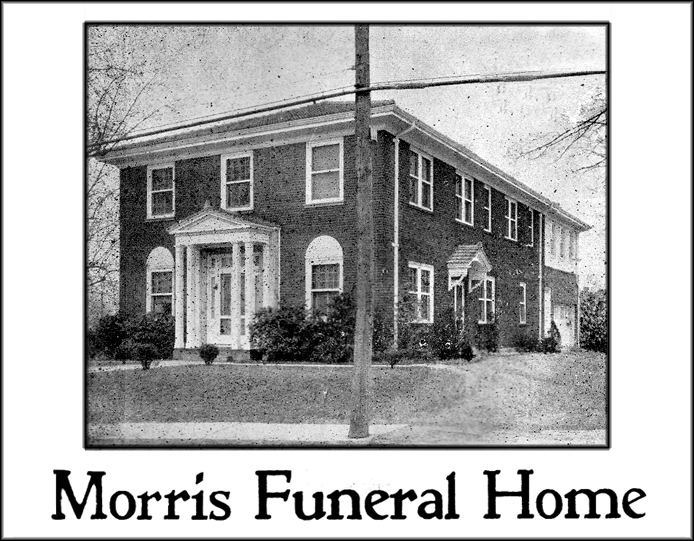
Forrest Morris, president of Morris Funeral Home (located at 305 N. Roan Street, opposite Central Baptist Church) and, prior to that, Sterchi Funeral Home on Spring Street), suggested to the widely-known radio personality, that his type of humor was completely in bad taste and the character should be permanently “laid to rest.”

In May 1948, Morris called attention to the insensitivity of the program with an editorial in the Johnson City Press-Chronicle that was sent to the popular radio program. In part, it said:

“Throughout my long tenure of service, “said Mr. Morris, “it has never been my desire to make light of death or its accompanying grief” and I confidently feel that if this well-known punster were to suffer poignant grief, he would without hesitation seek another means of livelihood.”

“Twixt you and me, “Dig,” death is never funny, nor, in the human circumstances of deep sorrow, can funeral service ever be considered festive or jovial.

“In all fairness, Mr. Digby, we put to you the case of a family suffering bereavement. Not an exceptional case of some overly sensitive family issue, but the typical family of average, decent Americans. They recently lost, let us say, their elderly mother. To keep the case entirely fair to you, let us think of this family, not in their first poignancy employing grief, but some weeks after the funeral.

“Picture this scenario: This family is still in the phase of adjustment and transition. They're slowly, very slowly beginning to find their way back into normal paths of life they'd known before the shock of their recent heartbreak. They are seated in their home on any given Saturday evening, trying as best they can to comfort one another, seeking any seemly diversion that may bring some sense of sorrow in their hearts.

“Someone turns on the radio, and all of a sudden without the slightest warning, comes Digger “Digby” O'Dell, the friendly undertaker” to the microphone. Before you know it, you have been exposed to a pointed pun, or play on words that conjures up a cold, hard, callous, grim allusion to man's physical mortality.

“In the circumstances of these people, and there are of several million like them at any given time in these United States, do you suppose your act would be a joke to them? In my opinion, Digger, it is something that far exceeds a joke.

“It is true that the funeral director earns his or her living from services connected with the burial of the dead, but no decent funeral director or embalmer, in my opinion, has ever been made happier to learn of any person's death.

“In a matter of speaking, funeral directors do have the patience of Job, but there's a limit to all things. In the tolerant opinion of many, your burlesque is no longer funny. It is time to take “Digby” and bury him six feet down.” Well said, Mr. Morris.

According to my research, the role of “Digger” was never eliminated from the radio show; instead, when the program was switched to television in 1949, it retained, not only the same character but also the same actor … John Brown.

In case you're even remotely interested, on May 16, 1957, Digger (John Brown) died of a heart attack at age 54 while en route to his doctor's office. It is unlikely that there was any blatant merriment present at his funeral service. We can only wonder.

Read more