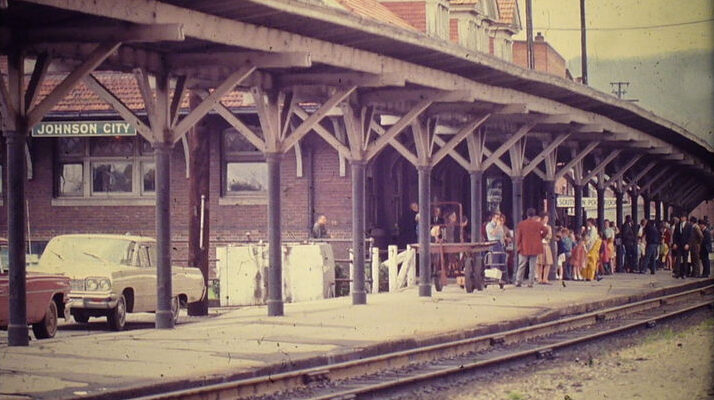
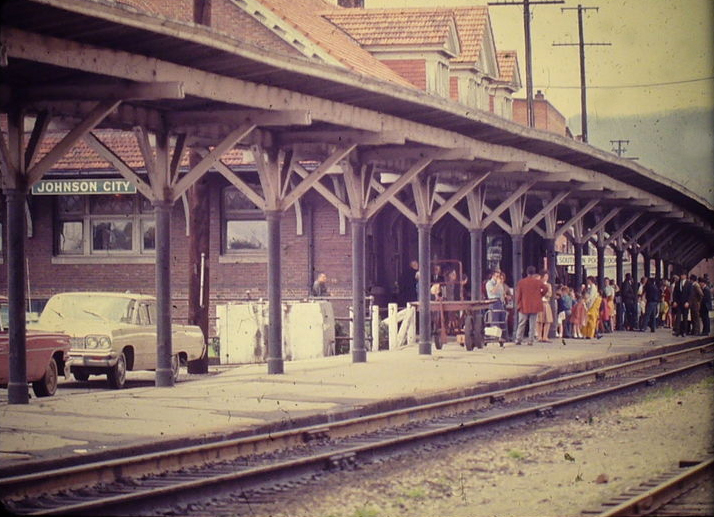
Today’s column photo should take many of my readers on a nostalgic journey back to the old long ago razed Southern Railway Depot. It was a fun place to go, especially when trains arrived and departed. It was even more pleasurable to purchase a ticket and ride the rails. My subject concerns an unpleasant incident – a train wreck.

The collision occurred in Johnson City on Dec. 21, 1956, resulting in a fatality and two injuries. Specifics of the tragedy were described in a detailed Feb. 1, 1957 Interstate Commerce Commission report. The accident happened within the yard limits of Johnson City on a single-track line over which trains were operated by timetable, train orders and an automatic block-signal system. 
According to my source, Work Extra 6507, a maintenance service train, was comprised of a diesel engine, eight cars and a caboose. It departed westbound from the east siding at Johnson City about 6:30 a.m. and stopped on the main track where the locomotive was detached and moved onto the middle siding.

No. 73, a westbound second-class freight train consisted of four diesel engines, coupled in multiple-unit control, 62 cars and a caboose. It departed from Bristol at 5:30 a.m., being seven hours late. It stopped briefly at signal 23.9A in Johnson City. The signal light indicated, “Proceed.” About 15 minutes later, after some cars had been removed and others added to the train, it continued on its journey.

Suddenly while the train was chugging along at about 10 miles per hour, it struck the rear end of No. 6507, pushing it 265 feet down the track and destroying its caboose. Three section men were riding in the caboose. One was killed and the other two were injured. The front end of No. 73 and the rear car of No. 6507 incurred some damage.

Early that morning, the crew of the service train reported for duty at Johnson City and assembled the train on the east siding. The locomotive then moved on the main track from the east siding-switch to the west siding-switch, entering the siding at the latter switch and was coupled to the west end of the train. It was then moved to the east switch of the middle siding and the locomotive was detached and moved onto the siding for the purpose of adding additional cars to the train. The conductor said that his plan was to enter the siding and permit No. 73 to pass. He said that a lighted red lantern and the red reflectorized disc, which served as a marker, were displayed at the rear of the caboose.

Before No. 73 reached the station at Johnson City, the engineer saw a yard locomotive pass by and assumed that it was the same one he had seen earlier. As the freight locomotive passed the station, the operator handed the fireman copies of three train orders and a clearance form. Almost immediately, he spotted the caboose of No. 6507 about 30 feet ahead of them and instantly applied the brakes, but it was too late to avoid a collision.

Contributing factors to the accident were a light rain and the early morning darkness. The front brakeman testified that dirt on portions of the front windows was not being cleaned sufficiently by the wipers, obstructing his view of the track ahead. He acknowledged that he did not see the caboose until seconds before the collision occurred. Crewmembers concurred that the large train was moving at about 10 miles per hour at the time of impact.

The official accident review, an impressive detailed report, noted that because of the curvature of the track and a building situated north of the track, the caboose could not have been seen until the locomotive was within 658 feet east of the accident site. The reflectorized disc, which served as a marker, was not visible by the big train until it was 380 feet from the small one.

The ruling by the Commission further stated that the accident was caused by failure to maintain a proper lookout ahead while moving within yard limits. Corrective policy changes were implemented by the company. 

Read more

I have fond memories of attending Henry Johnson School (W. Market Street opposite Kiwanis Park) in the 1950s. When I transferred there after completing the first grade at West Side School, I received a warm reception from the principal, Miss Margaret Crouch who escorted Mom and me on a tour of the school.

Mrs. Mary Jordan was the school’s music teacher, instructing students in all six grades. Several years later, I enrolled in her husband, Glenn’s, mechanical drawing class at East Tennessee State College. The couple resided in the Franklin Apartments on E. Main Street.

Mrs. Jordan taught us several patriotic songs like “America,” “America, the Beautiful” and “The Star Spangled Banner.” We routinely sang them during her class.

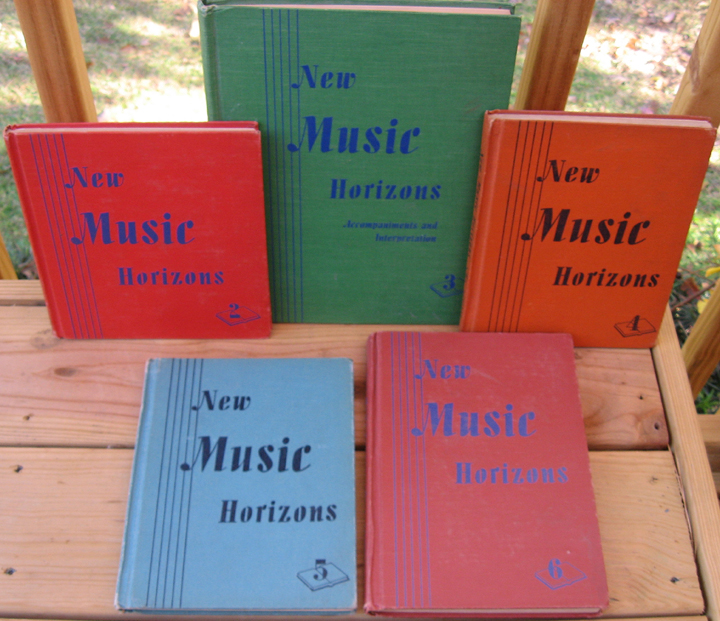
Our textbooks were the “New Music Horizons” series published in 1945 by the Silver Burdett Company for grades one through six. Each book was of a different size and color with the grade positioned on the lower right cover. Over the years, I began collecting them at flea markets and antique stores and acquired five, missing only the first one.

The six books focused on music activities through “singing, playing, dancing, listening and creating.” They were designed to deepen students’ appreciation of their forefathers who were a part of our American heritage. The primary grade books 1-3 provided a period of enrichment that helped prepare the students for more advanced concepts. The intermediate class books 4-6 took the pupils to a higher level of specific skills.

Notes contained at the back of each book provided specific instruction for teachers. The lessons provided the basics for reading music and also taught us about such instruments as the violin, cello, trombone, French horn, flute, trumpet, cornet, clarinet and saxophone in an effort to awaken our interest in instrumental performance. 

Mrs. Jordan occasionally brought records to class and played them for us. Some had stories associated with them while others introduced us to light classical music, such as “The Nutcracker Suite” and the Russian composition, “Peter and the Wolf,” by Sergei Prokofiev. I have a set of 78-rpm records that are narrated by Basil Rathbone. They possibly are the same ones she played for us. Another frequently played disc was about an old clock maker. There were a variety of alarms heard on it. 

Mrs. Jordan kept a variety of musical instruments in her room for illustrations, but she made it clear to her students that they were to be looked at, not touched or played. She decorated the room nicely around the theme of music. I have always enjoyed music and Mrs. Jordan enhanced my appreciation of it even more.

Our dedicated teacher instructed us in a French song titled “Alouette,” first published in Montreal, Canada in 1879: “Alouette, gentille Alouette (Skylark, nice Skylark). Alouette je te plumerai (Skylark, I will pluck you). Alouette, gentille Alouette (Skylark, nice Skylark). Alouette je te plumerai (Skylark, I will pluck you). Je te plumerai la tête (I shall pluck your head). Je te plumerai la tête (I shall pluck your head). Et la tête (and your head), et la tête (and your head). Alouette (Skylark), Alouette (Skylark), O-o-o-o-oh. Alouette, gentille Alouette. Alouette je te plumerai.”

The folksong, while very easy on the ear, was a bit shocking. It originated from French-Canadian women who sang the ditty while plucking skylarks, considered tasty game birds. Each verse built on the previous verse, much like the “Twelve Days of Christmas, as each part of the bird's body was plucked: la tete (head), la bec (beak), le nez (nose), les yeux (eyes), le cou (neck), les ailes (wings), le dos (back), les pattes (feet) and la queue (tail). Mrs. Jordan never told us what the words meant for obvious reasons. 

My thoughts often revert to the five years I spent at Henry Johnson School; it was a pleasant, carefree time in my life. 

Read more

Charles Kuralt is remembered for his popular 25-year “On the Road” program for CBS, a television series that began as a three-month trial in October 1967. Teamed with a cameraman and a soundman, the American journalist logged more than one million miles in six motor homes while producing approximately 500 segments. His formula for success was simple – stay off interstate highways and abide by no set itinerary. It worked.

Kuralt maintained a state-by-state file of letters from fans, references from public relations firms and ideas from local chambers of commerce. He sought out-of-the-way places with atypical stories and unsung heroes. He was given total freedom to explore this great vast land we call America.

Recently, I purchased a book titled, On The Road With Charles Kuralt (G.P. Putnam’s Sons, New York, 1985) from a local flea market. The chapter on Jonesboro (Jonesborough), Tennessee caught my eye. Kuralt branded the town as “The Most Contentious Little Town in North America.”

The first part of the report mentions the State of Franklin: “Jonesboro, Tennessee’s oldest town, stands quietly in the late autumn sun. It’s all so peaceful now. Hard to believe that it was once the most contentious little town in North America. That was just at the end of the Revolutionary War, when North Carolina, which had ambitions to be a civilized place, took one look at its western possessions, filling up with rough characters wearing buckskins and fighting Indians and decided enough was enough.

“So the state of North Carolina said to the brand new American Congress, ‘Tell you what we’re going to do. We’re going to give North Carolina west of the mountains to you.’ The Congress said, ‘Thanks, just the same. But we’ve troubles enough already and what we don’t need is a bunch of backwoodsmen living in a wilderness.’ People around here, left with no government, decided they’d better start one. And right here on this spot, they did. As far as they were concerned, it was the 14thstate. They named it “State of Franklin” after Ben Franklin.”

Headquarters for the new territory was in a building on the site where today’s Washington County Courthouse is located. The new government elected Colonel John Sevier as its governor. The book was a bit unkind to Sevier by noting that the venture was unsuccessful because his constituents were a headstrong, unruly, rough and tumble, ungovernable lot who ever tried to form a government. They were unable to get along and frequently engaged in physical altercations in the courtroom. They even had competing sheriffs to arrest one another. The old graveyard in town received brisk business from the frequent use of muskets and pistols.

The situation grew even worse when a daring young lawyer, named Andy Jackson, rode into town itching for a fight. He and Colonel Robert Love instantly engaged in a verbal exchange. “You sir,” said Jackson, “and all your family are a band of land pirates.” Colonel Love countered, “And you sir are a (expletive) long, gangling, sorrel-topped soap stick. John Sevier added his two-cents worth: “Andrew Jackson is the most abandoned rascal my eyes have ever beheld.” Jackson replied angrily in a newspaper ad: “Know ye that I, Jackson, do pronounce, publish and declare to the world his Excellency, John Sevier, is a base coward and poltroon.” The initial battle of words eventually gave way to swords, canes and guns.”

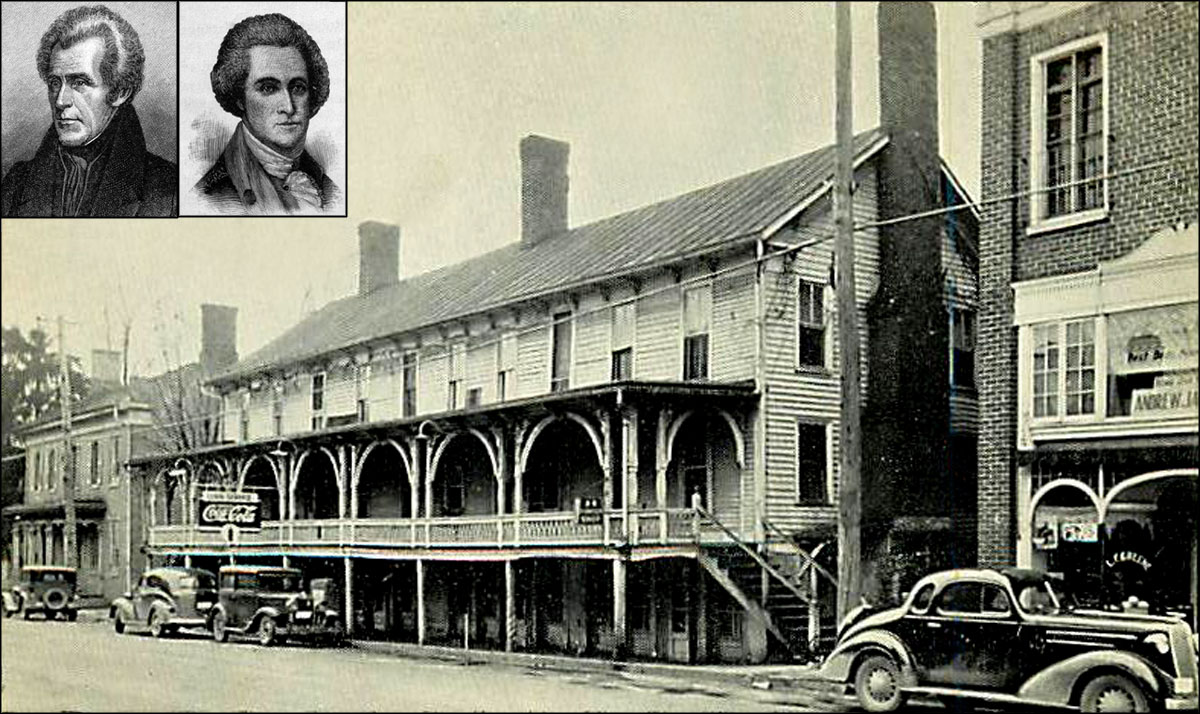
The book recalled an incident that occurred at the Chester Inn as told by the late historian, Paul Fink. Jackson came to town to hold court, but he was so ill, they had to help him from his horse and put him in bed at the inn. Believing that he was about to be tarred and feathered, Jackson asked for guns at his bedside and dared anyone to approach him. No one did and the incident was quickly defused. Kuralt noted that after the three men moved away from the town, “Jonesboro’s been a lot quieter.” 

Read more

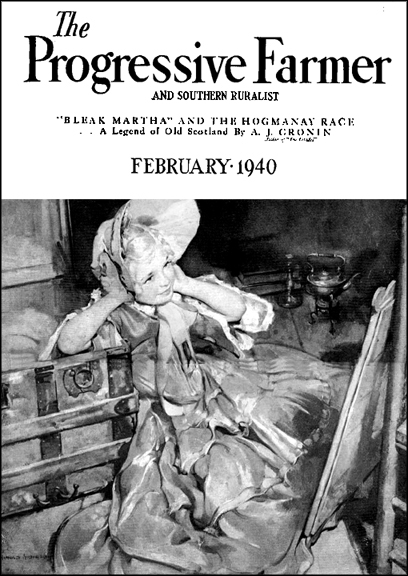
During my youth, I recall seeing a magazine titled, “The Progressive Farmer” lying around in some of my relatives’ country homes. I loved to glance at the ads in it. Today, I occasionally purchase one at a flea market, antique store or auction and I still enjoy its dated contents.

Today’s column photo is from the February 1940 edition. Reading it is a nostalgic trip down memory lane. Allow me to paraphrase comments from selected ads:

Prince Albert tobacco evoked a special memory for me. Some of us pranksters phoned grocery stores and asked the attendant if he or she had “Prince Albert in a can?” The response was always in the affirmative. We then responded: “Well, you better let him out before he suffocates.” We then hung up. The tobacco was advertised as “Crimp Cut” to be used in long burning pipes and rolled (yes rolled) cigarettes.

In another ad, seven panels reveal a father trying to convince his young son to swallow some foul-tasting adult laxative. Mother soon comes to the rescue with a spoonful of Fletcher’s Castoria. The lad gleefully laps the spoon. Somehow, I do not remember it being that wonderful, but it definitely beat Castor Oil.

International Harvester’s new McCormick-Deering Farmalls introduced ‘Lift All,” the first all-purpose hydraulic air lift and ‘Culti-Vision,” with offset controls that gave the driver full view of his field. Four models were offered.

Plymouth offered a two-way guide to the best car value. Customers were urged to examine the quality chart for facts about the new 1940 vehicles and then take the luxury ride for proof. Plymouth’s rating that year was 21, the highest score among the other cars.

The Lifebuoy’s Health Soap ad proclaimed that hard work, exercise and even the lightest farm chores could bring on perspiration. To the rescue comes Lifebuoy; its crisp odor immediately disperses, leaving the bather with protection that lasts and lasts. I loved the smell of Lifebuoy in my youth and still do.

Ball Band Shoes were so-named because they had a black band around them. They were marketed with a big red dot with the words, “Look for the Red Ball.” They supposedly fit better, were more comfortable, resisted wear and were more affordable than their competitors.

Lee Overalls is another one I recall. A Ripley’s “Believe or Not” entry that year stated, “If Lee overalls started marching today past your home 13 paces apart, they would march forever and no overall would pass your home twice.” Ripley explained why. “As fast as this line would march, new overalls being manufactured by Lee would maintain the line and the march would go on (indefinitely). The ad concluded with “If Lee overalls don’t last longer than any overalls you ever wore, Lee will give you a new pair free.” Believe it or not.

A&P Food Stores promoted their coffee line by joining thousands who saved on their three brands of coffee: Eight O’clock, Red Circle and Bokar. I don’t recall those brands.

Harley Davidson told farmers that owning a motorcycle offered many advantages: riding to and from school, performing farm errands quickly and economically and taking scenic vacations. Sending in a coupon brought a 24-page brochure featuring photos and stories from owners.

Tuxedo Starting and Growing Allmask guaranteed to keep farmers’ chicks healthy, allowing them to grow into well-developed pullets with high egg production. The product aimed at helping these birds withstand diseases induced by vitamin starvation such as nutritional roup, nerve disorder and rickets. The product’s empty bag could be used for making dresses, romper suits, draperies, furniture coverings, pillows and other useful articles. 

Finally, the Bristol Chick Hatchery took out a small ad for Leghorns, Rocks, Reds, Irpingtons, Wyandottes, Hampshires, Giants and Cornish. Interested parties could write for an illustrated circular describing the products.

The thing that stands out in the publication is the low cost of products and services in 1940.  

Read more

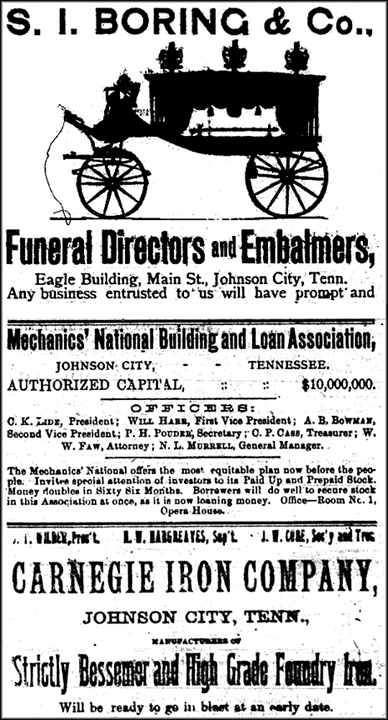
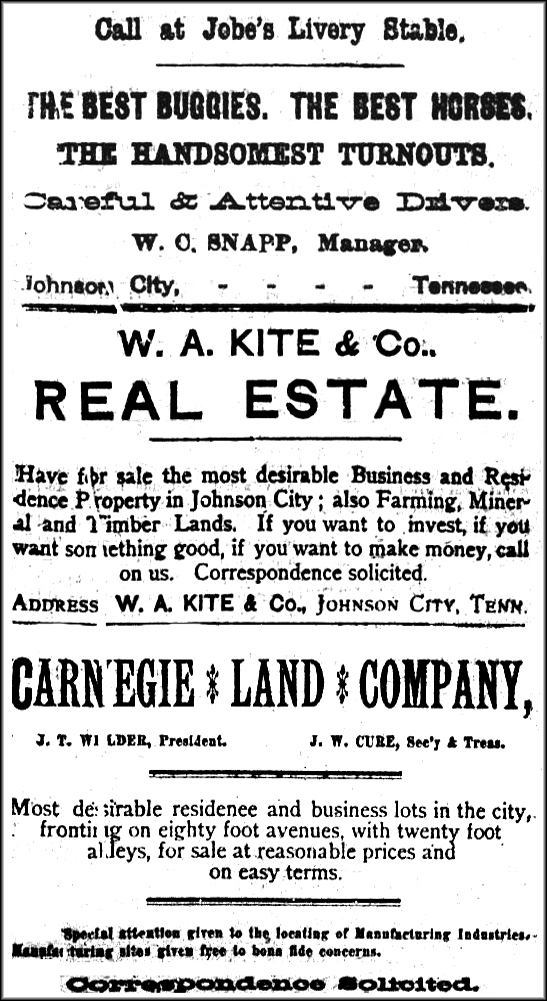
An oft-repeated article in the 1891 edition of an early Johnson City newspaper, The Comet, promoted the town as being a great place to reside. According to a Dec. 1891 depiction, the city had several taglines: “Center of Trunk Lines and Terminal Roads,” “Gateway to the Mineral and Timber-Laden Alleghenies” and “In the Heart of the Celebrated Magnetic Ore District.”

The publication noted that Johnson City was located 106 miles northeast of Knoxville at the intersection of two great trunk lines, the East Tennessee, Virginia and Georgia Railroad and the Charleston, Cincinnati and Chicago Railroads. It was also at the termini of the East Tennessee and Western North Carolina and the Johnson City and Carolina Railroads.

The Johnson City and Greensboro Railroad, an extension of the Richmond and Danville line from Greensboro to Johnson City via Wilkesboro, had been chartered and a preliminary survey made. In addition, the Johnson City and Cumberland Gap Railroad Co. had been organized.

The Southern and Eastern Line was building from Shelby and Cranberry to connect with the East Tennessee and Western North Carolina Railroad. While Johnson City was not considered to be a speculative town, it was a substantial young city whose progress within the past two years bore favorable comparison with many other cities in the South. It was in the midst of an excellent agricultural section.

Cereals, tobacco, grasses and a variety of fruits grew to perfection. There was no better section for the stockman, the cattle breeder, or the fruit grower. Also, it had at its door an unlimited supply of the finest timber obtainable. Nearly all of the hardwood abounded in vast quantities, an excellent source for wood working plants of every description.

The town was literally hedged in by mountains of iron ores, with red and brown hematite abounding in seemingly inexhaustible quantities. It was situated near the base of the Cranberry Mountains, whose celebrated magnetic ores were its natural outlet. Its proximity to the magnetic ores of the east and coalfields on the west certainly made it the steel-making center of the South. Limestone was found here in quantities beyond estimation and of the best quality.

The city, with an altitude of 1650 feet above sea level, was noted to be very healthful and was growing in leaps and bounds. The population, according to the 1890 census, was 4160, an enormous 507% increase over the 1880 one, when it was only 685.

In December 1891, the following enterprises were either in operation or being constructed: Johnson City Tin and Stove Co. (manufacturers of tinware), W.C. Remine (marble yard), Johnson City Foundry and Machine Works, Johnson City Furniture Co., Watauga Electric Lighting and Power Company, Johnson City and Carnegie Street Railroad Co., Watauga Tanner, Carnegie Iron Company (with a 125-ton blast furnace), Brown and Biddle (125-barrel process flouring mill), Miller Brothers (machine shop and foundry), Crandall-Harris (tobacco factory), J.E. Harr (cigar factory), W.J. Graham & Co. (ice factory and bottling works), Johnson City Brick Works, S.F. Ivina & Co. (brick works), J.T. Hoss & Co. (brick works), Allison & Shafer (brick works), Campbell & Co. (brick works), Johnson City Canning Factory (A.B. Bowman), Watauga Lumber Company, Cooper Brothers (planing mill), J.M. Carr & Co. (planing mill), John Sanders (planing mill), Fishback & Weiger (bakery), City Steam Laundry, Browning & Co. (soap factory) and Watauga Water Co.

The Comet identified several city officials. The Johnson City Law Court, which convened the third Monday of April, August and December, was comprised of A.J. Brown (judge), S.H.L. Cooper (clerk) and P.H. Pouder (deputy clerk). The Johnson City Chancery Court, which met on the first Monday in June and December, consisted of the Honorary John P. Smith (judge), A.B. Bowman (c and m) and P.H. Pouder (deputy c and m).

Corporation offices convened on the First Thursday of each month. They were filled by Ike T. Jobe (mayor), George P. Crouch (recorder), Robert Ramine (chief of police), A.R. Johnson (city attorney), R.C. Hunter (city constable) and Dr. R.S. Bolton (city physician).

J.M. Martin was postmaster. The post office was open weekday from 8:00 a.m. until 7:00 p.m. It was closed on Saturdays but open on Sunday 7:00 a.m. to 8:20 a.m., 1:30 p.m. to 3:30 p.m. and 4:30 p.m. to 5:30 p.m. The Money Order Department conducted business on weekdays from 8:00 a.m. to 4:00 p.m.

The Board of Trade consisted of William G. Mathes (president) and Cy H. Lyle (secretary, publisher of The Comet). They met each Monday evening at an unspecified location on E. Main Street.  

Three train schedules were posted in the newspaper. The first was the East Tennessee and Western North Carolina Railroad. One of four westward/eastward routes showed it leaving Johnson City at 7:45 a.m., traveling to Milligan College, Watauga Point, Gladeland (flag station), Elizabethton, Valley Forge (flag station), Hampton, Pardee Point (flag station), Blevins, White Rock, Crab Orchard (flag station), Roan Mountain, Shell Creek, Elk Park, Hotel and arriving in Cranberry at 11:15 a.m.

The second schedule was for the Charleston. Cincinnati and Chicago Railroad. One of the four north routes timetables had it leaving Ranges at 4:00 p.m., going to Harrisburg, Austin Springs and arriving at Carnegie at 4:50 pm. After a two-hour stopover, it continued on to Main Street in Johnson City, Okalona (Okolona), Fagans, Marbleton, Unicoi and Erwin at Unaka Springs.

The third schedule showed the East Tennessee, Virginia and Georgia Railroad. Three times a day, the train left Johnson City going west for Knoxville, Cleveland and Chattanooga. In addition, three trains left Johnson City heading toward Bristol and points east.    

Finally, ten churches were listed: M.E. Church South (K.C. Atkins), Watauga Sunday School at Lusk’s Institute (J.W. Crumley), M.E. Church (G.W. Coleman), Presbyterian Church (J.C. Cowan), Baptist Church (East Carnegie Baptist Church (J.H. Snow), Christian Church  (D.T. Buck), Carnegie Mission Methodist Church (T.S. Russell), Episcopal Mission (W.C. Wells) and Cumberland Presbyterian Mission Church (T.B. McAmis).

The Comet was a quality publication offering a glimpse of mostly long-forgotten history from yesteryear. 

Read more

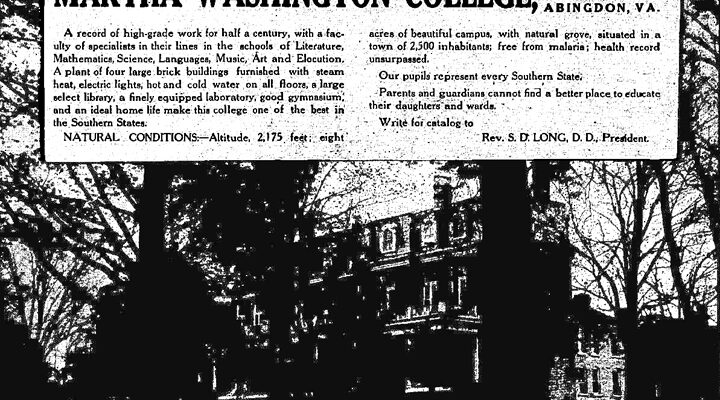
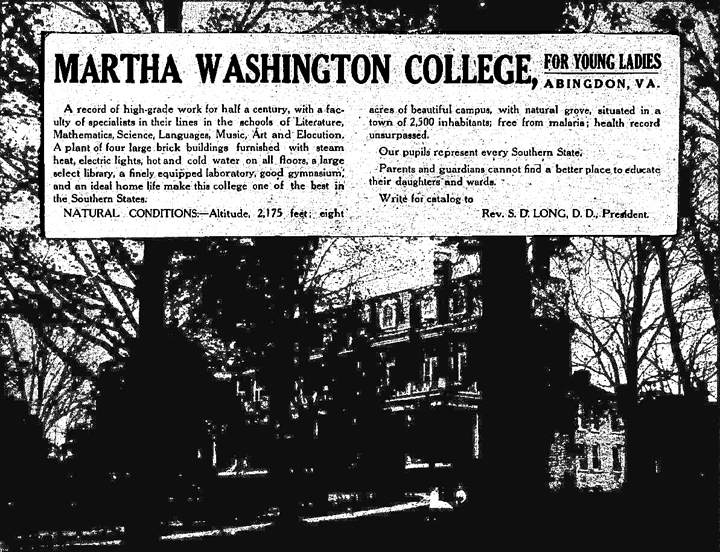
Most area residents are familiar with the Martha Washington Inn, located near Barter Theatre in downtown Abingdon, Virginia. General Francis Preston, hero of the War of 1812, had the building constructed in 1832 for his family of nine children. Over the years, it served as a women’s college, a Civil War hospital and barracks and as an inn for actors and guests of Barter Theatre.

The general built the brick residence at a cost of $15,000. It remained in the Preston family until 1858, when it was sold for $21,000 to the founders of Martha Washington College.

The school offered the following curricula: bookkeeping, shorthand, typewriting; English, history, expression, French, German, fine and industrial arts, home economics, mathematics, science; Latin and Spanish music for piano, pipe organ, violin and voice. Graduation from the standard 4-year high school admitted a student to the junior class, making graduation possible in two years. Completion of two high school years admitted them to the Freshman Class.

During the Civil War, the college served as a training ground for Confederate soldiers, known as the “Washington Mounted Rifles.” The building became affectingly known as “The Martha.” The college, devoted entirely to women, operated for 70 years until finally falling victim to the Great Depression.

In 1935 after passing through various hands, the Martha Washington Inn opened. It has operated ever since in the capacity of a hotel. In 1984, the United Group, an investment group of businessmen, purchased the inn and financed an 8 million dollar renovation. Eleven years later, the property was admitted to the Camberley Collection of historic places. Today, the inn is known as Martha Washington Hotel and Spa.

The architectural integrity of the Martha was preserved from the beginning. The original living room of the Preston family became the main lobby of the inn. One of the original items owned by the family was the Dutch-baroque grandfather clock, which stood over nine feet tall. This beautiful clock, which was shipped from England by one of the Preston daughters, took its rightful place in the East Parlor of the inn.

Some of the famous guests who lodged at the inn included Eleanor Roosevelt, President Harry Truman, Lady Bird Johnson, Jimmy Carter and Elizabeth Taylor. The hotel has also played host to actors performing at the Barter Theatre, which is across the street from the inn.

I located four advertisements promoting the long vanished school in some old newspapers dated from 1900 to 1911. For brevity, I have paraphrased the comments.

July 12, 1900: Martha Washington College is the oldest female college in Southwest Virginia and has made a glorious record in the education of the daughters of our immediate section and of the South. Last year was one of the most successful it has ever enjoyed, boasting the largest number of boarding pupils in its history.

August 24, 1905: Martha Washington College and Sullins College, located respectively in Abingdon, Virginia and Bristol, Tennessee are 15 miles apart and are under the same management through courses in literature, music, art and elocution. The facilities have steam heat, electric lights and bathrooms on all floors with hot and cold water.

July 13, 1906: The Martha Washington College campus is on the Norfolk and Western Railway, being located 290 miles southwest of Richmond, 93 miles from Roanoke and 14 miles from Bristol.

August 20, 1911: The college opens September 13, 1911. For 50 years, this college has stood in the forefront of the colleges of the South with an ideal climate, altitude at 2,175 feet, delightful home life and a health record unsurpassed.

A drive by the Inn today reveals a facility as beautiful as it was then. 

Read more

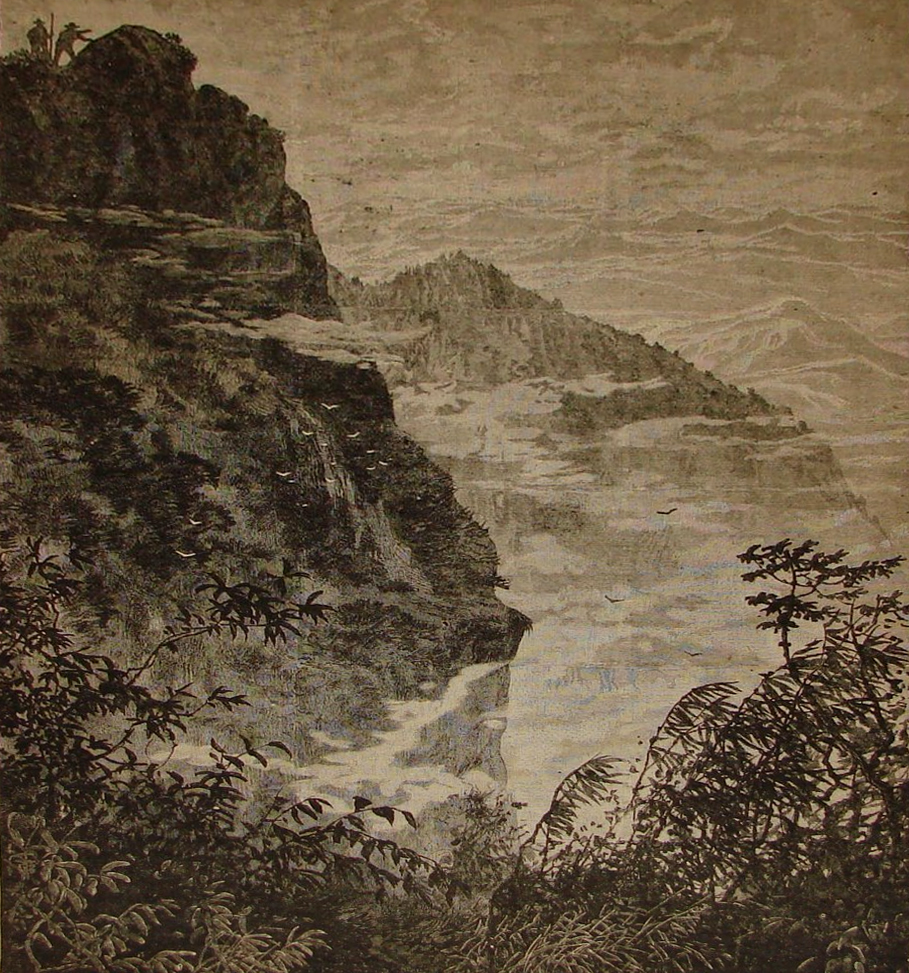
A nameless correspondent had the unique privilege of touring a mica mine on Roan Mountain, Tennessee in 1890. The writer, obviously impressed with the stunning terrain, made some astute observations:

“Mountains after mountains and hills upon hills go rolling over the broad expanse and here and there is to be seen the swift mountain stream rushing on with furious speed and tireless course to the ocean, mother of all. The salubrity of the atmosphere is something to be wondered at and, if anything, will instill new life into the over-worked and indisposed city man.”

An overcoat was essential for those not acclimated to climbing steep declivities. The writer declared that the only way to travel there was on a mountain mule, a sure-footed critter with no danger of falling off, as it meanders over places where man would not dare to tread.

The country of East Tennessee in the late 1800s was sparsely settled and consequently not in a very high state of cultivation. Although the mountain’s thick wooded forests produced the finest timber in the world, they were so inaccessible to railroads and waterways that land could be obtained for five dollars an acre. Lumbering was one of the principal vocations of the people. Some coal mining was pursued because it could be found all over the area in considerable abundance.

A crew of mine workers graciously invited the reporter to descend into their mica mine with them. It began with a scenic drive to the mine site on roads uncommonly smooth for mountain treks. Upon arrival, the reporter encountered “a strange kind of people.” They lived peacefully with very little commercial intervention from outsiders. They raised crops and hunted meat on their land. When they obtained enough mica from the mine, they shipped it off in low wagons, drawn by mountain mules, to be used in exchange for clothing and other necessities that their land could not produce.

The machinery of the mine was crude compared to those found in larger ventures in other regions. The party was then precariously lowered 60 feet through a shaft by a rickety machine, which consisted of a rough platform attached to a rope that was powered by two brawny looking fellows.

When the group reached their subterranean destination, their special guest was introduced to mica, being told that the ore could only be obtained by blasting. The group then walked down several dark little corridors, almost freezing to death, until they spotted the ore they were seeking.

One massive six-foot gentleman, who appeared to be the boss, ordered blasting power to be brought out. There was no dampness detected in the mines; nor were there any noxious gas explosion concerns to deal with. The miners wore ordinary oil lamps on their hats because regular lamps used in other mines were unnecessary with mica.

The journalist then noticed some safety manhole covers in the mine with doors on them that allowed personnel access. After powder was placed in strategic positions, the fuse was ignited and every man scampered into a manhole for protection. Following the explosion, their visitor started to exit the barrier, but was quickly warned to stay inside to keep from smothering to death from dust and smoke. After a few moments, the all clear was given and everyone exited the enclosure to claim the prize – enough mica for a couple of cartloads. Also present were general debris and dirt.

After the waste was removed, each blast yielded enough mica to fill a bushel container. The miners were restricted to two blasts a day due to smoke and gas rising from the burning of powder.

As the correspondent departed the mine, he felt sorry for the individuals who made a living in this crude manner. Although the mine was not very profitable, he later found out that it yielded the purest mica than any mine located in the country. 

Read more

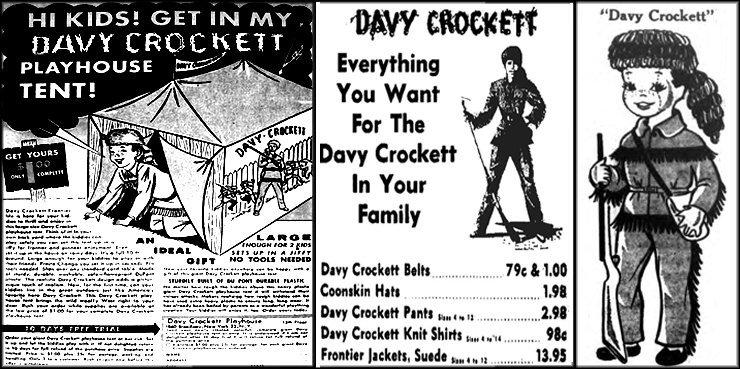
In the spring of 1955, coonskin caps and similar paraphernalia became the fashion among youngsters when a song, “The Ballad of Davy Crockett” by Bill Hayes, reached the top spot on the pop charts, remained on the pinnacle of the charts for five weeks and eventually sold over seven million records. Other artists also recorded it.

Davy was born in 1786 on the banks of the Nolichucky River. Today, a restored cabin at the Davy Crockett Birthplace State Park in Limestone marks the spot of his birth. After a remarkable outdoorsman and political career that eventually took him to Texas, the pioneer bravely gave his life at the Alamo in 1836, along with other volunteers.

When I was a young lad, my father used to drive my mother and me to the park, usually on a Sunday afternoon outing, which included steering our car through a shallow creek and swinging on thick grapevines in trees along the riverbank. Those were fun times.

Davy Crockett became a five-part television special, which aired in one-hour black and white episodes on ABC’s “Disneyland.” The story featured Fess Parker as the real-life frontiersman and Buddy Ebsen (later Jed Clampett on The Beverly Hillbillies) as his friend, George Russell:

Episode 1: “Davy Crockett, Indian Fighter” (Dec. 15, 1954). The initial program introduces the characters and unfolds the storyline. In one scene, Davy and a bear savagely go head-to-head in the bushes with Crockett, of course, emerging as victor. Major General Andrew Jackson summons the two men to secure a truce with a band of Indians who had assaulted a military outpost. Davy earns the respect of their leader, Chief Red Stick, after beating him in hand-to hand combat.

Episode 2: “Davy Crockett Goes to Congress” (Jan. 26, 1955). Davy learns of the death of his wife, Polly, back in Tennessee. Later, he wins a seat first in the Tennessee House of Representatives and later in the U.S. House.The pioneer quickly learns that Andrew Jackson, then a candidate for president, is using him to help rob Indians of their rightful property. Disgusted, Davy quits politics and returns to the great outdoors that he loves.

Episode 3: “Davy Crockett at the Alamo” (Feb. 23, 1955). Crockett and Russell reunite and head for the Alamo in San Antonio, Texas to help the Texans secure the fort. They realize that the outlook is grim but, against all odds, stick it out and fight a spirited battle to the finish. In the final scene, Davy swings his rifle as hordes of Santa Anna’s soldiers descend upon him. Disney spares his viewers from seeing Crockett’s death scene.

Episode 4: “Davy Crockett’s Keelboat Race” (Nov. 16, 1955). Even though Davy had perished at the Alamo, Disney was not about to let his popular specials come to an end. Crockett reappears in a flashback in Kentucky with his buddy, George, to take on Mike Fink (Jeff York), the pompous, self-proclaimed “King of the River.” They are challenged on a money bet to a keelboat race to New Orleans. Fierce competition and shenanigans ensue as the two boats travel down the mighty Mississippi River.

Episode 5: “Davy Crockett and the River Pirates” (Dec. 14, 1955). This concluding story is a continuation of episode 4, but in this one, Davy and George befriend Fink to bring to justice a group of bandits posing as Indians. They enlist a traveling minstrel who is secretly in cahoots with the outlaws. It’s a race against time to avoid a major conflict. The outcome is predictable.

Although the five television specials were seen on black and white TV sets, Disney wisely filmed the originals in color. Later, he combined the first three shows, totaling 150 minutes, into a 93-minute motion picture titled, “Davy Crockett, King of the Wild Frontier” that was released on May 25, 1955. He then put the last two episodes of 100 minutes into an 81-minute edition called, “Davy Crockett and the River Pirates. It hit the theatres on July 18, 1956.

A viewing of those movies today conjures up memories of those wonderful days in the 1950s. 

Read more

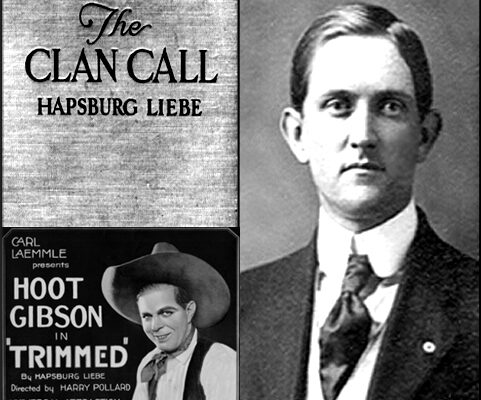
While examining my late Grandma Cox’s scrapbook and photo collection, I stumbled upon a picture and an obituary notice for Charles Haven Liebe. According to her compilation, their great grandfathers were brothers.

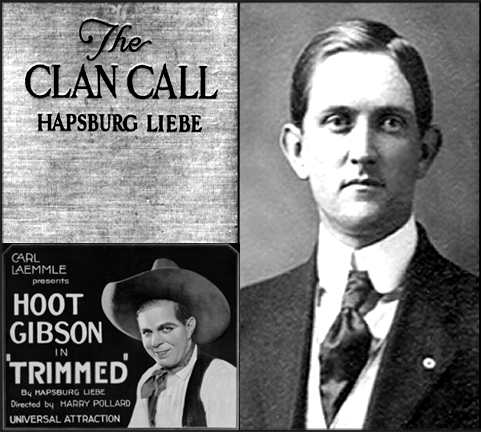
Charles was born in 1880 on Lick Creek in Greene County. After serving in the Spanish-American War in 1898, he married Harriet “Hattie” Lee White. The couple moved to Johnson City about 1916, residing for about two years at 915 E. Sixth Avenue (Carnegie designed street later renamed Holston Avenue). Charles’s writing career began in 1910 and kept him gainfully employed until 1953, yielding one fiction novel and an estimated 321 short stories for pulp magazines and newspapers. He used “Hapsburg Liebe” as his pen name, but occasionally utilized two additional ones, “Charles Haven” and “John Bennett.” The Liebe family moved to St. Petersburg, Florida where he purchased a movie studio by the name of Tropical Pictures.

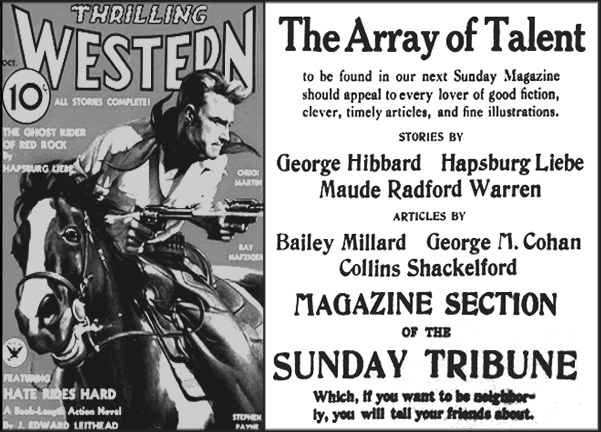
Pulp magazines were very popular from 1896 through the 1950s because of their low cost (about 10 cents) and entertaining action packed stories. They were so-named because they were printed on cheap wood pulp paper often with untrimmed edges. However, the covers were eye grabbers, featuring bold multihued colorful art and bold action scenes. Hapsburg focused mainly on westerns, but occasionally ventured into stories about the mountaineer clan that he knew so well. Some of the magazines (and years) that Liebe wrote for include the following:

Ace-High Magazine (1928-41), Adventure (1916), All Western Magazine (1935-38), Argosy (1918-36), Big-Book Western Magazine (1940-41), Blue Book (1913-27), Colliers (1919), Complete Story Magazine (1925), Double Action Western (1936-39), Double-Action Gang Magazine (1938), Exciting Western (1941-42), Fiction Quarterly (1944), Frontier Stories (1927), Good Stories (1921-31), Grit Magazine(1929), Gun-Swift Western (1938), Jester’s Luck (1936), Master Thriller Series (1937), Mellifont All Western Library (1940s), North West Stories (1927), People’s Home Journal (1912-13), Popular Western (1936-42), Range Riders Western (1942-49), Romance (1915-29), Romantic West Annual (1952), Short Stories (1920-59), Street & Smith’s Western Story (1942-47), Texas Rangers (1937-57), The Danger Trail (1928), The Golden West Magazine (1927), The Phantom Detective (1935), The Rio Kid Western (1940-41), Thrilling Western (1934-40), Top-Notch, (1925-36), Triple-X Western (1928-31), West (1927-51), Western Action (1938-39), Western Magazine (1936-45), Western Romances (1937), Western Short Stories (1942), Western Yarns (1938), Wild West Stories (1936), Wild West Weekly (1940-43) and World Wide Adventure (1967, published after his death).

Seven silent black and white movies were made from Hapsburg Liebe’s stories. Shown below (if known) are film titles, date, genre, run times, recognizable movie stars and production companies: Circumstantial Evidence (1912, 10 minutes, Selig Polyscope Co.), Weapons of Love (1916, Big U Co.), The Last Rebel (1918, drama, Triangle Film Corp.), Bill Apperson’s Boy (1919, drama, Jack Pickford Film Co.), Trimmed (1922, drama/western, five 10-minute 35-mm reels, starring Hoot Gibson, Universal Film Manufacturing Co.), The Broad Road (1923, melodrama, Associated Authors) and Down Upon the Suwanee River (1925, melodrama, Royal Palm Productions). Perhaps this inspired Hapsburg to purchase his own movie production company.

Surprising, Hapsburg wrote only one fiction novel, a 239-page mountaineer story titled Clan Call (Doubleday, Page and Co., 1920), which makes references to several East Tennessee landmarks. It deals with a mountain clan.

In 1957, Hapsburg passed away in St. Petersburg and was given a military funeral. William Johnson of Houston Texas, who amassed a large collection of his writings, donated it to the Swem Library at the College of William and Mary. Perhaps it is time for my wife and me to visit Colonial Williamsburg and learn more about my relative. 

Read more

During Christmas 1928, Johnson City was merrily clad in holiday yuletide adornment as the holiday spirit prevailed throughout this area where hundreds of enthusiastic people had arrived to shop. The much-awaited day fell on Tuesday that year.

Because Johnson City merchants knew that shopping would occur on a far greater scale that year, they secured additional stocks of goods several months prior in order to take care of shoppers’ expectations. Store windows throughout the downtown area were elaborately and colorfully decorated, enhancing the excitement in the air. Many people shopped early to beat the ever-growing crowds.

Special programs were given in local churches and schools as the big day neared. Attendance was so good that some houses of worship had to schedule additional services. The “white gift service” that had become an annual tradition in many area churches resulted in churchgoers placing gifts wrapped in solid white paper under a selected tree for distribution to the city’s needy folks.

Steam driven trains that were crowded to capacity chugged along on all railroads tracks passing through Johnson City as the festive season approached. College students and people from all sections of the country were en-route to their homes to spend the holidays with friends and loved ones. It was truly a joyful time of the year.

Typical chilly weather prevailed that year in East Tennessee, although little snow had covered the ground. Weather forecasters offered news of the possibility that the North and Middle Atlantic States might enjoy a white Christmas. However, fair weather with temperatures somewhat below normal was predicted for the South Atlantic and East Gulf states. Rain or snow was anticipated for the Ohio Valley and parts of Tennessee.

Christmas trees were available in abundance. In the downtown section, large numbers of them lined the sidewalks and in vacant lots all across the city, hundreds of well-shaped trees were being sold at below normal prices. Area markets were stocked with plenty of turkeys and chickens while local stores carried an abundance of cranberries, nuts, celery and other food items considered essential for a delectable Christmas dinner.

As had been present in previous years, large Christmas shopping crowds were jamming city streets on that Saturday afternoon before Christmas. A majority of those seen on city streets were out-of-towners making Johnson City their shopping headquarters. Many residents can recall when Main Street was so jam packed with people on Saturdays that it was an effort to maneuver through the downtown district. Automobiles, buses, cabs, trains, streetcars and other means of conveyance were everywhere. Shoppers swarmed the city on the Saturday before Christmas, visiting the various stores until late at night making purchases. Christmas Eve also brought a frenzied swarm with late shoppers buying last minute gifts.

King’s Department Store advertised a “Half Million Dollar Holiday Campaign” that year, which included a family night dinner on its fourth floor from 5:30 to 7:30 on the Tuesday evening before Christmas. The menu included fried chicken, creamed potatoes, creamed asparagus, fruit salad, hot rolls, chocolate pie and a choice of coffee, tea or milk. The cost was fifty cents. Since the downtown was nearly filled to capacity as Christmas approached, many businesses extended their store hours to accommodate late minute purchases.

Times were happy that Christmas of 1928, but unknown to the masses, within ten months the dark ominous clouds of the Great Depression would abruptly descend on the economy adversely affecting Christmas shopping for several years to come.  

Read more