Chester “Chet” Willis is a man with his heart wrapped up in his work. In 2003, he retired from his job as construction foreman with the City of Johnson City Water and Sewer Services Department and eagerly became involved with preserving Oak Hill Cemetery.

Oak Hill is the oldest cemetery within the city limits and contains the remains of just over 2700 inhabitants. As a member of the Cemetery Survey Team of Northeast Tennessee, this assiduous 80-year old individual assumed numerous laborious tasks that included restoring grave markers, producing and maintaining a massive directory of graves, installing 177 small red brick row markers, opening and closing the two main gates each day (at 6 a.m. and sundown) and helping keep the grounds well-groomed. 

This seven-gated chain length fence necropolis is one block off W. Main Street and surrounded by four streets – Wilson (north), Boone (east), Lamont (south) and Whitney (west).

Well-known Oak Hill residents include Henry Johnson (city founder), Tipton Jobe (landowner), Col. LeRoy Reeves (Tennessee state flag designer), Sam R. Sells (U.S. Congressman), Major Cy Lyle (publisher of the Comet newspaper), George Hardin (supt. of ET&WNC Railroad), Captain William Dickinson (Confederate pioneer and owner of Piedmont Hotel), Rev. John Wright (soldier in War of 1812 and officer for the Confederacy) and others.

Some 141 veterans are buried at Oak Hill  from the Civil War (55 Confederate, 29 Union), Spanish American War (16), Philippine Insurrection (1), Mexican War (1), World War I (30), World War II (5), and regular Army (4).

Mr. Willis produced a notebook full of annual reports from the Oak Hill Cemetery Association. The Jan. 24, 1946 one is particularly significant because it represents the golden anniversary of the society. The report began with a brief history of the cemetery: “Dear Member: On March 2, 1870, a bond was made by Robert Love and Samuel H. Miller to seven trustees – T.A. Faw, James M. Gentry, Wm. H. Taylor, Jm. Johnson, J.W. Seehorn, L.H.P. Lusk and P.P.C. Nelson – giving title to a part of their farms to be used for a cemetery for the growing village of Johnson City.”

Love donated about a half-acre and Miller roughly a quarter-acre. Each man reserved a 25’ x 35’ plot for his family members. Love’s was located in the northeast corner and Miller’s in the southwest sector. The oldest grave is that of Love’s daughter who died as a youngster in 1867. The contract specified that a “good plank fence” be built around the perimeter of the property and that the facility bear the name “Oak Hill Cemetery.” Over the years, additional adjoining land was added expanding the grounds to 6.5 acres. 

By 1888, the downtown cemetery was described as being a wilderness of weeds and briers and nothing less than a pasture for the town cow. When a new fence was needed in 1896, a committee of women from each of the area churches was formed to raise money. Mrs. C.K. Lide served as its first president. The group held oyster and strawberry suppers, sponsored lectures by such notables as Bob and Alf Taylor and hosted numerous musical productions to maintain the venerated downtown property.

A big “thank you” is in order to Chet Willis from the people of Johnson City for his unfaltering efforts toward preserving the final resting place of some of Johnson City’s most prominent citizens. 
Read more

Hacker Martin (1895-1970) was a legendary former resident of the Gray community with some pretty impressive credentials – old-time fiddler, gristmill owner/operator and expert gunsmith.

Hacker and Maude Martin raised a daughter, Betty, and two sons, Raphael and Donis, the latter being longtime owner of Martin’s Jewelers in downtown Johnson City. Betty Thompson recalled that her father learned to play the fiddle from a mail-order correspondence course. His musical prowess inspired her to use music as a hobby and sing in church choirs over the years.

Mrs. Thompson remembered some of the tunes Hacker and friends played: “Turkey in the Straw,” “Big Rock Candy Mountain,” “Billy Boy,” “Goodbye Liza Jane,” “Red River Valley,” “Hand Me Down My Walking Cane,” “Little Brown Jug,” “Oh Dem Golden Slippers,” “Old Gray Mare,” “Coming ‘Round the Mountain” and “Wait for the Wagon.”

Betty discussed Hacker’s gristmill business: “Dad had such a love for cheap power and waterpower was the least expensive form of energy available. Dad’s first investment was the Cedar Creek Mill that he purchased from Grover and Dolly Campbell in 1940. We were living seven miles west in Pleasant Valley at the time. The old mill was in need of repair so Dad and some of his friends put it in operation again. My brothers and I helped build the dam that supplied water to the big wheel. My dad used the mill for corn and wheat. It had two sets of French burr (or buhr) grinding stones. One set was used for animal feed and the other for human needs. Mom used to say: ‘now Dad, when someone comes in with that good hickory cane corn, save me the toll (small amount of product charged as a fee) out of it.’ It made awfully good cornbread.

“When gas rationing went into effect during World War II, traveling back and forth from the mill each day became a problem. Mom made Dad a bed upstairs in the mill where he stayed 5½ days a week. He bicycled home on Saturday afternoons to help with farm chores and then returned Monday mornings. In 1947, my father built a large cinderblock building beside the mill. It has eyebrow windows with arches above each one. He knew that arches were very strong. In 1951, Mom and Dad moved to Appomattox, VA, where Dad purchased the Stonewall Milling Company, a large mill. He and Raphael later bought the Flourville Mill.”

Mrs. Thompson’s conversation then turned to Hacker’s gunsmith trade: “Dad stored large slabs of curly maple tree stock in the top of the mill. “He first sawed it in the general shape of a rifle using a band saw and then rasped it down. It took several months to make each of his beautifully crafted guns. “The mill’s waterpower allowed him to grind the flats on the barrels. The cinderblock building became used as a shop for his gunsmith work and our family’s apartment.”

Hacker was the embodiment of old-time gunsmiths; his stunning looking muzzle loading rifles and pistols appeared to be 200 years old. Today, they are collectors’ items. “Dad loved to sit around with his friends and tell one tall tale after another,” said Betty. “I loved to listen to them and wish I could remember some of their yarns.”

The Smithsonian Institute recognized Hacker for continuing to make rifles for muzzle loading hobbyists during the depression. Daniel Boone High School further honored him by including him on a mural located in the commons area at the school.   

Read more

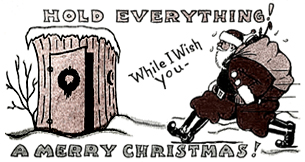
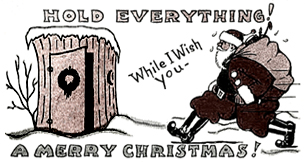
In 1965, songwriter and recording artist, Billy Edd Wheeler, hit the pop charts with the novelty tune, “Ode To The Little Brown Shack Out Back,” referring to outhouses. In the amusing song lyrics, Wheeler begs for the traditional little brown building to be spared its rapidly approaching demise.

Many Johnson Citians can recall these little icons of the American backyard, affectionately dubbed by additional names as privy, necessary house, shanty, backhouse, throne and john. The little pine shed with its sloped roof was about 4x4x7 feet, positioned over a hole that was 4-5 feet deep. A quarter moon cutout along the top of the door allowed some light and ventilation.

Outhouses stood about 100 feet behind a family’s primary residence, which in the winter was 100 feet too far (bitter cold), but in the summer was 100 feet too near (lingering fragrance). The specified distance was a decided compromise. The average privy was a one or two “holer.” Some had one seat for adults and another modified for toddlers. Those at churches, schools and public places had additional amenities to handle crowds.

A Sears and Roebuck catalog was a standard fixture inside an outhouse, but the number of pages in the big book seemed to decrease with each passing visitor. Also present in many backhouses were spent corncobs and a bucket of lime. Every 1-2 years, the evocative little shack needed to be moved and centered over a nearby freshly dug pit. The old hole was promptly covered and packed down with dirt from the new one.

Most outhouses were unpainted and seemed to unassumingly blend in with the surroundings. The little sheds became the targets of Halloween pranksters who would move them, sometimes with some poor hapless soul sitting inside. Others would have signs painted on them that read “Sitty Hall,” “Half Moon Inn,” “Rest Home” and “The Establishment.” People learned to keep the door closed when not in use. Many a hound dog found solace from adverse weather by curling up inside a privy with an opened door.

Slop jars, or chamber pots as they were alternately called, were used in tandem with outhouses. These were three-gallon metal pots with lids that conveniently sat at night under the bed or in a nearby closet. A person waking up in the middle of the night with that certain urge had a decision to make. He or she could go to the privy outside or utilize the slop jar inside. Choosing the privy meant exiting the house and traveling to the john in the darkness of night and whatever weather conditions might exist. This choice occasionally resulted in a chance encounter with a mouse, rat, snake spider or even a colony of ferocious bees or hornets. Conversely, selecting the slop jar at night meant having to “live with it” until morning, after which it had to be taken outside, emptied, cleaned and dried for the next night's exploit.

The universal desire for in-house facilities led to numerous patents over the years, including several from 19thcentury Chelsea, England plumber, Thomas Crapper. (I am not making this up.) Billy Edd Wheeler’s worst fears in the song were realized when health regulations outlawed the familiar little sheds, leaving behind a lingering thick green vegetated plot of land.  

Read more

After 50 years, I finally read the 260-page 1957 bestseller “Bridge to the Sun” (The University of North Carolina Press) by Johnson City native Gwen Terasaki.

In 1961, MGM turned the writer’s memoirs into a movie starring “Baby Doll” actress Carroll Baker as Gwen Terasaki and “Flower Drum Song” actor James Shegeta depicting Hidenari “Terry” Terasaki. August 16 ushered in the world premier of the motion picture at the Majestic Theatre, bringing international attention to the city.

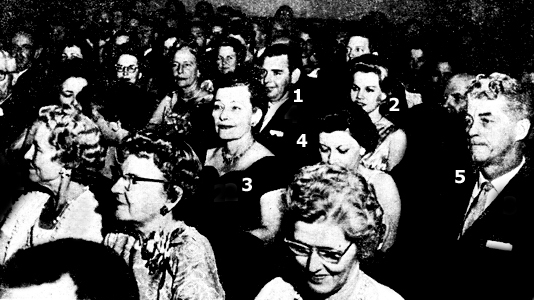
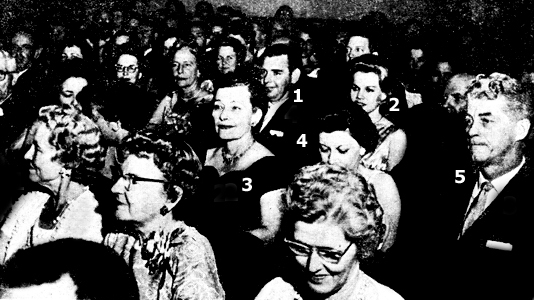
My cousin, the late Lanny Bowman, was chosen to be Baker’s escort during the gala festivities and viewing of the much-anticipated film. Also present were Mrs. Terasaki, Mayor May Ross McDowell and City Manager David Burkhalter. The mayor proclaimed August 16 to be “Gwen Terasaki Day.”

The book’s jacket notes offered this brief synopsis of the literary work: “‘Bridge to the Sun’ is a beautiful, tender and moving love story – the true report of an international and inter-racial marriage of a Japanese diplomat and an American girl from the mountains of Tennessee.”

Gwen Harold met ambassador Terasaki while she was vacationing in Washington DC in 1930. The two soon married against family objections. After the attach on Pearl Harbor, Gwen, Terry and daughter Mariko were sent to Japan in exchange for American diplomats stationed there. Terry’s long-standing antagonism to the war caused him to be placed under the watchful eye of the Japanese secret police. Gwen became torn between allegiance to her native country and affection for her new home.

In the book, Mrs. Terasaki quoted Kipling: “To Terry – Two things greater than all things are, The first is Love, and the second War. And since we know not how War may prove, Heart of my heart, let us talk of Love!”

In spite of concerns related to language and loneliness plus her constant struggles to find food and other critical supplies, Gwen remarkably displayed no bitterness. At the conclusion of the war, Terry served as a liaison between Emperor Hirohito and General MacArthur and was instrumental in re-establishing diplomatic relations between the two countries.

A sampling of reader comments regarding the book shows a postwar public’s fascination with the subject: “Gwen Terasaki is a remarkable woman and her story allows us to experience life as she knew it during some of the most tumultuous times in the recent past.” “As literature, this book is not the best; as a historical first-hand document that recounts a personal, interesting, and very unique story, this is superb.” “Terasaki puts a human face on the Japanese war experience by emphasizing the heroic actions of her husband.” “The book is a rare chronicle of an outsider's experience in Japan during a time when outsiders were most unwelcome.”

The years took a heavy toll on Hidenari; he eventually suffered a series of debilitating strokes causing a significant lifestyle change. At Terry’s insistence, mother and daughter agonizingly left him behind and returned to the states to enroll Mariko in college. Mrs. Terasaki abruptly ends the book with some surprisingly stoic words: “A Western Union boy knocked at the door and handed me a cable gram. Terry was dead.” Gwen passed away in December 1990.

I hope my readers will visit the Johnson City Public Library and engage in this highly absorbing story of a courageous lady’s … “Bridge to the Sun.”  

Read more

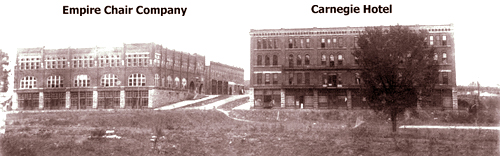
Johnson City Comet readers eagerly opened their newspapers on Sunday morning, April 10, 1910 to these attention-grabbing headlines: “Carnegie Hotel Burned Down This Morning – Alarm Sounded at One O’clock – Hotel Totally Destroyed.”

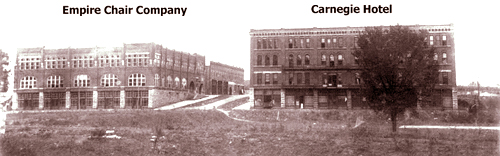
Civil War General J.T. Wilder built and furnished the palatial Carnegie Hotel in 1891 at the southwest corner of Broad Way (Broadway) and Second Avenue (Fairview) for $125,000. R.N. Farr, a man experienced in hotel management, leased it and opened the complex to customers on Sept. 27 of that same year.

The three-story edifice contained 125 rooms with six additional storage rooms along the sloping south end at First Avenue (Millard Street, between hotel and railroad tracks). The best materials were used throughout the structure, the interior finish being antique oak. Immense plate glass windows in all rooms provided abundant daytime lighting, with more shining down through a large opening into the centralized lobby. The interior was endowed with an electric passenger elevator, numerous accessible stairways, spacious hallways and a ventilation system.”

Dining rooms were large and beautifully furnished; parlors and reception rooms were unequaled in finish and furnishings. The Comet further stated: “Its billiard, library, bath and other rooms have the polish of perfection.” The roof, overlaid with pitch and gravel, provided guests with an impressive observatory where “one can see quite a distance up and down the valley and across the mountains miles away.”

On the south side, there were two 100-foot verandas with wrought iron balustrades extending out from the first and second floors of the hotel proper. A large entrance veranda faced Second Avenue. Along its sides were several additional smaller verandas, each extending from the terminus of a hallway. The hotel offered first class water and electric systems including lighting by gas. Rooms were heated by radiation from a furnace below. The floors were laid with very fine carpet. Every room was elegantly furnished.

The Comet offered this précis of the Carnegie: “The auspicious beginning of this magnificent enterprise marks a new and important epoch in our history. It is a proud and enduing moment in far-seeing business genius and for the energy, the hopefulness, and the confidence and courage of capital which have transformed in a few brief years, a struggling unsightly village to a gem city.”

For 17 years, the hotel was a showcase for visitors traveling through the city. The trolley made scheduled visits to the Carnegie. By 1908, the hotel was used almost exclusively by the CC&O Railroad. After that, a number of people rented it for a while and pro rated the maintenance costs. The now declining Carnegie was in the process of being converted to an apartment complex when the massive early morning fire cut short its 19-year reign.

The April 3, 1910 Comet article concluded with these epitaphic words: “As the Comet goes to press at 3 o’clock, the ruddy glare of the flames can be read in the sky for miles. It is impossible to save the building and no effort is being made to do so, but the office building across the street occupied by the CC&O officials will be unharmed.“

With that, one of the finest hotels in East Tennessee history went up in smoke and became a fleeing memory.  

Read more

Mack Houston, “Trail Boss” of The Tennessee Western Film Club, is proud of his group’s recent accomplishment – celebrating its 34thanniversary on Feb. 16, 2007.

Mack said the recent meeting was devoted to deceased members: Howard Ferguson, Carl Oliver, Chester Hand, Richard Arrowood, Ray Hall and Clyde Livingston. “Clyde and Carl were original members of the club. We are appreciative of the efforts of Joe Fair during his presidency. Joe furnished 16mm films for many years from his own collection or borrowed from collectors.”

The meeting featured a lively agenda: 7:00 – Marshal of Reno (Republic, 1944) with Wild Bill Elliott (Red Ryder) and Bobby Blake (Little Beaver), 7:45 – Intermission and snack break, 8:45 – The News Parade of the Year – 1942 and 9:00 – The Ivory-Handled Gun (Universal, 1935) with Buck Jones. The club developed a top ten list of its favorite B-western flicks of all time:

1. The Rider of Death Valley (Tom Mix, 1932), 2. Bells of San Angelo (Roy Rogers, 1947), 3. The Sundown Rider (Buck Jones, 1933), 4. Sante Fe Saddlemates (Sunset Carson, 1945), 5. The Marshall of Mesa City (George O’Brien, 1939), 6. Hop-A-Long Cassidy (William “Hoppy” Boyd, 1935), 7. Overland Mail Robbery (Bill Elliott, 1949), 8. End of the Trail (Tim McCoy, 1932), 9. The Strawberry Roan (Gene Autry, 1948) and 10. My Pal Trigger (Roy Rogers, 1946).

The club was formed in Mack’s Elizabethton home on Feb. 8, 1973. After initially meeting at the Senior Citizen Center and the Emergency Rescue Squad Building, it eventually moved to Mountain Home Theatre in Johnson City. In 1991, Mack invited the group to gather at his Piney Flats residence, where the organization remains to this day. The films have utilized three formats over the years – 16mm, VHS and DVD.

Since its inception, the club has supported B-western film festivals in Memphis, Nashville, Orlando, Atlanta, Knoxville, Asheville and Williamsburg. A large number of B-western stars were regular attendees including: Bob Steele, Charles Starrett, Ray Corrigan, Kirby Grant (Sky King), George O’Brien, Fred Scott, Ray Whitley, Lash LaRue, Sunset Carson, Bob Allen, Rex Allen, Smith Ballew, Don Barry, Rod Cameron, Harry Carey, Jr., Michael Chapin, Buster Crabbe, Eddie Dean, Jimmy Ellison, Dick Foran, Monte Hale, Russell Hayden, John Kimbrough, Robert Livingston, Jock Mahoney, George Montgomery, Max Terhune, Tex Ritter, Reb Russell, Jimmy Wakely and James Warren.

Other special guests were leading ladies, villains and stuntmen. Over time, television western stars began to be attracted to the annual events. Sadly, Monte Hale is the only B-western hero living today. (Update: Hale died on March 29, 2009).

Mack recalled attending four B-western films in Feb. 1936 at Johnson City’s Liberty Theatre: Gallant Defender (Charles Starrett), The Ivory-Handled Gun (Buck Jones), Bulldog Courage (Tim McCoy) and Western Courage (Ken Maynard). The group’s attendance dwindled from 150 members in 1972 to fewer than a dozen in 2007, one explanation being that some fans acquired their own collections.

Mack concluded by saying, “We are not sure how long the club will continue; our members are getting older. Most of our western heroes are long gone, but we still thrill at the sight of seeing them ride across the screen. We travel back to the days of childhood when we attended the local theatres and watched our heroes ride their horses and catch the bad guys. They were the “'good old days.'” 

Read more

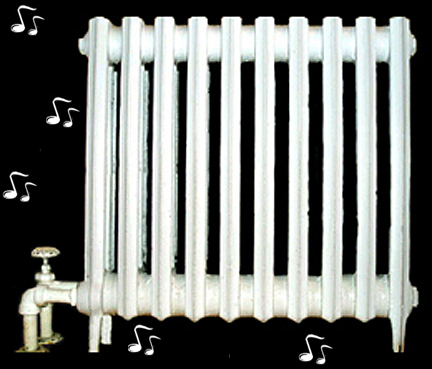
During the cold weather months of 1942 to 1950, my family regularly awoke each morning to a clanging sound vastly different from that of an alarm clock. Our small rented Watauga Avenue apartment contained steam heat and the noise was emanating from one or more of the radiators.

Although the racket was a bit bothersome, it was comforting to know that the atmosphere would soon be toasty warm. Steam heat was wonderful. Ernest Green, the apartment custodian, made his early morning excursion into the cold, damp and dimly lit rodent-infested basement long before residents crawled out of their cozy beds. The caretaker’s mission was to get heat flowing from the coal-fired furnace to the large apartment complex. As steam circulated to the building, some radiators began making a “hammering” or “knocking” noise, sometimes being quite loud.

Steam systems generally had one pipe with the dual purpose of supplying the radiator with steam and providing for condensate to return to the boiler. Torpedo shaped vents hissed each time steam pressure was released. Three malfunctions – improperly sloped piping, steam valve not fully open and defective or plugged steam valve – orchestrated these annoying early-morning “radiator recitals.”

Drain piping was supposed to be slanted toward the boiler supply valve to allow condensate to completely drain from the radiator. When steam flowed into a unit, any cool water present would forcefully collide with hot steam, producing the aggravating noise. An age-old trick was to place wooden blocks under the opposite end of the radiator to insure adequate slope for condensate removal. Radiators were generally located under a window where heat loss was the greatest. They were usually about the same width as the window, flush with the windowsill and approximately 2.5” from the wall.

A 1947 booklet titled, “1003 Household Hints and Work Savers,” offers some practical suggestions for saving on heating bills. The publication said to keep radiators clean to insure maximum heat from them. The best way to clean one was to hang a damp cloth behind it and use the discharge end of a vacuum cleaner to blow dust off the fins onto the cloth. Another trick was to “Go over your radiator with an oiled cloth to prevent rusting, save paint and increase heat efficiency.” An added suggestion was to leave the radiator full of water during warmer months: “This water cannot rust the radiator because it is deoxygenated.”

The brochure went on to say that bronze or aluminum paints should not be used because they could reduce heat output by 10%. Instead, dark colored oil based paints were recommended as the best choices. Cast-iron radiators became a common fixture in urban schools during the first half of this century. They were purposely oversized to compensate for classroom windows that were partially left open for ventilation.

I became quite familiar with steam heat since we had radiators at school – West Side, Henry Johnson, Junior High, Science Hill and even my old University of Tennessee dorm, Melrose Hall. Steam systems eventually gave way to hot water ones and then to air units that allowed hot air to flow from a coal fired furnace to individual rooms via floor registers. Many area folks can remember when these were popular.

For the most part, the nostalgic early morning “radiator recitals” have been silenced by technology. 

Read more

I received a letter from Lynn Williams, former radio engineer at radio stations WETB and WBEJ, concerning my Berlin “Pecos Ben” Benfield article.

Lynn alleged: “I began my radio career at WBEJ in Elizabethton on April 23, 1948 as transmitter engineer-operator. Berlin came to the station about that same time. Unlike WETB where the studio and transmitter were together, WBEJ’s transmitter was a mile from the studio. My contact with Berlin was mostly via telephone when we would contact each other at station sign-on or sign-off. In addition to our duties, we engineers did a small amount of radio repairs for friends.”

Lynn recalls a humorous event that occurred after Berlin brought a defective console radio to the transmitter for Lynn to examine to see if it was worth fixing. Benfield flipped his microphone switch off and called Lynn at the transmitter to get a prognosis on the repair. The engineer turned the monitor speaker volume down low so the two of them could converse. What both individuals failed to realize was that Berlin’s microphone switch had stuck in the “on” position, allowing their personal chit chat to be broadcast all over Elizabethton and surrounding area.

Mr. Williams continued: “After Berlin went to WJHL-TV with his Pecos Ben show, I seldom saw or heard him except when I would be passing the television on my way to or from work.” Lynn remembers coming home one day and telling his family that he had run into Pecos Ben. His 4-year-old son, Condon, ran up to his dad and asked, “Did he have his horse?”

“Another memory of Berlin,” said Lynn, “is when Vice-President Nixon came to Carter County and the Roan Mountain Rhododendron Festival. WBEJ and WETB each broadcast the event by delayed tape recording. I was elected to take both stations’ recording equipment to the mountaintop, along with a P.A. system belonging to the Elizabethton Star newspaper. '”Curley’ White (WBEJ) and I went on the mountain trip the evening before and spent the night sleeping on an air mattress in my 1953 station wagon.

“The next morning, newsmen Berney Burleson (WETB) and Mack Morriss (WBEJ) came up to do the announcing and recording. A large crowd assembled by mid-morning. I had the equipment connected and feeding the P.A. set with WBEJ’s signal when Nixon’s entourage came through Elizabethton headed for Roan Mountain. Bill Hale (WBEJ) had set up two broadcast points along the route as well as at the studio proper. As he was manning one of the remote broadcast points, (he spotted) none other than Berlin Benfield, who had been gone from the station for five or six years. Berlin’s familiar sonorous tones and sharp wit echoed forth far and wide from atop Roan Mountain, as he gave a very good description of the activity back in Elizabethton.

“Years later, my boyhood next-door neighbor, Bradie Vanhuss, moved to Atlanta and on one of his visits back to the old stomping ground, I learned that he knew and worked with Berlin Benfield. Bradie had been a carrier for the Johnson City Press-Chronicle in 1940. I accompanied him with both of us riding bicycles.”

 Lynn concluded his letter by saying that it was through Brady that he was able to re-connect with Ray Moore, with whom he and Merrill Moore worked at WETB. The former radio engineer blissfully described those bygone days as … “when the air was so pure and the water was so blue.”  


Read more

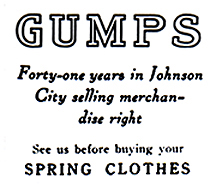
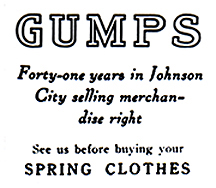
I mentioned in a previous column that M.I. (Martin Independence) Gump was assistant manager of Jobe’s Opera House and owner of Gump’s clothing emporium, both located at the southwest corner of E. Main and Spring streets. 

I received several inquiries from readers wanting to know more about Gumps, as it became known. According to Joyce and W. Eugene Cox’s History of Washington County Tennessee, A.S. Gump and D.B. Barr established the first store in 1880, four years before Jobe’s Opera House opened upstairs. On June 7, 1884, The Comet revealed that Martin had taken charge of the store that featured “a large stock of Gent's clothing made in the latest styles.”

Subsequent 1880 ads refer to the store as A.S. Gump & Co., Gump & Co. and Gumps. Lucy Gump surmises that Martin moved to town to manage a branch of first cousin Abraham Simon Gump’s Bristol business.

In the early 1890s, two younger Gump family members – Harry D. and Louis D. joined the enterprise. The business was renamed Gump Brothers by 1891 and operated until about 1921.

Big news in the July 8, 1909 Comet was the upcoming demolition of the front side of the Gumps and Opry House building, construction of a new one and remodeling of the interior. The stated reason for the project was “to make suitable background for the new fountain,” likely referring to the Lady of the Fountain statue across the street.

In that same edition, Gumps announced a “Re-Building Sale” that included furnishings, shoes, hats, trunks and bags: “Our business was established in Johnson City 29 years ago and this is our first sale.” Named brands included Hart, Schaffner and Marx; Schloss Bros. & Co. clothing; Hanan, Ralston & Bostonian shoes; John B Stetson & Young Bros hats. Carhartt overalls were excluded.

A July 16, 1903 Comet says that M.I. Gump established a wholesale grocery house in 1898 that served Tennessee and North Carolina. In 1903, the company moved into a new building on Roan Street; the Southern Railway constructed a sidetrack to it. Mrs. Louis D. Gump etched her name in local history by becoming a pioneer in the Parent-Teachers Association that originated in 1910, serving as first president of the Martha Wilder School PTA. 

A 1989 reprint of the 1909 J.O. Lewis book titled Johnson City, Tennessee (Overmountain Press) mentions two Gump stores located in the downtown district – Gump Brothers Clothing and Gump’s Wholesale Grocery. The book offered a flattering assessment of the clothing business: “Probably in the history of representative houses of Johnson City, no more worthy example can be found of what can be accomplished by energy, industry and well-directed efforts, than is so strikingly exemplified in the successful career of the big and influential house known as Gumps.”

Two members of the firm, H.D. Gump and L.D. Gump, were said to be “gentlemen of excellent high standing in business and social circles.” Later, the Gump name was attached to other Johnson City enterprises. About 1921, Louie, Harry and Jay Gump (Louie’s oldest son), formed Gump Investment Co. The younger son, Alan, soon joined the firm.

In 1927, Harry Gump filed plans in Jonesborough for a subdivision to be developed on Hillrise Farm, land he had owned since 1907. While the subdivision was officially called Hillrise Park, it was and is commonly called the Gump Addition  

Read more

In 1966, I was a senior at the University of Tennessee in the era of slide rules, large heavy simplistic desktop calculators and no PCs. Computers were relatively slow oversized machines, driven by stacks of labor consuming keypunched cards.

As I made my daily pilgrimage early each morning from Old Melrose Hall to “The Hill,” I began seeing posters advertising “Operation Match,” a university-sponsored computer dating service, developed by a group of Harvard University students. The much-ballyhooed happening was to be held on Saturday, February 19 in the old gym, featuring a band known as The True Tones. I hastily concluded that this evening would be one of definite delight or absolute annoyance for daring participants, dismissing any thought of my involvement.

My dorm buddy, Terry Thompson, desired to participate and wanted me to do the same. He surmised that it would be fun to let a computer select our ideal dates. He further reasoned that if we took this venture seriously, we just might be meeting our future brides. I was not so sure. After insistent prodding, Terry persuaded me to give it a try. The two of us walked to the Student Center and enrolled in the program.

We were given an eight-page questionnaire containing 105 rather personal questions, ranging from absolute requirements to semantic preferences. The instructions emphasized that questions be answered accurately and spontaneously. I received mild heartburn when I read this sentence in the questionnaire: “It should be stressed that a match between individuals cannot be guaranteed because of the possibility of an uneven number of boys and girls participating in the project, or a possibility of extremes not finding a match.”

When the big evening arrived, Terry and I agreed that the one with the best-matched date would pay the other a dollar as a consolation gesture. The long awaited shindig began at 7:30 pm with the first order of business being to match individuals. This activity was carried out with surprising speed and efficiency. I held my breath as I was introduced to Janet, a petite nice looking brunette from West Tennessee; Terry’s mate was a very attractive blond.

The social event was then kicked off, lasting from 8:00 until midnight. Regrettably, Janet and I promptly realized that we had little in common. Surprisingly, there was a “grievance table” where students could literally swap incompatible dates. I was too dignified for that action; Janet showed no indication of dumping me either. We were now committed to four hours of absolute annoyance.

We mutually agreed to leave the crowded noisy gym and drive to Shoney’s “Big Boy” drive-in restaurant on Kingston Pike. We sat in my “sooped up” 1960 solid red Chevrolet Corvair, listened to the radio and talked for quite a while. Admittedly, we became somewhat more attuned to one another.

After returning Janet to her campus dorm, I went back to Old Melrose Hall. Upon approaching my room, I spotted Terry sitting alone in a chair just outside my door with his head down and holding up a dollar bill in one hand. Without uttering a word, I snatched my solace offering from his loose grip and abruptly went into my room. My first and last computer-dating venture was history.

Four years later, I married my perfect mate, a pretty redhead, accomplishing it without the aid of an imprudent computer. It has been a journey of absolute delight.

Read more