James Garrett shared his memories (band, Buda's burgers, zoot suits) of living in Johnson City from 1939 until he went away to college in 1957.

“My Junior High music instructor was Vernon ‘Sleepy’ Weaver,” said James. “I attended the old downtown Science Hill High School where my major subject was music under the direction of Mr. Warren Weddell. I was one of the drum majors in the school marching band and often twirled a fire baton at football games at half time in Memorial Stadium at night while all the lights were turned off.”

James commented about John's (Buda) Sandwich Shop that operated in the 1950s at 105 Buffalo: “Circa 1951, my family lived near Antioch Baptist Church (Little Cherokee Road). Since we did not have a car, we rode the city bus to A.L. Street's Grocery (2501 W. Walnut) and walked past Bernard School (Old Jonesborough Highway) to home. I often ate at John's before my bus arrived. “I cannot remember eating a hot dog at John's as I always had a hamburger or hot tamale. Both were delicious. I have tried to duplicate John's hamburger and tamale many times but always come up short. Is there any possibility of obtaining the recipe for either?”

I checked with George and Wanda Buda. George is the son of John and Ethel Buda. Wanda sent me the recipe for a John Buda Chili Burger, one that came from Ethel and was used by Patty Smithdeal Fulton in her book, And Garnished with Memories, (The Overmountain Press, 1985). 

According to Wanda: “Obtain one pound of ground round or sirloin; two eggs, beaten; one roll chili, water; two tablespoon dry bread crumbs; salt and pepper to taste; and sliced onion and tomato, mustard and mayo. Beat the eggs and mix with breadcrumbs into the ground beef. Mix thoroughly with hands and then pat into desired thickness. Grill until done, turning only once. Do not mash down with spatula. To make chili, use a roll from a grocery store and mix with one tablespoon of water. Keep thick. Put chili on top of hamburger, then tomato, onion, mayo and mustard and salt and pepper. Get a bib, open wide and enjoy.” George and Wanda said that John didn’t make the hot tamales; instead, he bought them from an older black gentleman named Will Cope who delivered them on a bicycle. I often hear people speak of him and his terrific tamales.
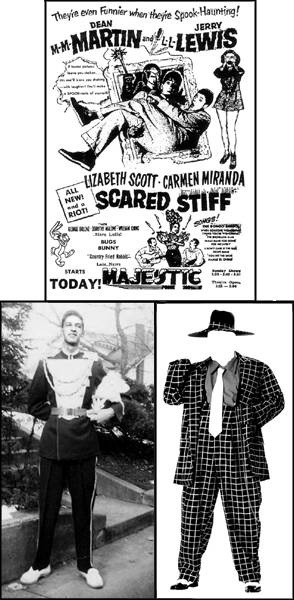
“I worked at the Majestic Theatre (237 E. Main) as an usher.” continued James. “The popcorn sold at the Majestic was made by the Liberty Theatre. I took two empty sacks about the size of a kitchen garbage bag to the Liberty where the concession girl filled them. I then took them back to the Majestic. At one time, I recall making the popcorn in a machine under the stage at the Majestic and taking it in bags to the Liberty.

“The ushers at the Majestic wore ‘Zoot Suits’ to work. We got tired of wearing them so we jointly asked the manager if we could buy some real suits from Hannah's, Inc. (‘Fashions for Men,’ 213 E. Main) if we paid for them. He agreed. The song, “A Pink Sport Coat and a White Carnation” (sung by country singer, Marty Robbins) was on the top ten list of popular songs at the time so we all bought pink sport jackets and black slacks.”

Zoot Suits were a fashion fad in the 1940s. They consisted of baggy men’s suits; tight-cuffed pegged trousers; usually high waisted; an oversized jacket with inflated broad, padded shoulders and wide lapels; and an equally exaggerated wide-brim hat. They were worn with suspenders and a long watch chain. Big band leader, Cab Callaway, often donned one when he performed his novelty hit song, “Minnie the Moocher,” (“Hi-de-hi-de-hi-de-hi, Ho-de-ho-de-ho-de-ho”).

Ah, what great memories from yesteryear. Keep them coming, folks. 

Read more

The recent college football bowl games may bring to mind an incident that occurred on Thursday afternoon, Jan. 1, 1948 while area football devotees were huddled around their radios.

Those were the days when the medium of television had not yet arrived in most households; therefore, sports enthusiasts had to rely on radio to receive play-by-play game action. Since the University of Tennessee did not receive a bowl invitation that year, WETB AM 790 was broadcasting a bowl game believed to be the Sugar Bowl, matching the sixth-ranked Crimson Tide of Alabama with the fifth-ranked Texas Longhorns.

The game site that year was Tulane Stadium in New Orleans. The (Texas-Alabama) scoring by quarter was 7-0, 0-7, 7-0 and 13-0. The Longhorns prevailed by 27-7. During the final two minutes of the contest, diehard fans still clinging to their radios were flabbergasted to hear the words:

“And as we conclude our broadcasting schedule for today, WETB, Johnson City, Tennessee, operates on 790 kilocycles with a daytime power of 1000 watts by authorization of the Federal Communication Commission. WETB is owned and operated by East Tennessee Broadcasting Company, affiliated with Johnson City Press-Chronicle. Transmitter and temporary studios are located on the Erwin Highway. We invite you to join us again tomorrow morning at 7:15 when we return to the air. Thank you for listening and a very pleasant good evening to you all.”

To the chagrin of area sports fans, the station summarily went off the air without broadcasting the final two minutes of play. This occurred because the station was strictly mandated by the Federal Communication Commission (FCC) to be off the air at 5:15 p.m. The fact that the game was still being played was not an issue with the FCC. The rules had to be followed or the station could lose its license.

Carl Jones, Jr., owner of the Johnson City Press-Chronicle and WETB took action prior to the 1948 regular football season to prevent a recurrence of a game being cut off. He composed a carefully worded letter to FCC’s T.J. Slowie with a proposal. Jones noted that the radio station had contracted to carry all of the University of Tennessee’s 1948 football games.

“Your attention,” he said, “is respectfully called to the fact that we are broadcasting these games in response to great demand by the people in this area. “As football games normally are concluded within two hours, presently scheduled starting times of eight games at 2:30 p.m. and two games at 3:00 p.m. should enable us to compete each broadcast prior to signing off the air at 5:15 p.m. during the month of November. We request authorization from the (FCC) for an extended period not to exceed 15 minutes after regularly licensed sign-off in order to compensate for unexpected delays during games. While it may not be necessary to use the extended period whatsoever, authorization for such an extension in case of necessity will enable WETB to perform its obligations to the radio audience in this area. We are attempting to avoid a reoccurrence of the last New Year’s Day game when we were prevented from carrying the final two minutes of the event because of sign-off. Very truly yours, East Tennessee Broadcasting Company, Carl A. Jones, Jr., President.”

I conferred with Bud Kelsey, former program director of the station. Although he did not recall the specific event, he was highly skeptical that the FCC granted an extension. Although quite amusing today, missing the final moments of a major sporting event was anything but humorous 62 years ago.  

Read more

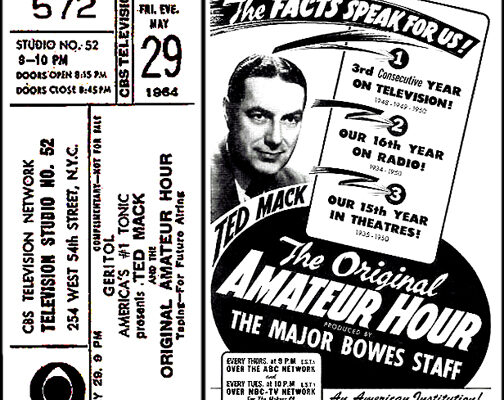
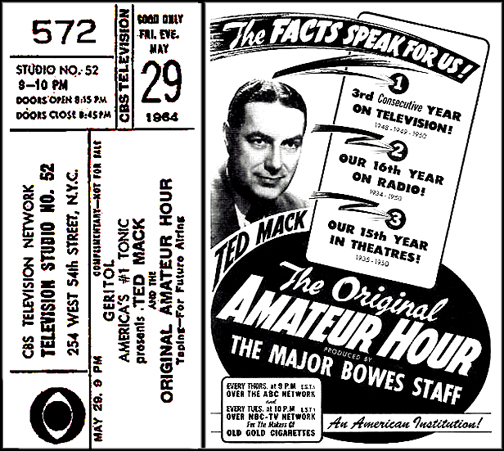
In January 1961, five young local men, ranging in age from 16 to 23, went to New York City to participate in a nationally televised program, “Ted Mack’s Original Amateur Hour.”

Mr. Mack brought America’s talent to television audiences and invited viewers to vote for their favorite act by calling or sending postcards to the network, similar to today’s talent reality shows. The Faircloth Chevrolet Co. sponsored the quintet that initially consisted of Tony Bowman (lead singer, upright bass), Avery Blevins (high tenor, trumpet), Bill Williams (baritone), Eddie Broyles (bass) and Buddy Fox (piano).

According to Bowman: “In 1959, we formed a Southern Gospel music group known as the Crusaders and frequently sang in the nearby area. A year later, we made a 45-rpm double-sided record containing four songs: ‘Lord, I'm Coming Home,’ ‘Walk Them Golden Stairs,’ ‘Fling Wide the Gates’ and ‘Jesus Lifted Me.’ For the Ted Mack show appearance, we changed our name to the Corvairs, the name of Chevrolet’s newly introduced rear engine air-cooled automobile. Mr. Faircloth provided two Chevrolet cars and rode with us to Orlando, Florida to audition for the show. We were invited to come to New York City in January 1961 to film the show.

“We chose the song, “He’s Got the Whole World in His Hand” because we wanted to sing something befitting of the Southern Gospel music we loved. We sent a reel-to-reel tape containing our rendition of the song so the studio orchestra could practice backing us up. “Mr. Faircloth again supplied us with two Chevys to drive, but this time, he chose to fly there. Also, Eddie and Bill did not make the trip and were replaced by Mickey Crawford (bass, ukulele) and Willard Blevins (baritone, clarinet). When we arrived in Manhattan, we checked in at the Hilton Hotel and later ate at the famous Toots Schorr Restaurant near Central Park.

“Our group arrived at the 254 West 54thStreet studio wearing matching outfits, consisting of a bronze coat, black pants, white shirt and matching tie. Mr. Mack was not present when we initially arrived. Since the set musicians had received a tape of our singing, they were ready for us. During the taping of our act, we began by singing and playing, but 30 seconds into the song, the orchestra joined us, elevating the music to a much fuller sound. It was then that Mr. Mack entered the studio. While he was talking to us and asking us questions, the crew filmed the conversation. Ted Mack had a nice personality, an upbeat demeanor and showed politeness to his employees. After we left the studio, the stagehands combined the two tapes into one. Our act was ready for television.”

The show aired in March. The group’s 85-second segment began with Mr. Mack introducing them: “We have two high school students, two college students and an automobile parts salesman for the Faircloth Chevrolet Company; call themselves the Corvairs. Ok, let’s hear it.” When the performance concluded, Mack reminded viewers: “They are the Corvairs from Johnson City, Tennessee and that voting address is Box 191, Radio City Station here in New York.” The group came in second place after being edged out by a grandmother playing a trumpet.

When the young men returned home, they became known as the Crusaders again. They received coverage in the Johnson City Press-Chronicle and were scheduled for 19 consecutive Sunday singing concerts. The group disbanded in the fall of 1962 when some of them went back to school.

“Ted Mack’s Original Amateur Hour” ran from 1948 until 1970. During its 22-year span, it had the distinction of being carried by all four television networks – CBS, NBC, ABC and Dumont.  

Read more

Pat Greer Eunis recently shared her remembrances of living in Johnson City, particularly in the Keystone area of town. After residing in JC since 1940, she moved away in 1965 but returned in 2006.

Upon arrival back in the city, Pat leisurely drove around the streets to rekindle memories of her youth. She warmly recalled the Dutch Maid Drive-In, The Spot Steakhouse, the 88 steps leading up to the old Science Hill High School, stopping at The Rexall Drugstore, getting a grilled doughnut and cherry coke before school at the Gables and attending the city’s movie and drive-in theatres. 

“In the summer of 1952,” recalled Pat, “we were among the first families approved to live in the newly built Keystone Housing Project at Broadway Street.” “My mother, maternal grandmother, two brothers, baby sister and I were living on Colorado Street at the time. We used my brother’s red wagon to haul our belongings to our new apartment.

“Mother worked for Carl Ingram's Dress Shop that was located in the Arcade Building between Main and Market streets. Carl sold some of the prettiest women's and girl's clothes at very reasonable prices. That is where mother bought our dresses, crinolines and poodle skirts.  He was a very kind-hearted man who often gave her an advance in salary. In the mid 1950s, I went to the shop and got $15 to buy groceries, which bought a lot of food for our family of five.”

Pat also recalled Jimmy Kennedy’s Used Furniture Store located on Market Street across from the Arcade. The owner also sold many odds and ends including comic books, letting her swap hers for some of his that she had not read. 

Pat remembered her maternal grandmother bringing the children to town every Saturday to see a movie: “That was the highlight of our growing up days. Christmas was the best of all because everywhere you looked was a fantasyland of colored lights, carols playing, people shopping and the ever-present Salvation Army bell ringers.”

Mrs. Eunis fondly recalled when the Appalachian District Fair, carnivals, circuses and tent revivals set up in the large vacant field at Broadway opposite their home. She said some of the events also took place between Main and Market opposite Roosevelt (Memorial) Stadium. Her two favorite preachers were Billy and Bobby McCool, who eventually established a church here. It was during this time that she developed a love of singing gospel music.

“We had some fun times at the Keystone recreation center,” she said, “playing ping pong, watching movies, competing in softball, chasing each other on bikes and roller skates, flying kites, playing hop scotch (including Double Dutch jump rope), engaging in snowball fights in the winter and enjoying snow ice cream made by our grandmother. We picked up empty pop bottles from the stadium after sporting events and cashed them in for money at Tipton’s Grocery. Also, in summer we swam at the Sur Joi pool at Watauga and Market.”

Pat attended Keystone Elementary, Junior High and Science Hill. Her first job at age 16 was working at The Spot making shrimp salads, an employment that lasted only 2 weeks. Next, she served as a curb hop at a drive-in restaurant at the corner of Main and Broadway. Later, she was hired at S.H. Kress lunch counter making, among other things, great chili hotdogs with coleslaw piled on top. Pat became an LPN after attending the J.C. Vocational School of Practical Nursing at Memorial Hospital.

Pat’s biggest shock upon returning to Johnson City in 2006 was finding the Arcade and other buildings torn down. She noted the smallness and deterioration of the downtown area and missed seeing local passenger trains. The city had changed significantly in her 41-year absence.  

Read more

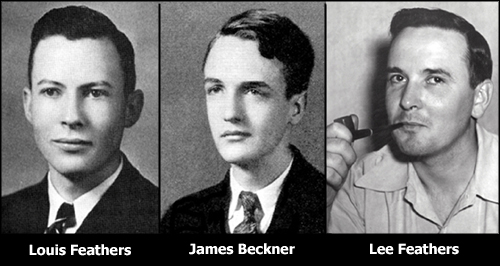
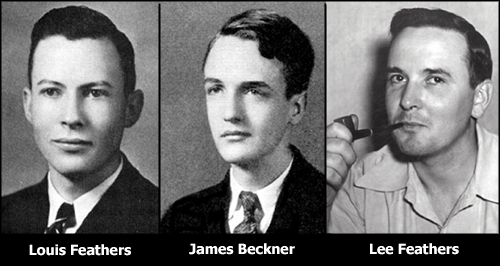
Louis Feathers, former resident of the city, once worked for the Johnson City Press-Chronicle. He shared his memories of working for the newspaper.

“My source of spending money from 1932 until 1938,” said Louis, “was from delivering papers. My first route was inherited from Dan Meador who moved from the city to a farm near Watauga. It involved delivering ‘Grit,’ for which there were a few customers spread over a large area. The quality weekly tabloid-size family publication is still being printed in Williamsport, PA. Back then it cost five cents.”

Feathers explained that his next paper route was a joint effort with his brother, Lee, delivering the Johnson City Staff-News. It was an afternoon edition that soon experienced competition from a new city newspaper, The Johnson City Press-Chronicle, started by Carl A. Jones and Charles Harkrader. It soon acquired the Staff-News and its companion morning newspaper, The Chronicle, which produced morning and afternoon editions.

“Shortly after quitting my job at a textile mill located in the “Y” section in the southwest part of town,” said Louis, “I received a telephone call from Judge C.F. Callaway at the Press-Chronicle about a position in the business office. He was referred to as judge because he had previously been a Justice of the Peace. I was told the firm had just discharged an employee and wanted to talk to me about the open position.

“It looked like an interesting job so I accepted it at a pay rate of $18.50 per week, not too bad considering the fact that the country was not yet out of the Great Depression. My responsibilities involved verifying an advertiser’s space and logging it in a journal, delivering copies of tear sheets (cut or torn pages from the publication to prove to the client that the advertisement was published) to advertisers, assisting wherever needed in the Advertising and Circulation departments and working in the Photo Engraving Shop. The latter job consisted of sending half-tone plates to other newspapers and printing shops that utilized our services. In short, I was a ‘go-fer’ for them.”

Louis described the composing room as a loud and foul place consisting of a bank of about six Linotype machines setting and casting the type for all the news matters in the paper. He described a large container of melting “pot metal” from which the plates for the printing press would be cast. The large print for headlines and advertising were typeset by hand. Feathers worked in the Press-Chronicle office from mid 1939 until he left for the military in January 1942.

In the 1970s, Louis revisited his former place of business and was escorted by his good friend Jim Beckner. By this time, the composing room had been converted into an art studio. A page make-up consisted of “pasting up all the material that was to be on the page. “It was then photographed for engraving on a thin sheet of metal,” said Louis. “This replaced the heavy half-cylinder casting that was used in the former process. The changeover occurred about 1950.”

Lee Feathers was employed in the composing room and belonged to the Pressman’s Union. The organization objected to the changeover because it eliminated several jobs and went on strike, but to no avail.

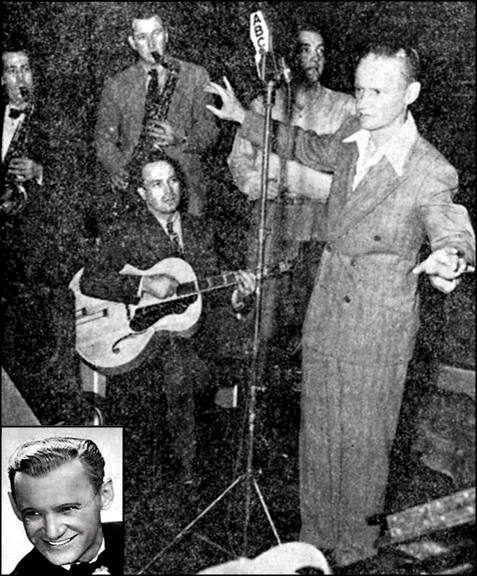
When Louis was drafted on Jan. 19, 1942, his strong desire to enlist in the Army Air Corps evaporated because his 1-A classification directed him into the Army. He was listening to bandleader Sammy Kaye’s “Sunday Serenade” on NBC radio that fateful Dec. 7, 1941 afternoon and heard the chilling news that Japan had attached Pearl Harbor. He later wrote in his journal: “News that your country is at war can ruin your afternoon.”  

Read more

Christmas 1912 was a pecuniary delight to the pocketbooks of about 9,000 local inhabitants because of abnormally low Christmas tree, poultry and fruit prices.

While some people located and cut trees in rural areas, most urban dwellers purchased theirs from street vendors and nearby tree farms. Choice 4- to 10-foot trees that were straight and shapely could be acquired for 10 and 15 cents, affording the luxury of an indoor tree for even the poorest city dwellers. A cedar tree could be obtained for the cost of a loaf of bread. Vendors were eventually compelled to lower their prices to about the cost of transportation.

What caused this unexpected drop in prices? Talk early in the season of an embargo of cedar and spruce trees prompted residents to believe that prices for the commodity would be high for the coming holiday season. This caused a momentary swell in tree prices.

Soon, a glut of trees became available on the market by those wanting to make a profit from the supposed shortage. Those patrons who bought their trees early paid a dollar or more for them. Almost overnight, a deluge of trees became available for sale dropping prices substantially.

Sellers normally sold trees on a “cash and carry” basis. For those affluent citizens, trees with stands on them could be delivered to the customer’s home at a cost depending on the distance to the buyer’s residence. A stand added 15 cents to the price tag while a few sprigs of holly increased it another 10 cents. The plunge in prices allowed many shoppers to buy a second or third tree for home decorating. Christmas greens were also cheaper than usual that year with red berry wreaths selling at $1.25/dozen, pine ropes at 2.25 cents/yard and roping of laurel wreathes for 3 cents. The lone exception was holly, which was in short supply and high demand.

A similar scenario occurred in the poultry markets brought about by mild weather and good crops. The market became overstocked with a variety of fowl and game, causing the risk that the Christmas season would leave dealers with thousands of birds on their hands.

A 1912 newspaper noted that Southern Railway picked up approximately 150,000 birds, mostly turkeys, at Morristown and delivered them to New York for distribution. Suppliers of birds were situated mainly in East Tennessee, Northern and Southwest Virginia, Western North Carolina and Kentucky.

The rail trip with numerous stops took 45 hours, traversing the rugged and beautiful mountains of North Carolina, northward to Washington and onward to the Jersey yards by the Pennsylvania Railroad.

Surprisingly, there were no single turkey farms of any magnitude in East Tennessee; shipments were made up from numbers of small “drives.” An amusing aspect of this business was the fact that turkey raising was orchestrated primarily by farmers’ wives of the surrounding mountain country. Proceeds from the sale of their flocks provided a source of Christmas spending money to the ladies.

Poultry prices per pound were turkeys, 25-28 cents (compared to 32 cents the previous year); geese and roasting chickens, 25 cents; chickens for fricassee (cutting the bird into pieces and stewing it in gravy), 20 cents; and celery-fed ducklings, 25 cents. Prices were corresponding low for squabs, pigeons and other game.

Trimming for the Christmas dinner was also quoted at reasonable prices caused by the arrival of trainloads of fruit and nuts. Mexican oranges went for 10 cents/dozen, a basket of 10 to 14 apples brought 25 cents and large grapefruits sold for 6 cents each. 

Don’t look for those prices today; that was almost a century ago. 

Read more

My mother was a huge fan of big band music in the 1940s, preferring “sweet” as opposed to “swing” bands. Although orchestras tended to focus on one genre or the other, most leaders incorporated a blend of each to satisfy their customers’ voracious musical appetites. Mom’s favorites were Guy Lombardo (“The Sweetest Music This Side of Heaven”), Sammy Kaye (“Swing and Sway with Sammy Kaye)” and Russ Morgan (“Music in the Morgan Manner”).

As a young lad, I also listened to the likes of Count Basie, Cab Callaway, Frankie Carle, Tommy Dorsey, Jimmy Dorsey, Duke Ellington, Shep Fields, Jan Garber, Benny Goodman, Woody Herman, Harry James, Wayne King, Kay Kiser, Ted Lewis, Johnny Long, Glenn Miller, Tony Pastor, Artie Shaw, Orrin Tucker, Ted Weems and others. 

Local radio station WJHL, affiliated with NBC’s “Blue Network,” (comprised of cultural and news programming) routinely held contests that awarded a prize to the first person to call the station and correctly identify the band being played from a 78-rpm record. 

About 1948, Mom won a contest and received $25 worth of groceries from Cut Rate Supermarket at 410 W. Walnut Street. I had never seen that much foodstuff at one time. We stacked it on the floor under our apartment dining room window. It took several weeks of hardy ingestion to make a dent in the victuals.

Sammy Kaye became known for a unique radio program that debuted in 1941 titled, “Sunday Serenade.” It was heard over NBC’s “Red Network” (consisting of entertainment and music) each Sunday afternoon from 2:00 to 2:15 Eastern Standard Time. Between 1942 and 1945, it was aired at the same time on Eastern War Time (the equivalent today of year-round Eastern Daylight Savings Time). The show eventually was expanded to 30 minutes and remained on the air into the 1950s.

The Sunday afternoon lineup featured performances from the band; the Kaye Choir; The Three Kaydettes, vocal trio; solo vocalists, Billie Williams and Nancy Norman; and special guests. The group’s two most recognized hits of that era were “Harbor Lights” and “The Old Lamplighter.”

Kaye's “Sunday Serenade” was a compilation of soothing music and thought-provoking poetry, submitted by amateur wannabe lyricists. The show became so popular that it spawned several books of poetry. Republic Music Corporation published a 66-page book in 1942 containing 49 poems. Sammy Kaye wrote a brief foreword to the work:

“This volume is printed in answer to the requests of thousands of our ‘Sunday Serenade’ listeners. If it can provide some measure of encouragement, comfort or just enjoyment, we shall have fulfilled our aim in bringing it to you. In selecting poetry for our broadcasts, we always try to find poems that will strike a responsive chord in the hearts of our listeners. We have also been fortunate in securing selections from the works of several poets who have achieved a distinct place in the field of literature.”

 A typical stanza from the book reads: “And when the shadows of life may fall; On the hopes that rise in the hearts of all; When you are gone – oh, come what may; There are memories never to pass away.” (Eugene Hall).

The most remembered episode of “Sunday Serenade” occurred on Dec. 7, 1941 when announcer Ben Grauer broke in to reveal the shocking news that Japan had attacked Pearl Harbor. One prophetic song played during the broadcast was “This Is No Laughing Matter.” In response to the bombing, Kaye penned the song, “Remember Pearl Harbor,” which became an instant rallying war cry with the public.  

Read more

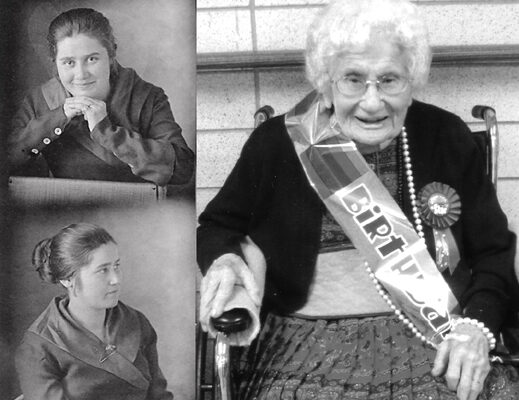
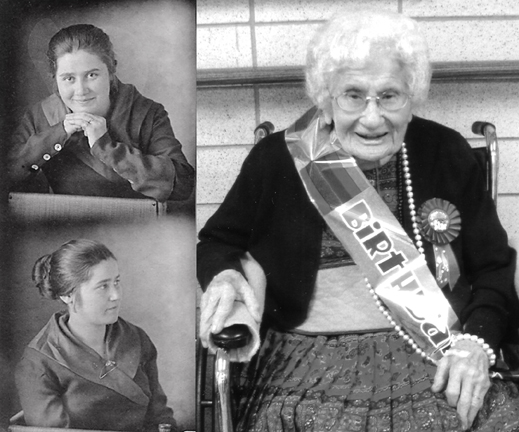
Besse Brown Cooper, former area resident, celebrated her 113th birthday on August 26, making her a super-centenarian (someone over 110) and currently #8 (as of Mar. 3) on the list of the oldest living people in the world (www.grg.org/Adams/E.HTM).

Her son, Sidney, and daughter, Angie Tharp, shared her story for this column. Besse, a daughter of Richard Brown and Angie Berry Brown, was born in Sullivan County on Aug. 26, 1896, and lived on the banks of the Watauga River for several years. She and her siblings enjoyed the benefits of living near and playing in the river. 

According to Sidney: “In November 1900 while Mother was four years old, her aunt and uncle convinced her parents to move to Arkansas, known as the ‘Land of Opportunity.’ The two families built a large houseboat alongside the river for the journey. It was fabricated upside down, turned over and then placed on the river. This attracted a lot of attention from neighbors and friends.  

“Their journey took them down the Watauga River and into the Tennessee River. They had a rudder and guided the boat with a big pole. They docked at night and traveled by day. Besse remembered being tied around the waist to keep her from falling off the boat.  One night, the weather was so cold that the river froze delaying them for three days.”

When the two families reached Chattanooga, they became stuck on a sandbar at low tide causing Mr. Brown to go into town to get assistance. He was advised against going to Arkansas because of a high number of Yellow Fever cases there. They abandoned their journey, sold the houseboat and rented a house for about a year while Mr. Brown worked in the city as a carpenter.

They decided to return to the Johnson City area. In 1906, the Brown family moved to the Boones Creek community where they built a two-story wood house on 15 acres of land on a hill along what is now called Brown Road. Besse attended Boones Creek School, graduating in 1913.

Miss Brown enrolled at East Tennessee Normal School (which had opened just two years prior). She rode the CC&O train between Gray Station and Johnson City on weekends and boarded with her aunt in Johnson City during the week. She commuted to and from the Normal School on a trolley. She greatly admired school president, Sidney J. Gilbreath, later naming a son after him.

After earning a teacher’s certificate, Besse taught at a school in Tiger Valley, TN, between Hampton and Roan Mountain, and rode the Tweetsie narrow gauge railroad to and from there each weekend. When she exited the train, she had to walk and carry a suitcase another five miles to her boarding house in all kinds of weather. Her next jobs were at Cog Hill School at Etowah, TN where she taught about a year and at Piney Flats.

Besse moved to Georgia in 1918 where she met and married Luther H. Cooper in 1922. This union bore four children: Angie Tharp; L.H. Cooper, Jr.; Sidney Cooper; and Nancy Cooper Morgan.   

Sidney attributes his mother’s long life to her being an outdoor person who loved working in her yard and garden, not worrying about things and eating right. While in Boones Creek, she was a member of Boones Creek Baptist Church. Several family members are buried in the church cemetery. 

Besse’s four brothers: Thomas Cecil Brown (BC storeowner), John Ralph Brown, Edward King Brown (butcher at Copp’s Grocery on Millard Street in JC) and Richard E. Brown) and three sisters: Besse Berry Brown Cooper, Mary Lee Brown (long time BC schoolteacher) and Urcel Brown (Morton Brothers meat producers) were residents in the Boone’s Creek area.

The city of Monroe, GA honored the super-centenarian by proclaiming Aug. 26, 2009 as “Besse Cooper Day.” 

NOTE: Besse Cooper passed away peacefully on Tuesday, December 4, 2012 at the age of 116. I wish to thank her son, Sidney, for the honor of allowing me to write her story for the Johnson City Press.

Read more

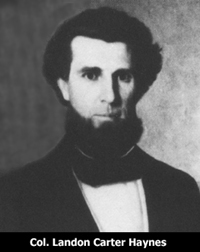
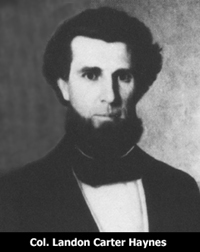
Col. Landon Carter Haynes is a familiar name to area history buffs. What is now Johnson City, which began as Johnson’s Tank and Johnson’s Depot, was once briefly identified as Haynesville before officially being renamed Johnson City on Dec. 1, 1869.

Haynes was born in 1816 by the banks of the Watauga River in the Buffalo community of Carter County. During the Civil War, he aligned himself with the Confederate cause. He became a major stockholder in the East Tennessee and Virginia Railway and worked hard to obtain state support for the construction of the rail line.

The well-known lawyer and stump speaker was the brother of Emily Haynes Taylor, wife of Rev. Nathaniel G. Taylor. This celebrated family was the product of “War of the Roses” gubernatorial candidates Bob and Alf Taylor.

An undated Comet newspaper article had lustrous comments to say about Landon: “His celebrated tribute to East Tennessee is a literary gem of such beauty that it bears frequent repetition and should never be forgotten by the local citizens of the Old Volunteer State. It was delivered at a banquet of the local bar (in 1872) at Jackson, Tennessee.”

General Nathan Bedford, toastmaster of the event, introduced Haynes by saying, “I propose the health of Col. Landon C. Haynes of East Tennessee, the country sometimes called God-forsaken.”

Col Haynes, obviously offended by the hurtful remark countered: “Mr. Chairman and Gentlemen: I plead guilty to the ‘swot impeachment.’ I was born in East Tennessee on the banks of the Watauga, which in the Indian vernacular is ‘beautiful river,’ and beautiful river it is. I have stood upon its banks in my childhood and looked down through its glassy waters and have seen a heaven below and then looked up and beheld a heaven above, reflecting like two mirrors, each in the other its moons and its planets and its trembling stars.

“Away from its banks of rocks and cliffs, hemlock and laurel, pine and cedar stretch a vale back to the distant mountain as beautiful and exquisite as any in Italy or Switzerland. There stands the great Unicorn, the Great Roan, the Great Black and the Great Smoky Mountains, among the loftiest in the United States of North America on whose summits the clouds gather of their own accord in the brightest day.

“There I have seen the great spirit of the storm, after noon-tide, take his nap in the pavilion of darkness and clouds. I have then seen him arise at midnight as a giant refreshed with slumber and cover the heavens with gloom and darkness. I have seen him awake the tempest, and let loose the red lightnings that run among the mountain tops for a thousand miles, swifter than an eagle’s flight in the heaven.

“Then I have seen them stand up and dance like angels of light in the clouds to the music of that grand organ of nature, whose keys seemed touched by the fingers of divinity in the hall of eternity, that responded in notes of thunder, which resounded through the universe.

“Then I have seen the darkness drift away beyond the horizon and the morn get up from her saffron bed, like a queen put on her robes of light, come forth from her palace in the sun, and stand up tiptoe on the misty mountain top, and while night fled before her glorious face to his bed chamber at the pole, she lighted the green vale and beautiful river where I was born and played in my childhood with a smile of sunshine. Oh! beautiful land of the mountains, with sun-painted cliff, how can I ever forget thee!”

The Comet concluded by stating that Haynes’ speech left Gen. Forrest in a state of sheer amazement. 

Read more

Science Hill High School, after using a variety of names for its school annual, permanently settled on one designation in 1921 – The Wataugan. The name was also used for the student’s monthly publication. The Nov. 1928 edition contained an eye-catching article, “Why Hoover Came to Johnson City.”

Herbert Hoover, the Republican candidate and future one-term (1929-33) 31stpresident, conferred with hundreds of Southern leaders in our city on October 6. It was said to be the most important gathering of Republicans ever held in the South. Hoover delivered an address at National Soldiers Home in the afternoon and then attended a gala all-southern banquet at the John Sevier Hotel.

The students’ wording of the article showed their overt pride for the school orchestra in the opening words of the periodical: “It may have taken Mr. Lovette to bring Mr. Hoover to Elizabethton, but it took Mr. Hoover only a very few minutes to decide to stop in Johnson City when he became aware of the fact that this is the home of the ‘Famous Johnson City High School Little Symphony Orchestra.’ It would be hard to say just who was the most excited on October 6 – Mr. Hoover at the prospect of at last realizing his life long ambition to hear the orchestra play or the members of the orchestra when they realized that they were playing music for most likely the next president of the United States.”

The students deemed Oct. 6 as one of the two most memorable occasions in the career of the orchestra, the other being the night they appeared in a grand concert in Erwin, Tennessee. On that particular night, they all felt as though the impression they would make would become a vital part of area history. consequently, they devoted superfluous attention to their instruments in various and sundry ways.

One student, Mary Emma, “was afraid that Mr. Hoover wouldn’t see and admire Ray.” It was noted that Georgie May and Mr. Hoover had something in common (their ‘figgers’) so they became fast friends on the spot. Margaret Pouder was interested in finding out if Mrs. Hoover was as dignified as a president’s wife should be. Therefore, she humorously demonstrated the fact that a certain port of the body is sometimes made of rubber and rubbernecked to her heart’s content. Hasseltyne Oakes seemed to be instantly smitten by the charms of Allen Hoover, the future president’s son and asked another student, Wilma, if she didn’t esteem the name ‘Allen.’ Wilma concurred, but personally favored the name ‘Harry.”

Mr. Hoover asked many questions about the school orchestra, especially concerning their experience in playing before large crowds and if they had ever made any overnight trips on the train. The somewhat partial students alleged the supreme hit of the evening that caused reporters to buzz and cameras to click repeatedly was the orchestra’s stunning performance featuring 14 violins, 2 violas, 2 cellos, 1 string bass, 2 flutes, 1 piccolo, 2 clarinets, 2 saxophones, 2 trumpets, 2 trombones, 1 French horn, 1 tuba, drums, tympani, bells, organ, 2 harps and a piano.

The student article concluded with a declaration from the students: “The reporters were also astounded at the difficulty of the pieces rendered, which were way beyond most high school orchestras. However, all orchestras are not fortunate in having a Miss Wright and such talented personnel as we.”

That must have been quite a show. 

Read more