Author's Posts

Today’s column is an extension of my April 30 WJSO feature story that Don Dale supplied. He also interviewed Ray Stockard and forwarded to me added facts about the once popular station. 
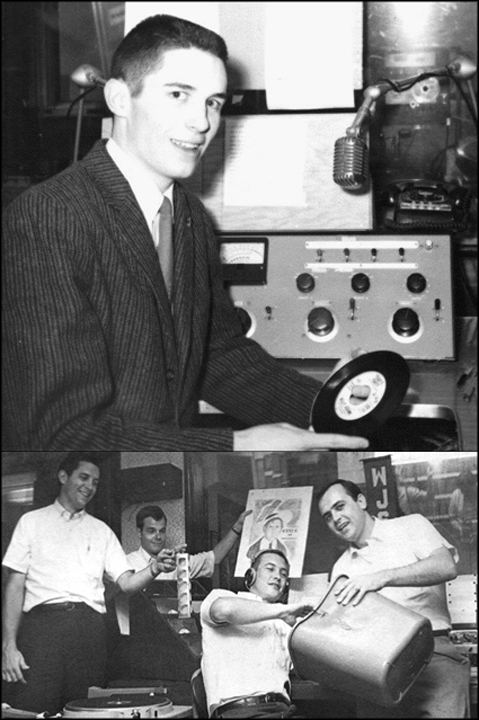
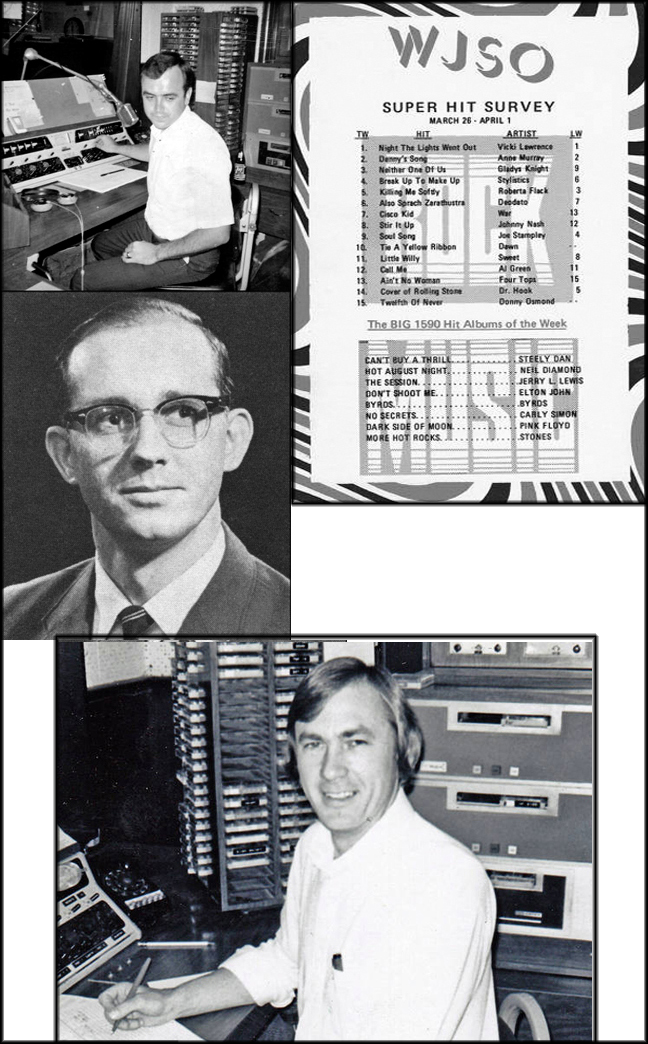
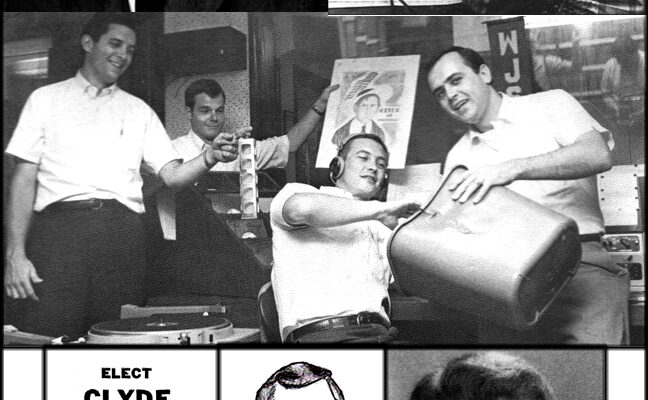
Top: Ray Stockard (about 1960);

Bottom (l to r): Ray Stockard, Don Dale, Jack London and Randy Jackson (about 1968)

“I started in radio at ETSC’s campus radio station, WETS, in 1957,” said Ray, “receiving much of my training from Professor Harold Frank. After auditioning for WJSO’s general manager, Bill Bachman, in the fall of 1959, I began working part-time at the station on weekends. About 1960, I was given Norman Thomas, Jr.’s afternoon shift. During that time, Bachman resigned to start his own station in Sumter, South Carolina. Don Sluder went with him. Jim Lewis was hired as sales manager and Bill Harris from Missouri replaced Sluder. A couple other announcers were hired when Bob Mattox left, but I can’t recall their names. Afterwards, others from WETS joined the station that included Eddie Carter, Norm Davis, Hugh Metheny and Don Dale.” 

WJSO initiated a new concept in radio when they became the only local station that played a formatted music list of top 40 songs. Such terms as “Top 40 Survey,” “Pick-Hit of the Day” and “Golden Oldies” were virtually unknown then. A record in the top 40 received considerable airplay over “Jayso.”  Almost overnight, the station acquired a vast listening audience.

“In the beginning,” said Stockard, “we had to record all our commercials in the control room after we went off the air because we had no recording studio. There were no tape cartridge machines at the time so we used two Ampex 601 reel-to-reel tape recorders for commercials, jingles, news openings and promos. For a couple of years we had a permanent sign-on time at 5:30 am at full-power; there were people who could hear us loud and clear in surrounding states. No one locally had ever broadcast the news like we did with all the effects and using a start time of 55 minutes past the hour.”

About 1960, WJSO applied for an FM frequency. A 100,000 frequency was available and there was much discussion about building an extra room on the back of their building to house the transmitter. However, Norman Thomas, Sr. at the last minute decided not to pursue it because he questioned if FM would survive.

Ray recalled an amusing event during a broadcast day when deejays played the same song over and over. Listeners flooded the phone line inquiring as to what was going on at the station. It seems they were doing a fundraiser for a charity and informed callers that they would switch to other records when they reached their goal. Ray was certain that this clever act of creativity increased listeners.

WJSO was the first local station to play records while broadcasting on-location remote broadcasts. They even had a “hospitality house” built to take to locations such as the annual Appalachian Fair at Gray, Tennessee. Ray recalled doing a remote with a live band performing on the roof of Gregg's Pizza during their grand opening in North Johnson City. The station also did remotes from car dealerships such as the Tennessee Motor Company on W. Market Street.

Stockard commented on WJHL’s name change: “In the middle 1960s, Jim Wilson purchased WJHL AM and FM, changing the AM station to WJCW and the FM one to WQUT. WJSO began to lose listeners in the middle 1970s when FM station listeners began surpassing those on AM stations. FM used stereo and produced a crisper, fuller sound quality than available on AM.”

Ray remained at “Jayso” from 1959 to 1969, leaving to pursue his own station in Lenoir City, Tennessee. However in 1974, he returned to the Tri-Cities area to become the sports anchor on WJHL-TV.

The pioneer broadcaster concluded his comments with Don by saying, “I often wonder where WJSO would be today if the owners had bought the 100,000-watt FM frequency they were considering in the early 1960s.”
Read more

Don Dale has a stack of memories from his working days at WJSO-AM where he once worked as program director:

“‘Jayso’ (as it became known), came along at the right time in the right place. When it first hit the airways in October 1958, it filled a niche as the first all rock and roll (Top 40) station in the Johnson City-Jonesborough area.”

The new station, located at Huffine Road in west Johnson City, attracted listeners almost overnight. Don said he wanted to be a part of it but realized he would have to wait until after graduation in 1961 before his aspirations would be realized.

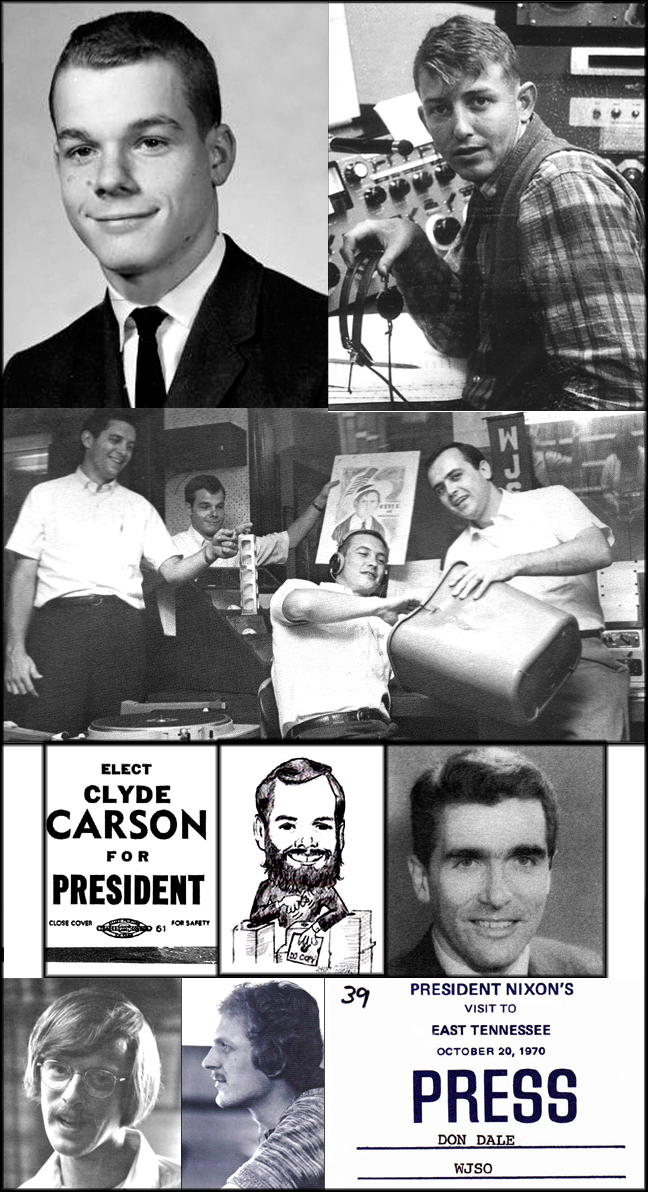
(Top to bottom, left to right: Don Dale; Hugh Metheny; Ray Stockard, Don Dale, Jackie London, Randy Jackson; Clyde Carson Ad; Don Dale Caricature; Eddie Carter; Al Lefevere; Fred Story; President Nixon comes to E.T.)

According to the former deejay: “When I started at ETSC (now ETSU) in the fall of 1961, I immediately began working at the school’s WETS station where I shared a shift with fellow student Johnny Wood, now the legendary television personality at WCYB-TV in Bristol. In December, WJSO’s program director, Ray Stockard, offered me a part-time job at the station. Thus began a career that continued until 1980.”

Norman Thomas Sr. of Chattanooga owned and operated Mountain View Broadcasting Corp.; his son, Norman Jr., served as general manager. Some of the early personalities from that era included Norm Davis; Hugh Martin (a.k.a. Hugh Metheny); Bill Harris; Don Sluder; and Bob Mattox, who also supplied the voice of the “Old-timer” in the mornings.

Don explained that being a deejay was not easy. It meant pulling daily and often weekend shifts, spending off-air time doing twice-hourly newscasts, simultaneously working a production shift where they recorded spots (commercials), dubbing agency spots and producing station promos.

Computers were far into the future. Music was aired directly from records, which became scratchy after multiple plays. They had to be cued on turntables before playing them. The vast majority of commercials were dubbed onto special tape cartridges, or “carts” as they were called. The use of reel-to-reel recorders for ads was infrequent. Eventually, new records were copied onto tape cartridges when their sound quality was improved.

Dale served as program director from 1966-1980, the longest period in the station’s tenure. He worked with some great newcomers, broadcasting veterans and others who became successful in their careers. Eddie Carter (who also used the air name Danny King) went on to be news anchor at WJHL-TV in the 1960s and later had a long career at stations in Charleston and Columbia, South Carolina. John Paul Jones also moved on to WJHL as news anchor and later had a successful profession in North Carolina.

Red Kirk came to WJSO as a broadcast veteran, bringing with him an equally impressive career in country music, both as a writer and performer. He later became spokesman for local car dealerships, most notably Sherwood Chevrolet. Jeri George, who has been one of WQUT’s most popular personalities for decades, got her start at WJSO. Bob Honeycutt, who adopted the air name Bob Gordon at WJSO when he broke into radio, was operations manager at WKOS-FM until 2008.

Top to bottom, right to left: Randy Jackson, WJSO Super Hit Survey, Norm Davis, Wayne Sparks.)

Al Lefevere signed on at “Jayso” as a deejay, eventually becoming station engineer and then chief engineer for the group stations of WQUT, WJCW and WKOS. Other familiar deejays from that period were Fred Story, Steve Castle, Charlie Knox, Jack London, Wayne Sparks and Gary Nelson.

Don shared some humorous anecdotes that occurred at the station over the years: “Wayne Sparks’ was working the morning show when he became locked in the bathroom while being the only one in the building. After about 20 minutes, he managed to pry his way out with a spoon. He rushed back to his show, where a record had long been clicking unheeded in the final groove on the turntable.

“In my early years, I worked the Sunday morning shift, which consisted of blocks of local religious programming. One minister, who was always accompanied by several members of his congregation, typically started preaching slowly but accelerated to a frenzy as his sermon progressed. Once he accidentally kicked his microphone cord out of the wall socket. I rushed from the control room to replace the cord, but not before throwing the first record I could find on the turntable to fill the void. Unfortunately, I chose an instrumental by David Rose called “The Stripper.”

“Another incident involved Hugh Martin slipping into the news booth while Red Kirk was doing a newscast and setting his long sheet of Associated Press news copy on fire. The unflappable Red coolly doused the fire without missing a beat.”

Don recalled a second prank involving Hugh. “Jayso” had an echo chamber in a back room to give the deejays' voices a distinctive echo effect. It consisted of a wooden frame covered by insulation with a microphone inside at one end and a speaker at the other that was wired to the control room console. The apparatus was later upgraded to an electronic reverberation unit. One morning, Don signed on the station and was giving the news unaware that Hugh had come in early, hid his car from sight and climbed into the echo chamber. While Don was doing the first newscast of the morning, he was stunned to hear a silly voice making comments in the background. After several minutes, Hugh came out of the chamber displaying his usual infectious, raucous laugh.

In 1968, the former program director ran a fictitious country bumpkin, known as Clyde Carson, for president, complete with campaign slogans and trinkets. The conjured-up character, played by deejay Randy Jackson, recorded nonsensical “campaign ads” that included his platform plank to “abolish wheat germ.”

On a serious note, Don recalled the major event that occurred in November 1963 while he was doing his midday show. Charlie Knox, who worked the wire room, ran in to announce that President Kennedy had just been shot. Don immediately put him on the air. Ironically, he remembered that the record “Last Date” by Floyd Cramer was playing on the turntable.

Other interesting events that transpired over the years were chaperoning a contest-winning Little League Baseball team on an all-night bus ride to Yankee Stadium to see the Yankees and Dodgers in the World Series; sponsoring the March of Dimes Superwalk in 1978; covering visits by President Nixon in 1970 and President Ford in 1976; and interviewing Peter, Paul and Mary, KISS, Brenda Lee, and listening to John McEwen of the Nitty Gritty Dirt Band play several tunes on his banjo at the station.

Don concluded by saying, “Working at WJSO for 19 years was a unique and interesting experience. I am grateful to Norman Thomas and Ray Stockard for providing me that opportunity.”

Read more

In November 2009, Alan Bridwell and I interviewed Ruth Cacy Fink at her Johnson City home. I then wrote a feature story about her long life in East Tennessee. She rewarded me with a copy of her well-written 21-page journal that documented her past remembrances. In addition, Julia Fisher-Rhees, her granddaughter, made a DVD of our dialogue and produced copies for family members.

During our visit with her, the Erwin native showed me her collection of memorabilia, which included some old newspaper clippings, school annuals, photographs and other related items. She also displayed two old undated poems that dealt with the fondness of farm life, which seemed to be of particular importance to her.

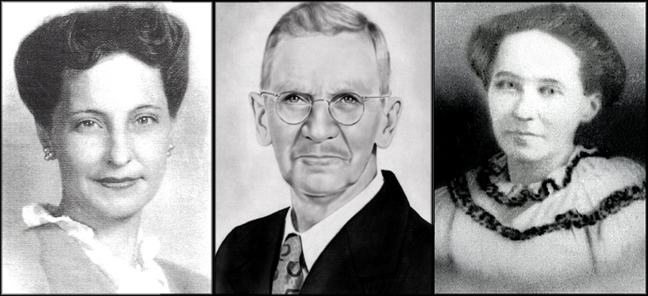
(L to R: Ruth Cacy Fink and her parents, George Cacy (former Clinchfield Railroad employee) and Virginia Cacy (only known photo of her mother taken when she was about 35)

One poem concerns an old grindstone that was delivered to a family’s farm to serve a vital role of sharpening tools. The other limerick lamented the selling of the old farm that had brought so much joy to the individual who penned it. Since both speak volumes about the cherished memories of growing up in rural America, I decided to reproduce them in today’s column.

The first one is titled, “The Old Grindstone” by Albert Hines:

“Grandfather bought it years ago, When he was starting out. There were no tractors, trucks or cars, The day he hauled it out.

“He placed it by the woodshed door, Some sixty years ago, And there it ground the farmstead tools, Come rain or sleet or snow.

“Each fall it ground the axes keen, In spring the mattock’s blade. At harvest time it lent a hand, Beneath the maple’s shade. How things have changed since that warm day. Grandfather bought the stone, And hauled it in the rude oxcart, To his new cabin home.

“Tall men who swung the cradle then, Are sleeping on the hill. The voice that called them home at noon, Is forevermore still.

“New faces came upon the scene, New feet ran out to play, But by the woodshed door the stone, Turned on from day to day.

“And though I used to hate the stone. It ground so hard and slow. I love it now because it knew, Those folks of long ago.”

The second one is named, “I Have Sold the Farm” by Adda C. Hall (Fall Branch, Tennessee):

“I have sold the farm where I was born, For a house on a crowded street. I have sold the bracing breeze of morn, For the city’s dust and heat.

“I have sold the pine tree’s glory grand, And the pale pink apple bloom. The roses set by mother’s hand, Long years she’s slept in the tomb.

“I have sold the lane across the hill, Where the children went to school, The rippling laughing mint-fringed rill, And the boys’ old swimming pool.

“I have sold the sycamore down in the glen, The chestnut tree on the hill, The ducks, the sheep, the pigs in the pen, And the family horse – Old Bill.

“I have sold the farm where mother came, A happy blushing bride, The farm that has borne the family name, And been the family’s pride.

“I have sold the mocking bird’s nest in the vine. And the whippoorwill’s song no more, Will cheer this aching heart of mine, As it has in days of yore.

“I have sold the graveyard on the hill, Where my loved ones peacefully sleep; Where the wild birds build their nest at will, And the stars lone vigils keep. 

“Oh, why did I sell the things I loved best, I ask myself o’er and o’er, I have sold the farm – its peace and rest, And I’ll regret it forevermore.”

I love Ruth’s poignant poems. Those who grew up working the land will likely identify with them. They evoke pleasant memories of the hard yet fulfilling life on the farm.

Read more

Wednesday, Jan. 10, 1934 was tagged “Professor Walter Clement Wilson Day” by the city’s Kiwanis Club at a meeting at the John Sevier Hotel. he honored person was a 71-year-old State Teachers College instructor and senior member of the club.  

Kiwanians Harry Crigger and Clyde Culpepper were responsible for planning an appropriate program to honor the admired teacher. The speaker was Professor C. Hodge Mathes.

Mathes and Wilson were both employed at the State Teachers College. Wilson had the distinction of having been with the college since it was founded as the Normal School in 1911. “Professor Wilson is my ideal of a real everyday Christian gentleman,” said Mathes. “He has developed a very wholesome philosophy of life. I know he is fearless, despite the fact that he is built like Mahatma Gandhi.” This comment brought laughter from the membership, which included the guest of honor.

“When I met him when the faculty for the old State Normal School was being formed, our president referred to him as ‘a little package of dynamite.’ Professor Wilson receives the respect of all the students at the college. Everyone who knows the Professor respects him and loves him. He has never acquired a great fortune, but I personally know many instances where he has aided students in a financial way in their careers.”

Chairman Crigger then introduced Wilson to speak to the club, bringing the entire membership of the club to their feet in respect to their “youngest member.” Speaking in his distinctive manner, Wilson told Kiwanians that he never believed that he would live long enough to hear his own obituary.

Then switching to a serious mode, the professor expressed his appreciation for the confidence and feeling the members had demonstrated in the social program arranged in his behalf. He was given a standing ovation at the conclusion of the brief talk. At the end of the meeting, every club member extended him a hardy handshake and congratulations. At each place, members found a typewritten sheet copied from “Who’s Who” of 1930 that gave an impressive list of his education credentials, positions held and books authored.

The Kiwanis Club then conducted a brief business meeting before adjourning. Clyde C. Culpepper, general chairman of the safety campaign being sponsored in the public schools by the club, spoke briefly and announced the members assigned to the various public schools:

Keystone (Phil McAfee and Lonnie McCown), Columbus Powell (Dan Wexler and Frank Brogden), South Side (Mayor Ben Snipes and J.S. Holt), New Martha Wilder (later renamed Stratton), Howard Phillips and E.C. Bowers), New West Side (became Henry Johnson, Dr. Carroll Long and Dr. C.V. Morgan), Old West Side (Joe Brown and R.S. Edwards), Langston (Buddy Beckner and “Lefty” Lindsey), Science Hill (Jim Preas and T.E. Hollingsworth); Old Martha Wilder (Joe Summers and Ned Stacey), Junior High (Lee B. Harr and Frank Hannah), Old Columbus Powell (Carl Miller and Morgan Cox), Training School at State Teachers College (Prof. Walter C. Wilson and E.S. Coleman), Douglas (Glenn Elliott and Ralph Carr), Dunbar (Ray Harbison and Roy Bigelow), Piney Grove (John Massengill and Bert Gump) and Northside (Harry Crigger and Prof. N.E. Hodge).

Professor’ Wilson’s wife was named Sophronia and they resided at 813 Lake Street located between W. Maple and Lynn streets. If anyone remembers the professor or knows anything more about him, please drop me a note. He was obviously an outstanding citizen of yesteryear.

Read more

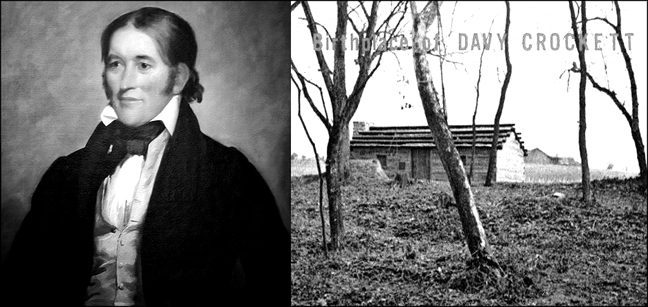
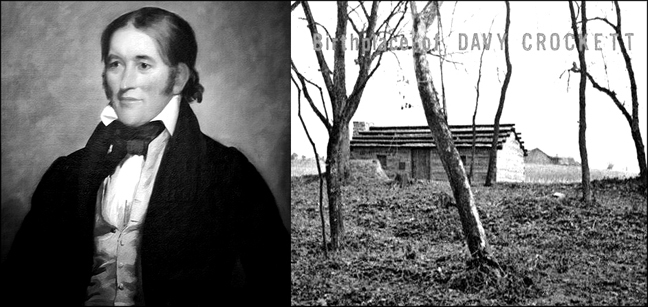
For David “Davy” Crockett (1786-1836), “it was the best of times, it was the worst of times.” The folk hero, frontiersman, soldier, storyteller, politician and defender of the Alamo was born near Limestone, Tennessee at the convergence of Limestone Creek and the Nolichucky River in the short-lived State of Franklin. Two counties, Washington and Greene, claim his birthplace.

(Crockett as he appeared while in politics, replica of the pioneer's cabin on the Nolichucky River)

Although Crockett likely possessed countless rifles throughout his 49 years on this earth, four stand out prominently. The first one was an unnamed .48-caliber flintlock that he acquired when he was about eight years old. With it he attained the hunting skills and resulting reputation that would remain with him beyond the grave.

The second weapon honored Crockett’s service in the Tennessee State Assembly in 1822. His Lawrence County constituents presented him with a .40-caliber flintlock crafted by James Graham. Davy affectionately named it “Old Betsy,” after his oldest sister. When he dropped out of politics in 1835 and headed for Texas, he gave the weapon to his son, John Wesley Crockett.  It was later handed down to Bob Crockett, grandson of the pioneer, who reportedly brought down much game with it before retiring it to honor his legendary grandfather.

About 1834, Davy was awarded a third firearm from his friends who were members of the Whig Society of Philadelphia. “Pretty Betsy,” as he called it, cost $250 and was paid for from donors each contributing 50 cents.

The Memphis Commercial Appeal described the unique relic as being of the flintlock type, with a .40-caliber bore. The barrel length was later shortened from 46 inches to 40.5 inches. It was impressively covered with gold and silver. The stock was trimmed in sterling silver with figures of the Goddess of Liberty, a raccoon, a deer's head, an elk’s head and other designs. The guard over the trigger displayed a silver alligator and underneath the stock was the inscription, “Constitution and Laws.”

Along the upper portion of the barrel were gold letters that read, “Presented by the young men of Philadelphia to the Hon. David Crockett of Tennessee.” Similar lettering near the muzzle said, “Go ahead,” referring to the backwoodsman’s famous admonition to “Be sure you are right, then go ahead.” After the presentation, the outdoorsman amused his audience by shooting holes in quarters as they were tossed in the air. Arkansas Secretary of State John M. Crockett, a great-grandson of the famous Tennessee pioneer, inherited “Fancy Betsy” in 1903. Because of its splendor, it never encountered the same exploits as the other three.

None of the aforementioned rifles played a role in the Battle of the Alamo. While it is not known what rifle (or rifles) Davy used to defend the fortress, it was not one of the three previously mentioned. On March 6, 1836, Santa Anna's Mexican army broke down their barricade and massacred the garrison during a 13-day siege, leaving no defender as a witness. Crockett earned even more acclaim for bravery for dying while defending the fortification.

Many stories of courage are related regarding this dreadful battle in which the defenders of the church gave their lives willingly, but in doing so slew or wounded eight of their assailants to one before the last brave soul was overcome. 

In 1898, 70-year-old Bob Crockett visited the Alamo. He drew the attention of local media who depicted him as being a typical southern gentleman, medium height, white hair and beard and standing straight as an arrow. The hallowed ground where his grandfather, David Bowie, William Travis and 169 other determined supporters perished likely moved him. 

Those of us who were captivated by Walt Disney’s Davy Crockett phenomenon in the 1950s will fondly recall Fess Parker, who played the role of Davy Crockett, frequently referring to his rifle as “Old Betsy.” He and his family of rifles left behind a colorful legacy.

Read more

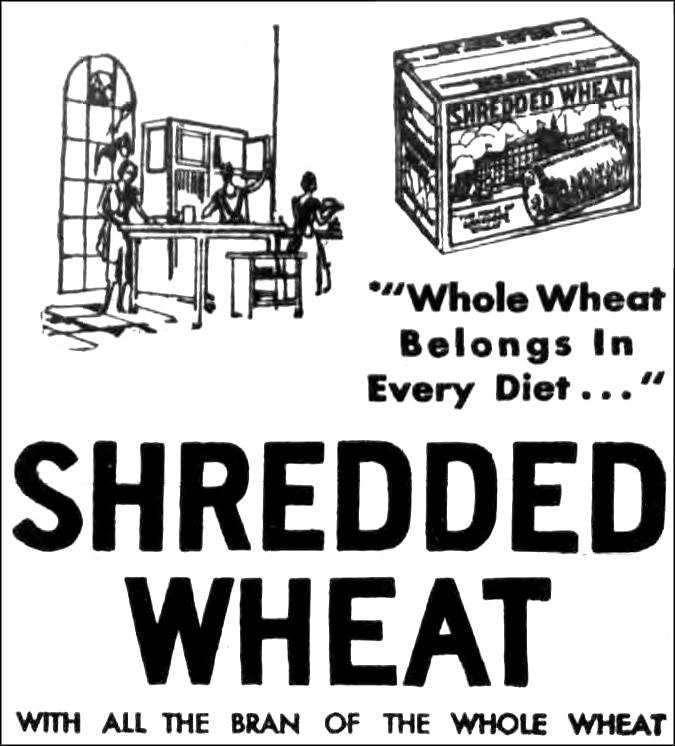
In June 1927, the Shredded Wheat Company of Niagara Falls, New York, conducted a nationwide essay contest that resulted in 20 grammar school students and their teacher being invited on an expense-paid railroad trip to visit their plant and take in all of the dazzling sights of the falls.

An estimated 200,000 school children submitted essays in the competition; winners were chosen based on their cleverness, originality and knowledge of the subject. Needless to say, the object of all this was advertising, believing that the most important feature of their ad campaign was the education of children to the food value of whole wheat and Shredded Wheat.

One student selected was George Cox. Although his address was listed as Morristown, Tennessee, he was shown as attending school in Johnson City, residing at the home of Mrs. W.N. Clamon. His teacher was John McCullough of 405 E. Maple Street in the city. Unfortunately, the school was not identified.

 A Niagara Falls news release revealed that while a multitude of organizations visited the falls that year none drew more attention than the public school students and their proud teachers.

The entourage, wearing white badges bearing the words, “Guest of The Shredded Wheat Company,” arrived at Niagara Falls on July 14 for a 2-day stay. They were promptly escorted to The Niagara Hotel where the choicest rooms reserved for them overlooked the swift flowing rapids of the Niagara River.

The youngsters were thrilled at the sights of the American and Canadian cataracts. One reporter captured some of the words expressing their excitement: “Gee whiz.” “Ain’t it wonderful, Bill?” “Hully gee.” “I’d hate to ride over the Falls in a boat, wouldn’t you?” “Certainly beats the old swimmin’ hole, doesn’t it?”

After breakfast, the children and their teachers were taken through the plant of the Niagara Falls PowerCompany where they learned how the falls had been harnessed and electric current sent to nearby cities.

At 12:30 p.m., the officers and executives of the company gave a luncheon for their special guests in the company’s private dining room where they were greeted. The president of the company and the director of publicity made short speeches of welcome.

Following the luncheon was a trip through “The Home of Shredded Wheat” where the students witnessed their favorite cereal being made. At 3:00 p.m., an excursion was made to the American Falls. After enjoying a nice dinner at the hotel in the evening, the visitors were escorted across the International Bridge to see the colorful illumination of the falls at night. Afterward, the fatigued group returned to the hotel for a night’s rest.

The program on the following day included a trip around Goat Island, a visit to Luna Island and Three Sisters Island for a view of the stunning Horseshoe Falls on the Canadian side. For lunch, they dined at the Clifton Hotel, followed by a ride down the Great Gorge Railway to Lewiston and their return home.

Shredded Wheat was my favorite cereal in my younger days. Brands of cereals were limited then to a few selections on store shelves. There were no bite size or frosted biscuits available then. My standard breakfast fare consisted of two large size biscuits that I crushed with my hands, sprinkled with sugar, covered with cold milk and consumed.

The product was once advertised as “A Warm Nourishing Meal for a Cold Day – Shredded Wheat with Hot Milk and a Little Cream … 100 percent whole wheat and so thoroughly cooked that every particle of each crisp, tasty flavory baked wheat is digested.” I do not recall ever eating it hot.

The company was in operation from 1904 until 1928 when it became Nabisco (National Biscuit Company) in late 1928.

Read more

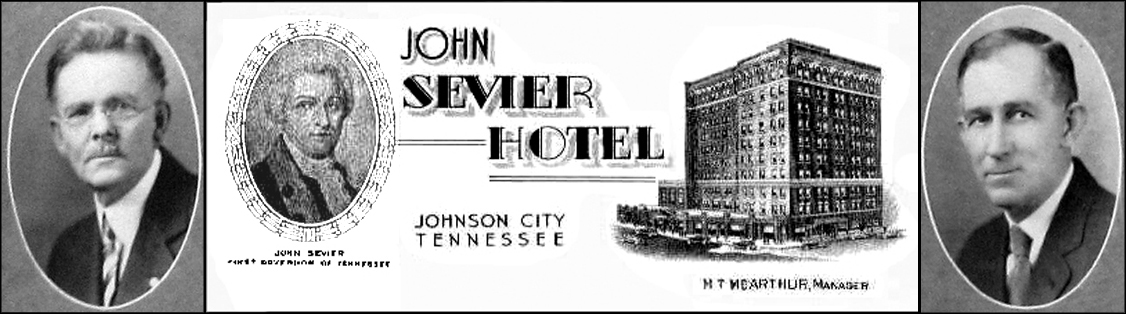
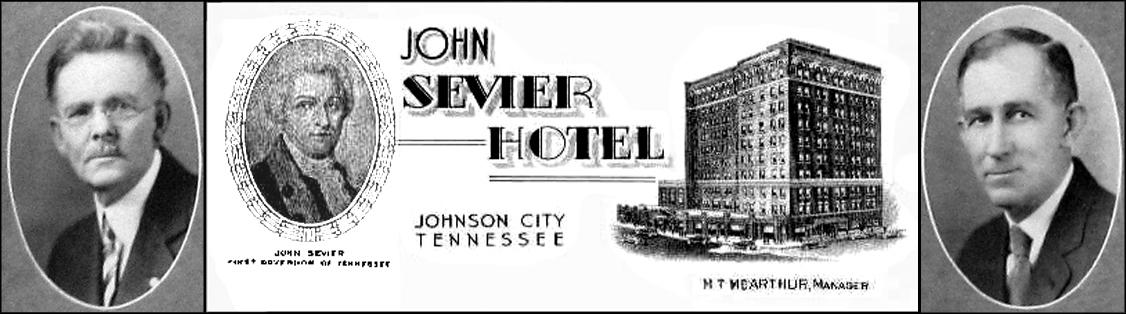
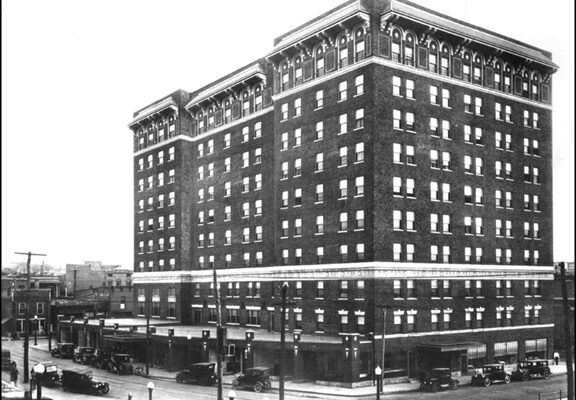
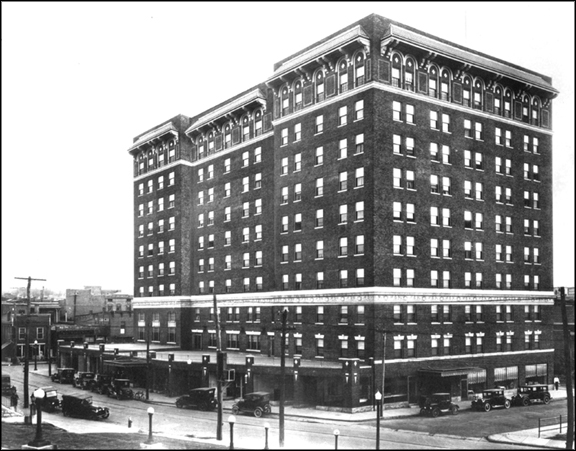
In September 1928, the Johnson City Chronicle announced that there were plans to proceed with the second of three expansions of the John Sevier Hotel. The first one, having 130 beds, was completed in 1924 on property adjacent to the Southern Depot. The second unit was to be appended to the south side of the first.

The first one, having 130 beds, was completed in 1924 on property adjacent to the Southern Depot. The second unit was to be appended to the south side of the first.

Altered Photo Showing the Three Proposed Expansions as Envisioned in the Early 1920s.

A third and final one was planned that would extend the building to Market Street, but it never materialized, blamed largely on an adverse economy caused by the Great Depression. Today, the missing section is noticeable when you view the hotel at the intersection of Roan and Market streets. My column photo is a trick photography depiction of way the building was supposed to look had it been finished.

The property once belonged to Harry Lee Faw whose family was prominent in Johnson City’s early history. It was serving as a boarding house when the hotel committee became attracted to the site. The land was once an asset because a spring located there supplied water at no cost to weary travelers and their animals traveling through the downtown area. It also served as a water source for Science Hill Male and Female Institute on the hill across the street. After the hotel was opened, the spring became a liability as the water had to be channeled to a sump in the basement and pumped out regularly to prevent flooding.

In 1928, contractors bidding on the second phase included M.L. Beeler and Co. (Johnson City), Hughes-Foulkrod and Co. (Philadelphia), Good Construction Co. (Charlotte), E.S. Glover (Bristol), Pyle Brothers (Kingsport), Walter Kidde Co. (Greensboro) and Burleson and Laws (Johnson City). Beeler submitted the lowest and most attractive proposal totaling $150,000. In addition to the firms competing for the complete job, several companies placed bids for specific work, such as heating, plumbing, electric wiring and installation of certain materials.

At a meeting in the assembly room at the hotel with representatives of the companies and other interested personnel present, the bids were opened and read. Following the reading, the information was tabulated by members of the executive committee. Afterward, the architects stated that final results would be announced the following Monday. Mr. Beeler, the successful bidder, acknowledged that he was anxious to begin work immediately.

The initial task was to clear the lot where the second addition would be located. Previously, it had been used as parking space. Also, land adjacent to the hotel was leased to allow ample storage and working space for the various crews involved. This necessitated delaying a proposed motor building and garage on the property until the new wing was finished.

As with the initial hotel, the new wing was to be 10 stories high and became the central part of the three completed buildings. The middle section was slightly offset toward the west. This added 100 additional beds bringing the total to 230 in addition to offices and storerooms.

After a meeting with the stockholders, authorization was given to proceed because the financing arrangements were in place and D.R. Beeson, the architect, of Johnson City had his plans and specifications ready.

The work was placed under the supervision of the hotel’s Executive Committee, which included notables S.R. Jennings, (president), James A. Summers, Sam R. Sells, Lee F. Miller and J.W. Ring.

Almost 90 years later, Johnson City’s big 2-section “skyscraper” is still proudly standing and serving as a reminder of its storied yesteryears. It became a favorite lodge for Southern Railway travelers and hosted many dignitaries over the years.

Read more

Since I wrote a column in August 2006 about Atlanta’s Montag Brothers Paper Company’s clever Blue Horse awards marketing promotion, I have received a steady flow of flow of comments. My column noted that literally millions of Blue Horse heads were exchanged for cash and prizes, making Montag one of the largest paper companies in the industry by 1950.

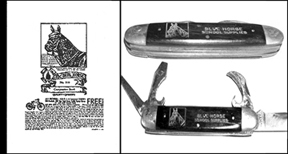
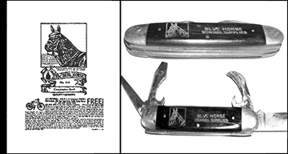
One lady sent me two photos of a Blue Horse pocketknife that her mother had owned. It is shown in my column photo. I decided to excerpt from several letters:

“I have several hundred Blue Horse trademarks. Is there a market for these trademarks?”

“I have every Blue Horse Trademark that I collected from the first to the twelfth grade. I never traded them in for any prizes, instead choosing to keep all 1161 of them.”

“I have access to a Blue Horse bicycle, purchased with Blue Horse heads back in the early 1950s. As a student in the sixth grade, I saved them and won one of the bikes.”

“My Father sent in several of the Blue Horse heads and received one of the bicycles. Before he passed away, he gave me the bike and told me to get it fixed. I don't know how many of them are actually left, but I have one and plan to have it restored in his memory.

“I have a complete 42 model bike that has been painted silver, but it has original tires and all.”

“I have a considerable number of trademarks. My older sister gave some to me and I collected others. There is not much information out there about them.”

“I have a Blue Horse spiral notebook in a relic's collection that I started several years ago. I saved enough labels and enough change, 25 cents as I recall, for a Blue Horse Beanie. In fact, I did it twice and was the talk of my grammar school class.”

“Recently while I was working as a substitute at our local library, a gentleman brought in some old books to donate. As he was flipping through the pages, he came across about a dozen Blue Horse emblems. They brought back a lot of memories to this man who, as a child, had apparently clipped and saved them for a gift that he wanted.”

“My son was cleaning out our attic and ran across two small boxes of Blue Horses that really brought back memories of my school days. I was wondering if you know of anyone, such as a history museum, that would be interested in them.”

“My husband has an old pearl handle pocket knife with the Blue Horse symbol on the end of it. We were wondering if it was a prize awarded by collecting the horse coupons.”

“While we were cleaning out my deceased mother’s belongings, we discovered 29 Blue Horse coupons. Mama had saved them for her sons. Printed under the horse’s head are the words, ‘counts as two trade-marks.’ We were wondering if Montag Brothers' Paper Company would honor them now. I would love to have a beanie cap.”

“Do you happen to have the words to the Blue Horse jingle that was popular at that time? I have a friend who is obsessed with finding the words to it.”

Another reader remembered the tune and took a stab at the lyrics: “… paper so white and lines so true (or blue), Blue Horse is …   Stamped on the back is one … (additional) proof, Blue Horse, Blue Horse ….” 

“I found a Blue Horse bracelet in my late sister’s old jewelry box and believe it is a prize from the Blue Horse redemption of horse heads for the 1950’s.  I was wondering if the company gave bracelets as one of the prizes. It has the dark blue horse and two little horseshoe charms. Also, my grandmother ran an old country store that I remember sold Blue Horse paper.”

The once popular old sapphire steed has long vanished from the scene but our memories of him continue to tug at our heartstrings.

Read more

Tuesday, September 14, 1915 was an exciting day for circus lovers in Johnson City. At 6:00 a.m., as the sun slowly began to disperse the darkness in the morning sky, the first array of circus trains began to appear in the city.

The Gentry Brothers Famous Shows, known as “the cleanest circus in the world,” had arrived, bringing with it the promise of an entertaining spectacle for its residents. Four Gentry brothers, Henry B., Frank, Walter W. and J. W., all from Bloomington, Indiana, originated the circus in 1887; it remained in business off and on until 1934.

Because of the number of cars coming to Johnson City, officials had to make provisions with the railroad for track space. The number of railcars on hand was said to be twice that used in previous shows.

Early risers desiring to witness the circus unload were rewarded with sights of showmen who had tumbled from their berths, ready to go to work after a night’s slumber. While most residents were still in bed, the surrounding lots were magically transformed into a city of canvas tents. To the casual observer, the exhibition appeared to be one of disorder and confusion, but the operation was performed as it had been done so many times before with not a single worker wasting time and energy.

At 10:30 a.m., the circus was ready for its famous street parade, which was billed as “taking place rain or shine.” By this time, the parade route was aptly populated with curious spectators of all ages.

Although the procession route is not known, it was advertised to be “a solid mile of gold and glitter.” Based on this clue and the previous carnivals and circuses that came to the city over the years, the likely starting point was at the railroad tracks near Model Mill (later General Mills). It probably turned left onto W. Walnut Street, took another left onto Buffalo Street, bore right onto E. Main Street at Fountain Square and traveled straight ahead to the large open field that the city’s Municipal Building now occupies.

The parade was a precursor to and an advertisement for what would later be presented in the big canvas circus tent. Oldsters and youngsters were caught up in dreams of fantasyland. The owners hoped this public display would attract scores of paying patrons to the performances.

The circus offered two exhibitions in Johnson City that day. Doors opened for a complimentary inspection of the animals in the menagerie at 1:00 p.m. and 7:00 p.m. Each performance commenced one hour after the gates opened. The displays were of a larger and grander scale than those previously offered. Children attending the show in the afternoon slot were permitted to ride an elephant or pony under the care of a trained and courteous attendant.

The Gentry Brothers Famous Shows, which were promoted as “the world’s pioneers in trained animal exhibitions,” had been extensively enlarged to offer realistic taming of jungle leopards and other ferocious beasts within “canvas coliseums.”

In addition to several feature acts, three of them were new to America: The Carr-Thomas Trio, sensational burlesquing acrobats; The Cole Troupe, novelty artists of breathtaking and difficult acts on the high wire; and The Krannell Sisters, aerial butterflies swinging by their teeth in a fascinating display of grace and splendor in mid-air. 

A funny story circulated about the circus. A fire once caused workers to scamper about pulling hose lines to extinguish the blaze. The next day, a trained monkey was observed pulling hose from a box in a corner of the menagerie. This action destined the primate to become the first monkey fire chief in the world. Soon, other monkeys mimicked the act and they, too, learned to battle a fake blaze. The act became an instant favorite with circus fans.

After the final show, the circus promptly returned to the railroad cars and discretely departed for its next destination, ending an exciting day for Johnson Citians.

Read more

My History/Heritage page feature last week dealt with the opening of a new Science Hill High School at N. Roan Street and John Exum Parkway. A different location was proposed in 1946 when C. Howard McCorkle, then principal of the school, sent a letter to the Johnson City Planning Commission proposing a 4-part program:

1. Construct a new senior high school building for grades 9-12 on property surrounded by E. Main, E. Market and Bert streets, adjacent to the Central Fire Hall. The main entrance would face south toward Roosevelt (later renamed Memorial) Stadium. Except for a small physical education gym included in the new design, the old gymnasium on “The Hill,” built in 1939, would continue to be used for sporting events.

2. Designate one large wing of the new facility for a combination school and civic auditorium capable of seating 1500 to 2000 people, thereby replacing the existing City Hall auditorium at Boone and W. Main streets.

3. Convert the old downtown senior high facility (N. Roan Street) to junior high for seventh and eighth grades. 

4. Remodel the existing junior high building constructed in 1922 at N. Roan and Fairview for a medical arts center. This would allow ample space and parking for most of the city doctors to have office suites there. Another advantage was its close proximity to the new Memorial Hospital next door. McCorkle and the School Board believed that this would greatly enhance the possibility of Johnson City becoming a future medical center.  

The new grade arrangement was known as the “6-2-4 Plan” (grammar schools, 1-6; junior high, 7-8; and senior high, 9-12), replacing the present “6-3-3 Plan” (grammar schools, 1-6; junior high, 7-9; and senior high, 10-12). Another bonus was that it would reduce congestion at the new hospital. The new high school would be near its designated athletic and drill fields. Further, the new junior high would be slightly closer to its athletic fields. An attractive feature of the new proposal was that none of the existing facilities would be abandoned or razed.

In spite of McCorkle’s petition, the Board of Education issued a resolution requesting that the city refrain from using the proposed strip of land for a new high school. Mayor Welsford P. Artz stated that the city had been approached by a manufacturing firm and was quoted a price for 600 feet of the 1000-foot frontage property in question. The type of building the company proposed was what the commission wanted to see there. It was to be a low one-story building, occupying only a comparatively small portion of the lot. The firm further intended to beautify the grounds, making it an attractive addition to the town. However, the city set aside a portion of the land adjacent to the fire station for future use.

The School Board immediately countered with another letter to the commissioners: “In the near future, the normal growth in the city’s population and the growing obsoleteness of Science Hill High School will make the erection of a new (school) imperative and that the land in question is an ideal site for a modern high school. It is adjacent to the stadium and ballpark, away from the congestion and noise of the downtown section, on the side of town toward where future growth will likely occur, level with ample parking space, abundant space for a modern high school building with a auditorium and room for a large recreation center in addition to a high school campus.”  

McCorkle’s proposal was rejected and the offer for the company to build there fell through. The land was essentially not used until years later when the city relocated its municipal and safety offices on the site. It would be another 15 years before a new high school would be constructed in North Johnson City.  

Read more